

- India's Interlinking of Rivers: An idea delinked from realities |
- Explosion at China fireworks factory kills 26 people |
- ‘US military adventurism’ responsible for new attacks on UAE |
- Iran says US military killed five civilians in attacks on passenger boats |
- Dhaka tops list of world’s most polluted cities |
Richest 1% Burn 2026 Carbon Budget in Just 10 Days
Credit: Oxfam
The richest 1% have exhausted their annual carbon budget—the amount of CO₂ that can be emitted while staying within the 1.5°C warming limit—just ten days into the year, according to new analysis by Oxfam. The richest 0.1% had already used up their carbon limit by 3 January.
The day, named “Pollutocrat Day” by Oxfam, highlights how the super-rich are disproportionately responsible for driving the climate crisis.
Emissions generated by the richest 1% in a single year alone are expected to cause an estimated 1.3 million heat-related deaths by the end of the century. Decades of excessive emissions by the world’s super-rich are also inflicting severe economic damage on low- and lower-middle-income countries, which could total up to $44 trillion by 2050.
To remain within the 1.5°C limit, the richest 1% would need to cut their emissions by 97% by 2030. Meanwhile, those who have contributed the least to the climate crisis—including communities in poorer and climate-vulnerable countries, Indigenous peoples, women and girls—are set to suffer the worst impacts.
“Time and time again, research shows that governments have a very clear and simple route to drastically slash carbon emissions and tackle inequality: by targeting the richest polluters,” said Oxfam’s Climate Policy Lead, Nafkote Dabi.
“By cracking down on the gross carbon recklessness of the super-rich, global leaders have an opportunity to put the world back on track to meet climate targets and unlock net benefits for people and the planet,” Dabi added.
Beyond their lifestyle emissions, the super-rich are also heavily invested in the most polluting industries. Oxfam’s research shows that, on average, each billionaire holds investments in companies that will produce 1.9 million tonnes of CO₂ a year, further locking the world into climate breakdown.
The wealthiest individuals and corporations also wield disproportionate power and influence. At the most recent COP summit in Brazil, for example, the number of lobbyists from fossil fuel companies exceeded that of any national delegation except the host country, with 1,600 attendees.
“The immense power and wealth of super-rich individuals and corporations have enabled them to exert undue influence over policymaking and weaken climate negotiations,” Dabi said.
Oxfam has urged governments to curb emissions from the super-rich and make wealthy polluters pay through several measures, including increasing taxes on the income and wealth of the super-rich and actively supporting negotiations for a UN Convention on International Tax Cooperation to create a fairer global tax system.
The organisation also called for excess profit taxes on fossil fuel corporations, noting that a Rich Polluter Profits Tax on 585 oil, gas and coal companies could raise up to $400 billion in its first year—an amount equivalent to the cost of climate damages in the Global South.
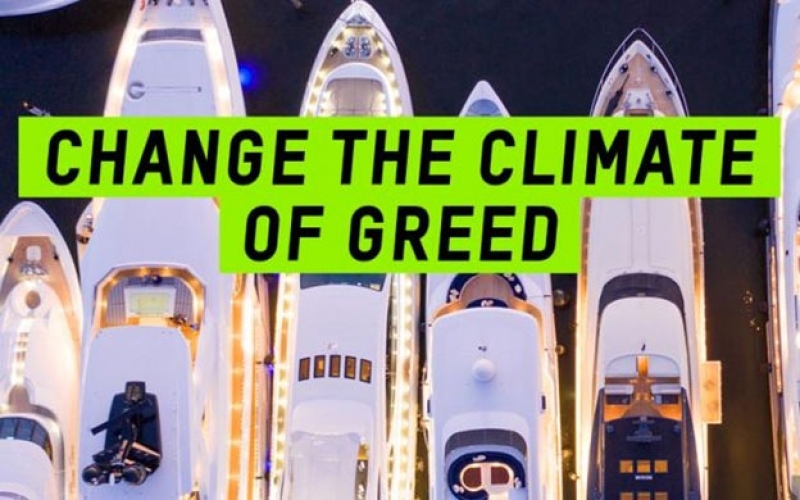
Other recommendations include banning or heavily taxing carbon-intensive luxury items such as super-yachts and private jets. The carbon footprint of a super-rich European from just one week of using super-yachts and private jets can equal the lifetime carbon footprint of someone in the world’s poorest 1%.
Oxfam further urged the creation of a more equitable economic system that prioritises people and the planet by moving away from dominant neoliberal models and towards sustainability and equality.
The International Court of Justice (ICJ), the world’s highest court, has recently confirmed that countries have a legal obligation to cut emissions sufficiently to protect universal rights to life, food, health and a clean environment.