

- Bangladesh stocks end week higher on upbeat mood |
- BDR name will be restored, army won't be used for politics: Tarique |
- Hili land port highway upgrade delayed again, cost Tk 588cr up |
- Tarique vows quick execution of Teesta Master Plan if elected |
- How Undecided voters May Decide the Election |
US Nuclear Test Threat Raises Global Security Fears
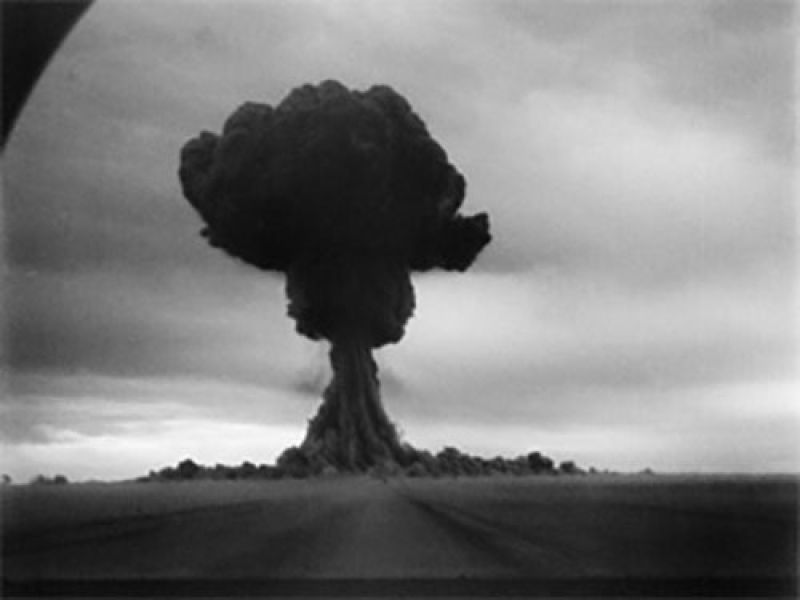
The first USSR nuclear test Joe 1 at Semipalatinsk, Kazakhstan, 29 August 1949.
In a Truth Social post that reverberated around the world, President Donald Trump wrote on 29 October: “Because of other countries’ testing programs, I have instructed the Department of War to start testing our Nuclear Weapons on an equal basis.”
A month later, it remains unclear what “testing programs” Trump was referring to. Other than North Korea, which last conducted a test in 2017, no country has carried out nuclear-explosive testing since 1998.
Some commentators speculated that Trump may have been referring to tests of nuclear weapons delivery systems, as Russia had recently tested innovative systems including a long-range torpedo and a nuclear-powered cruise missile.
Perhaps to reinforce that the United States also tests delivery systems, Sandia National Laboratories issued an unusual press release on 13 November announcing an August test in which an F-35 aircraft dropped inert nuclear bombs.
However, it appears that the “testing” in question concerns nuclear warheads. In an attempt to contain the implications of Trump’s announcement, Energy Secretary Chris Wright said on 2 November that the tests currently under discussion involve “noncritical” rather than “nuclear” explosions. The Energy Department is responsible for the development and maintenance of the US nuclear arsenal.
In contrast, Trump’s remarks in an interview recorded on 31 October point to alleged underground nuclear-explosive testing by Russia, China and other countries as the basis for parallel US testing. His comments may have been prompted by years-old US intelligence assessments suggesting that Russia and China may have conducted extremely low-yield experiments undetectable by remote monitoring.
The prudent assumption, therefore, is that Trump is signalling a potential US return to nuclear-explosive testing. This interpretation is reinforced by the fact that, shortly after Trump’s post, the United States was the only country to vote against a UN General Assembly resolution supporting the Comprehensive Nuclear-Test-Ban Treaty (CTBT).
The Russian government is taking this possibility seriously. On 5 November, President Vladimir Putin instructed relevant agencies to examine preparations for resuming explosive testing of nuclear warheads.
A US return to nuclear-explosive testing would be a disastrous policy. It would elevate the role of nuclear weapons in international affairs, heightening the risk of nuclear conflict. Nuclear tests can themselves function as a form of threat.
It would also accelerate the ongoing nuclear arms race among the United States, Russia and China. In the longer term, renewed testing could encourage additional states to pursue nuclear weapons as they respond to the major powers’ increased reliance on them.
Resuming nuclear test explosions would also violate US international obligations. The United States and China have signed, but not ratified, the CTBT. Russia is in the same position after withdrawing its ratification in 2023 to maintain parity with the United States. Because several key states have not ratified it, the CTBT has not formally entered into force. Since the treaty was negotiated in 1996, the three countries have observed a moratorium on nuclear-explosive testing.
This posture aligns with the obligation under the Vienna Convention on the Law of Treaties for signatory states to refrain from acts that would defeat a treaty’s object and purpose. For the CTBT, that purpose is clear: to prohibit any nuclear weapon test explosion or other nuclear explosion.
The CTBT is a major multilateral agreement backed by an active organisation operating a global verification system. It sets an important precedent for future agreements on fissile materials, delivery systems and the reduction of nuclear arsenals. Undermining the treaty through renewed testing would reverse decades of progress toward a nuclear-weapons-free world.
A return to explosive testing would also be incompatible with the Nuclear Non-Proliferation Treaty (NPT), whose Article VI requires negotiations toward an “early cessation of the nuclear arms race.” Nuclear-explosive testing has long been recognised as a driver of arms racing. The NPT’s preamble recalls commitments made in the 1963 Partial Test Ban Treaty to seek the complete discontinuance of nuclear test explosions.
In 1995, as part of the package enabling the NPT’s indefinite extension, states committed to completing CTBT negotiations by 1996 — a promise fulfilled. Review conferences in 2000 and 2010 called for bringing the CTBT into force.
To resume nuclear-explosive testing now — despite a negotiated, comprehensive ban — would represent a profound repudiation of a core aim of the NPT: ending the nuclear arms race. Such a move would erode the legitimacy of the NPT, which has served as a key barrier to nuclear proliferation since 1970.
The next NPT review conference will take place in spring 2026. A resumption of nuclear-explosive testing, or even intensified preparations for it, would severely undermine prospects for a consensus outcome.
It is imperative that the United States not return to nuclear-explosive testing. Doing so would strike a heavy blow against the web of agreements and norms that restrain nuclear weapons—and could move the world closer to the catastrophic consequences of nuclear conflict.