

- Govt to Build Padma, Teesta Barrages for Water Security |
- Bangladesh Warned Repeatedly Over Measles Vaccine Gap |
- 163 Olive Ridley turtle hatchlings found on Kuakata beach |
Iran Conflict Exposes Risks of Fuel-Driven Food System
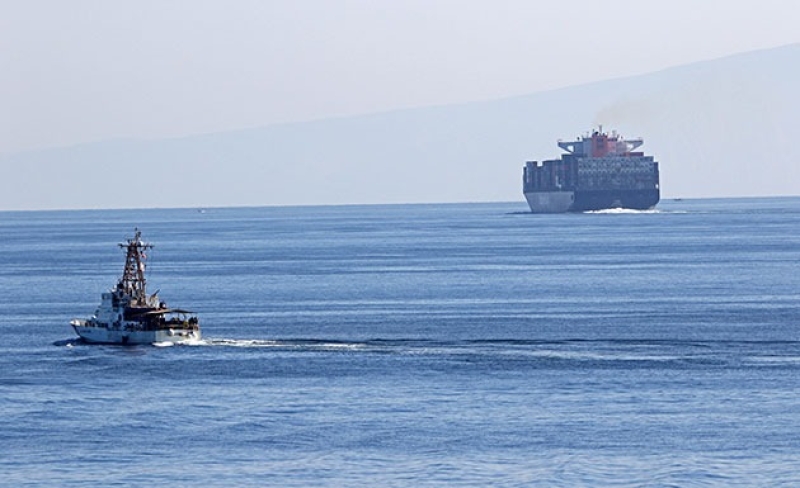
U.S. Coast Guard cutter USCGC Aquidneck (WPB-1309) in the Strait of Hormuz, with a large container ship visible in the background as it transits the critical global trade route (Dec. 2, 2020).
Sharp increases in energy, fertilizer, and food prices triggered by the ongoing conflict in the Persian Gulf highlight the deep links between geopolitical instability, food insecurity, and the fragility of fossil fuel–dependent food systems.
The Strait of Hormuz, which carries around 20 million barrels of oil per day (about 27 percent of global oil exports), also handles 20–30 percent of internationally traded inorganic fertilizers. These fertilizers rely heavily on natural gas for production. Any disruption to this route quickly affects global supply chains, leading to sharp price increases in fuel and agricultural inputs.
This situation shows how geopolitical shocks can rapidly disrupt modern agricultural systems that depend on external energy and complex global supply chains. It also highlights the vulnerability of food systems tied to fossil fuels, which can undermine food sovereignty and disproportionately affect smallholder farmers in low- and middle-income countries.
The World Food Programme has warned that if the conflict continues, rising oil, shipping, and food costs could push an additional 45 million people into acute hunger, raising the global total beyond 319 million.
Experts say food systems remain deeply dependent on fossil fuels across all stages, including fertilizer production, processing, transport, storage, and even food preparation. This dependence is reinforced by large subsidies and structural policies estimated at over $1 trillion globally in recent years.
Food systems account for at least 15 percent of global fossil fuel use, mainly through synthetic fertilizers, machinery, irrigation, and food processing.
In response, experts point to agroecological farming as a more resilient alternative that reduces reliance on fossil fuels while maintaining productivity. These approaches draw on natural processes and local resources to improve soil fertility and long-term sustainability.
Practices such as organic fertilisation, crop rotation, intercropping, cover cropping, reduced tillage, and integration of livestock systems are widely used in agroecology and often supported by traditional knowledge systems.
Research shows that diversified and agroecological systems often perform better in climate resilience, soil health, and nutrient cycling, while also maintaining or improving yields. Agroforestry systems can also provide alternative fuel sources such as wood energy, reducing dependence on fossil fuels.
Examples include cocoa farmers in Peru using organic soil amendments to restore fertility, rice-fish systems in Vietnam improving nutrient cycling and income stability, and crop rotation practices in Ethiopia that reduce fertiliser use while improving soil health. In India, the Zero Budget Natural Farming approach has shown improvements in biodiversity and farmer incomes alongside stable yields.
Other solutions include integrating renewable energy into farming systems, such as solar pumps, biogas digesters, and wind energy, along with fuel-efficient machinery and improved irrigation techniques.
Experts also suggest shifting from long global supply chains to more localised food systems to reduce transport energy use and packaging waste. Urban agriculture and home gardens can further strengthen food security and resilience.
In the short term, emergency funding should support access to organic and low-input alternatives to synthetic fertilisers in affected regions. In the long term, reforms in subsidies, technical support, and local governance are needed to help farmers transition toward more sustainable and resilient food systems.