

- SSC and Equivalent Exams Begin Nationwide |
- US, Iran Signal War Readiness as Talks Hang in Balance |
- Bangladesh, EU Push for FTA, Investment Pact Talks |
- Over 1.14cr workers sent to Middle East in 22 years |
- BNP finalizes 36 nominations for women’s seats in Parliament |
Race Begins for UN Secretary-General Amid Global Uncertainty
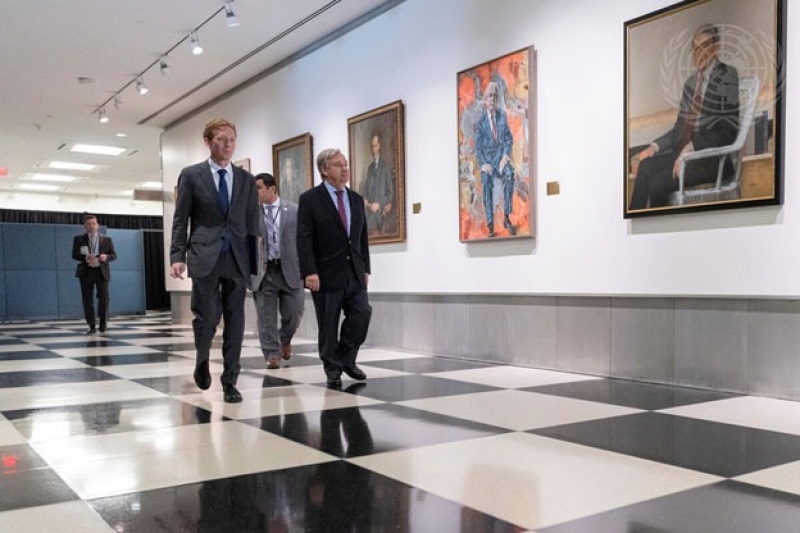
UN lobby with images of former UN secretaries-generals.
The race for the next UN Secretary-General has officially begun. April 1 marked the nomination deadline, coinciding with April Fool’s Day—perhaps a fitting date given the challenging global landscape.
The world is experiencing one of its most unstable periods since World War II. Multilateralism is under pressure, and the UN faces political and financial turbulence. The UN80 process aims to reform the institution, but the world is becoming increasingly multipolar. The new Secretary-General will inherit an organization uncertain about its future role.
Any candidate must secure the approval of the UN Security Council’s Permanent Five (China, France, Russia, the UK, and the US), each with veto power. Recent history shows Russia, the US, and China have used this right, while France and the UK have rarely exercised it.
Regional rotation and gender also influence the choice. Latin America and the Caribbean are expected to supply the next leader, following UN tradition. Calls for a female Secretary-General are growing, building on prior pushes that were unsuccessful.
Four official candidates will present three-hour “hustings” on April 21–22, viewable on UN Web TV:
Michelle Bachelet (Chile) – Former president and UN Women and Human Rights Commissioner. Advantages include experience, UN credentials, and potential to become the first female UN leader. Challenges include possible objections from the Big Five.
Rafael Grossi (Argentina) – Current Director General of the IAEA. Brings extensive diplomatic experience, particularly in nuclear safety. Challenges include political perceptions and not being a female candidate.
Rebeca Grynspan (Costa Rica) – Secretary-General of UNCTAD and former Vice President of Costa Rica. Advantages include UN experience and leadership in global initiatives, with some gaps in peace and security expertise.
Macky Sall (Senegal) – Former President of Senegal and African Union Chair. Offers seniority and regional diplomacy experience. Challenges include limited UN credentials and not being a female or Latin American candidate.
If consensus among the P5 is not reached, new candidates may emerge from Latin America, Africa, or beyond, including current Deputy Secretary-General Amina Mohammed or former European leaders Kristalina Georgieva and Vuk Jeremić.
The selection process, formalized only in 2015, often involves delicate diplomacy and backroom negotiations, making the outcome difficult to predict.