

- Dhaka-Seoul Ties Set for Strategic Partnership Push: Envoy |
- BSEC vows investor protection as top priority in IPO reform drive |
- Facebook post triggers tension in Shahbagh JCD-DUCSU brawl |
- Grameen Kalyan plans 300 healthcare centres in 64 districts |
- Italy dismisses replacing Iran at the World Cup, as Trump official says |
Global Democracy Faces Decline Amid Political Exclusion
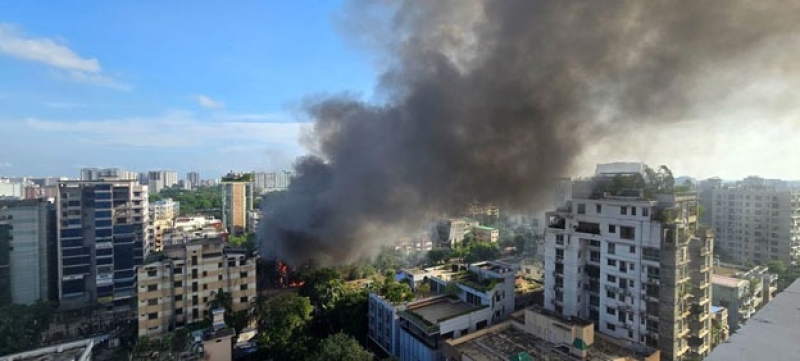
Smoke rises in downtown Dhaka, the capital of Capital, during the July-August 2024 youth-led anti-government protests.
Urgent steps are needed to rebuild the relationship between citizens and the state to halt the global decline of democracy. Experts identify inequality and political exclusion as two major drivers of democratic backsliding, with citizens excluded from policy and decision-making spaces experiencing “hollow citizenship.”
A report published by the Institute of Development Studies notes that Europe, Africa, Latin America, Asia, and the US have all seen growing support for populist leaders on both the left and right, fueling division and weakening democratic safeguards such as free elections and independent media.
Over the past decade, key democratic practices have declined, and now 74% of the world’s population—about 6 billion people—live under autocratic regimes.
The report calls for a renewed focus on people, power, and inequality rather than solely on institutions. Experts say past efforts concentrated too heavily on building institutions like legislatures, judicial systems, and electoral commissions while neglecting the needs of citizens.
To strengthen democracy for the future, urgent action is required to ensure meaningful inclusion and engagement of people at both local and national levels.
Shandana Khan Mohmand, Research Fellow at the Institute of Development Studies, said: “After decades of unsuccessful efforts and millions of dollars spent by Western powers to strengthen democracy, we must learn what truly works. While supporting democratic institutions is important, the missing ingredient is people—their ability to participate meaningfully in decision-making, whether in local councils or national policy on issues like green energy or war.”
While digital technology and social media were once seen as tools to promote democratization, the report finds they have delivered limited gains. Instead, many regimes have used these tools to enforce authoritarian control through mass surveillance and internet shutdowns.
The research also highlights that youth-led uprisings in countries like Bangladesh, Nepal, and Madagascar made headlines, but everyday acts of young people participating in decision-making are even more critical for strengthening democracy and peace.
Marjoke Oosterom, Research Fellow at the Institute of Development Studies, said: “The scale of democratic backsliding globally is a warning to leaders everywhere. Ignoring inequality and political exclusion allows anti-democratic politicians to stoke division and erode trust in democracy. Evidence shows that democracy remains the best model for inclusive and fair societies, and urgent action is needed to reverse this decline.”
Despite budget cuts in Europe and the US that have reduced democracy-strengthening initiatives, the report recommends practical steps for states, policymakers, and philanthropists. These include improving the state-citizen relationship through greater inclusion, accommodating diverse opinions and ideologies, and addressing the needs of marginalized groups to build trust in democracy.