

- PM calls FY27 budget 'life-friendly', promises relief |
- Govt Backs Off Package VAT After Business Outcry |
- Power Outages Continue to Disrupt Life in Sylhet |
- PM Tarique Makes Surprise Visit to SPARRSO |
- Argentina Beat Jordan 3-1 to Top Group J |
Teesta Barrage Master Plan to be implemented at any cost: PM
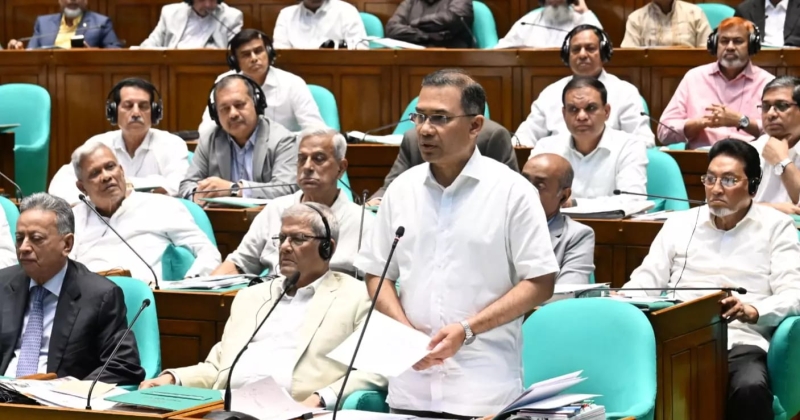
Prime Minister Tarique Rahman on Monday pledged to implement the ‘Teesta
Barrage Master Plan’ at any cost, describing it as a national priority
and a key step towards ensuring water security, supporting agriculture
and improving livelihoods in northern Bangladesh.
Speaking
during the general discussion on the proposed FY2026-27 budget in
Parliament, the Prime Minister said the government is committed to
addressing the country's long-standing water management challenges
through major investments in rivers, canals and irrigation
infrastructure.
“On the basis of national priority, this
government will implement the Teesta Barrage Master Plan at any cost,
InshaAllah,” he said.
Tarique said water remains one of the
biggest concerns for people in the northern districts, particularly in
the Rajshahi and Rangpur regions, where MPs regularly raise issues
relating to the Padma and Teesta Rivers.
He said ensuring year-round water availability for agriculture is one of the government's key objectives.
The
Prime Minister announced that the government has already taken steps to
construct the Padma Barrage to store excess monsoon water for use
during the dry season.
“Through the Padma Barrage, we will
preserve surplus water during the monsoon so that it can be supplied to
farmers and other users throughout the dry months and the rest of the
year,” he said.
Tarique said Bangladesh has long suffered from
the absence of an integrated approach to river management, water
conservation, flood control and inter-river connectivity.
He
noted that many rivers lost navigability over the years, affecting
irrigation and water availability in different parts of the country.
“I
have visited areas where there is water everywhere during the monsoon,
yet farmers just a short distance away cannot irrigate their land
because of water shortages,” the Prime Minister said.
To address the problem, he said the government has started dredging and re-excavating rivers and canals across the country.
The
Prime Minister said the government plans to excavate and re-excavate
20,000 kilometres of canals over the next five years to improve water
flow, irrigation and flood management.
He said around 900 kilometres of canals had already been excavated or re-excavated over the past three months.
“We
have received some complaints in certain areas. We are reviewing those
issues and will take further action where necessary,” Tarique said.
Highlighting
the government's support for farmers, Tarique recalled that one of its
first major decisions after assuming office was to waive agricultural
loans of up to Tk 10,000, including interest.
He said around 13 lakh million farmers benefited from the move.
The
Prime Minister also said the government has introducing a special
farmers' card to provide direct support and benefits to cultivators.
Under
the programme, about 43 lakh farmers are expected to receive financial
assistance and at least 10 additional services during FY2026-27.
“We promised to stand beside our farmers, and we are fulfilling that commitment,” he said.
Tarique
also highlighted efforts to create employment opportunities for young
people, improve skills development and expand overseas job markets for
Bangladeshi workers.
He said the government is working to send
more skilled workers abroad and strengthen support services for
expatriate Bangladeshis.
As part of that effort, Tarique said,
the government is developing a “Probashi Card” to help expatriates
access various services and reduce the difficulties they face while
living overseas.
The Prime Minister also underscored the
importance of energy security, saying a reliable energy supply was
essential not only for economic growth but also for national security.
He
criticised what he described as years of corruption, poor planning and
neglect in the energy sector, alleging that domestic gas exploration had
been overlooked while excessive dependence was placed on foreign
companies.
Tarique said the government is now focusing on energy
diversification, domestic gas exploration, renewable energy and greater
energy efficiency to reduce dependence on imported fuel.
“The recent crisis in the Middle East has once again shown how vulnerable import-dependent energy systems can be,” he said.
The
Prime Minister also said the government's broader goal is to build a
stronger and more resilient economy capable of supporting Bangladesh's
long-term development ambitions.
The Prime Minister later turned
to education, saying an educated and morally grounded population was
the country's greatest asset.
He alleged that the education
system has been systematically weakened during the previous regime and
stressed the need for comprehensive reforms to prepare future
generations for the challenges ahead, reports UNB.