

- Miraz puts Bangladesh within sight of victory as Australia stutter |
- Scale 7.7 quake off Indonesia coast, kills at least 47, topples homes |
- PM for swift steps to restore energy supply, patience to resolve crisis |
- 7 crore people to get mobile internet access within 6-12 months |
- 86 proposals from 14 groups to revive closed govt factories |
‘Toxic Rain’ Fears After Oil Depot Strikes in Tehran
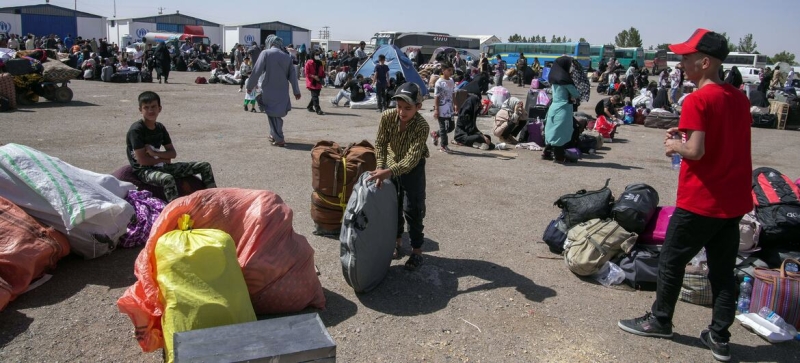
Afghan returnees from Iran gather at the Islam-Border, near Herat in western Afghanistan (file).
Toxic “black rain” linked to strikes on oil depots, mass displacement and continued disruption to aid supply chains are affecting lives across the Middle East and beyond after 10 days of war in the region, UN humanitarian officials said on Tuesday.
Speaking to reporters in Geneva, Ravina Shamdasani, spokesperson for the United Nations Office of the High Commissioner for Human Rights, raised concerns about the health and environmental impact of Israeli and US strikes on oil depots in Tehran as toxic pollutants spread through the air.
She said the situation raises “serious questions as to whether the proportionality and precaution obligations under international humanitarian law were met”, stressing that the sites targeted “do not appear to be of exclusively military use”.
A spokesperson for the World Health Organization, Christian Lindmeier, warned that the “black rain” and “acidic rain” reported in Tehran after the strikes pose a real danger to residents.
“We are in touch with hospitals and the authorities, and Iranian officials have issued an alert advising people to stay indoors, particularly following attacks on oil storage facilities,” he said.
The UN agency is also monitoring the health risks linked to the “massive release” of toxic hydrocarbons, sulphur oxides and nitrogen compounds into the atmosphere.
Lindmeier added that reported Iranian strikes on oil infrastructure in Bahrain and Saudi Arabia could lead to wider regional pollution exposure. He highlighted the long-term risks of pollutants that damage respiratory health and contaminate water sources.
Lebanon displacement crisis
Turning to Lebanon, more than 100,000 people have been displaced by Israeli strikes and evacuation orders in the past 24 hours, bringing the total number uprooted by the conflict to nearly 700,000.
Karolina Lindholm Billing, the country representative of the United Nations High Commissioner for Refugees, said the pace of displacement is even faster than during the conflict with Israel in 2024.
“We see cars lined along the streets with people sleeping inside them,” she told reporters. “Most fled in a rush with almost nothing. They are seeking safety in Beirut, the Mount Lebanon region, northern Lebanon and parts of the Bekaa Valley.”
Billing described visiting a shelter in Beirut on Monday where she met a woman in her nineties who had lost 11 members of her family in the 2024 conflict.
“She is now displaced again, staying in the same school that was turned into a shelter in 2024 and once more in 2026. Stories like hers illustrate the fear, uncertainty and repeated trauma that hundreds of thousands of people are facing right now.”
Afghans returning from Iran
Across the region, the UN refugee agency reported that significant numbers of people have been crossing back into Afghanistan from Iran.
According to the agency, about 110,000 Afghans have returned since the beginning of the year, with roughly 1,700 people crossing the border each day since the start of the Middle East conflict.
While insecurity and shrinking economic opportunities are pushing Afghans out of Iran, many face greater uncertainty after returning home.
Speaking from Islam Qala in Afghanistan’s Herat province near the Iranian border, Tajudeen Oyewale, the country representative of the UNICEF, warned that the number of children screened and treated for malnutrition has doubled in the past week.
Impact on global supply chains
The war is also disrupting supply chains and delaying essential humanitarian aid.
“The geopolitical tension is already disrupting procurement routes,” Oyewale said. “This means supplies needed to care for children and their mothers during this emergency will arrive late. A malnourished child may receive nutritional supplements not immediately, but with delay and at a higher cost.”
Jean-Martin Bauer, director of the Food and Nutrition Analysis Service at the World Food Programme, warned of the wider impact of the conflict on global shipping routes, particularly through the Strait of Hormuz and the Bab el-Mandeb Strait near the Horn of Africa.
“Two key points in the global supply chain are affected by restrictions and security risks, forcing shipping lines to divert their routes,” he said.
Bauer explained that war risk insurance has added an extra cost of $2,000 to $4,000 per container for shipments passing through high-risk areas.
In some cases, vessels must now travel around the Cape of Good Hope, significantly increasing travel distance and delivery time.
He cited the example of food supplies for Sudan that are usually shipped from India through Oman and Saudi Arabia to Port Sudan. Now, shipments must take a longer route through Tangier, adding about 25 days to delivery times.
“That’s an additional sail of around 9,000 kilometres,” Bauer said. “It’s like going coast to coast in the United States and then returning again.”