

- Fourth Palestinian baby freezes to death in Gaza amid winter crisis |
- Prof Yunus to focus on digital health, youths, ‘Three Zeros’ |
- Who’re back in the race? EC clears 58 candidates for Feb polls |
- 8 workers burnt in N’gan Akij Cement factory boiler blast |
- Ex-Shibir activist shot dead in Fatikchhari |
Iran Protest Death Toll Tops 500 as Crackdown Widens
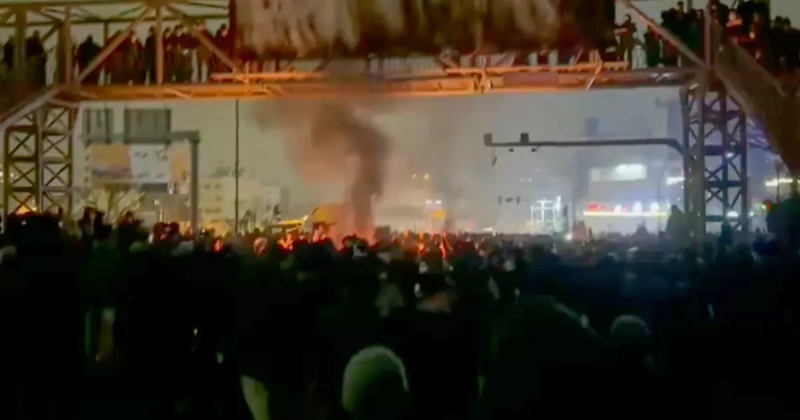
In a frame from video circulating on social media, protesters are seen on the streets of Tehran on January 9, 2026, defying an intensified crackdown as Iran remains largely cut off from global communications.
The death toll from Iran’s sweeping crackdown on nationwide protests has climbed to at least 538 people, according to activists, as security forces intensify efforts to suppress weeks of unrest across the country.
A US-based human rights group said more than 10,600 people have been detained, warning that the number of deaths is likely to rise further as access to information remains severely restricted. Of those reported killed, 490 were protesters and 48 were members of the security forces, the group said.
With internet services largely shut down and international phone calls blocked, verifying developments inside Iran has become increasingly difficult. Activist networks say they rely on local sources who cross-check information on the ground, a method that has produced reliable casualty figures during previous waves of unrest.
Iranian authorities have not released any comprehensive casualty data related to the protests.
Parliament rhetoric hardens
Tensions escalated further on Sunday as senior Iranian officials adopted a sharply confrontational tone. During a live broadcast of a parliamentary session, Speaker Mohammad Bagher Ghalibaf praised police and the Revolutionary Guard, including the Basij paramilitary force, for what he described as standing firm against unrest.
Ghalibaf also issued strong warnings against the United States and Israel, saying Iran would consider American military bases, ships, and what he termed “occupied territory” as legitimate targets if Iran were attacked. Lawmakers responded by chanting anti-US slogans inside parliament.
While it remains unclear whether Iran intends to escalate militarily, analysts note that any such decision would rest with Supreme Leader Ayatollah Ali Khamenei. Regional tensions have remained high since Iran’s air defences were damaged during a brief war with Israel earlier this year.
Protests continue despite heavy security
Despite the security crackdown, protests have continued in several major cities. Footage circulating online, believed to have been transmitted through satellite connections, showed demonstrators gathering in parts of northern Tehran, waving mobile phone lights, blocking streets, and banging metal objects as fireworks lit the sky.
Activists described protest tactics as scattered and short-lived, a response to heavy security deployment. Reports also indicated the use of surveillance drones and increased troop movements around protest hotspots.
In Mashhad, Iran’s second-largest city, videos appeared to show confrontations between protesters and security forces. Demonstrations were also reported in Kerman and other cities. State television, however, aired footage from selected urban areas showing calm streets, without including Tehran or Mashhad.
Rising casualties and official response
State media reported funerals for security personnel killed during clashes, while officials announced additional deaths among security forces in several provinces. Authorities also broadcast images from hospitals and morgues, reinforcing claims of widespread violence.
Senior security official Ali Larijani accused some protesters of using tactics similar to extremist groups, while reformist President Masoud Pezeshkian struck a firmer tone than earlier in the crisis.
“People have concerns and those concerns should be addressed,” Pezeshkian said in a televised interview. “But it is not acceptable for groups to destroy society under the cover of protest.”
International concern and calls for restraint
International concern over the violence continued to grow. Global leaders and religious figures urged restraint and called for dialogue to prevent further loss of life. Meanwhile, Iran’s exiled former crown prince, Reza Pahlavi, renewed calls for protesters to return to the streets, encouraging continued resistance.
The protests began in late December following the sharp collapse of Iran’s currency amid worsening economic conditions and long-standing international sanctions. What started as demonstrations over living costs has since evolved into broader challenges to Iran’s political system, marking one of the most serious internal crises the country has faced in years.