

- US Issues Travel Alert for Bangladesh Ahead of Election |
- Air ambulance carrying bullet-hit Hadi flies for Singapore |
- Can Dhaka’s arms recovery drive ensure peaceful polls? |
- ‘Unhealthy’ air quality recorded in Dhaka Monday morning |
- BD peacekeepers' deaths: UN chief calls Dr. Yunus, offers condolence |
Aid Delayed as Commercial Goods Take Priority in Gaza
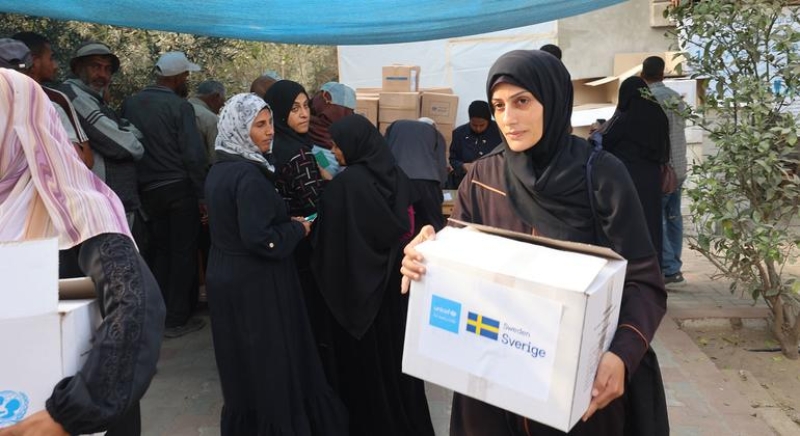
UNICEF distributes winter clothes kits to children across the Gaza Strip, as winter storms are adding to families’ hardship.
Humanitarian assistance in Gaza is being delayed because aid cargo is routinely deprioritised in favour of commercial goods, the UN’s aid coordination office (OCHA) warned on Monday, as winter storms continue to worsen already dire living conditions for displaced families.
Despite sustained efforts by the UN and its partners, humanitarian needs are rising faster than aid can be delivered, according to Olga Cherevko, an OCHA spokesperson in Gaza.
“We continue to provide a response, but the needs outpace the speed at which we can respond,” she said, pointing to the limited volume of supplies entering the Strip and a growing list of items that remain blocked by Israeli authorities. These include heavy machinery, equipment and spare parts needed to repair damaged infrastructure.
With repeated storms flooding large areas in recent weeks, humanitarian agencies have prioritised emergency winterisation. An estimated 1.3 million people are currently in need of shelter assistance.
“When the storms came, many people lost everything — it washed away all that they had,” Ms Cherevko said.
Over the past few days, aid teams have distributed around 3,800 tents, more than 4,500 tarpaulins and thousands of bedding items, assisting some 4,800 families. The response has also included plastic sheeting, cooking sets and short-term food assistance to help families cope with the immediate aftermath of flooding.
Some of the most flood-prone locations have been deemed unsafe by local authorities, prompting several hundred families to relocate voluntarily. The UN and its partners have supported these relocations by preparing and levelling sites and installing tents to ensure minimum standards of safety and dignity.
Winter conditions continue to pose serious health risks, particularly for infants. “The risk of hypothermia is heightened, and babies are in very grave danger,” Ms Cherevko warned.
UN partners are also raising awareness among caregivers, including guidance on body-to-body contact to help keep young children warm.
Beyond shelter, humanitarian operations include food assistance, nutrition screening, health services and the gradual reopening of learning facilities. In recent days, 13 additional temporary learning spaces have reopened, providing access to education for about 5,000 children.
However, major constraints persist. Inside Gaza, the number of routes available for transporting aid remains limited, as do the crossings through which supplies can enter.
“There are many instances in which humanitarian cargo is deprioritised and priority is given to the commercial sector,” Ms Cherevko said, noting that this causes delays that directly affect the speed of aid delivery.
Additional challenges include inconsistent opening and loading times at crossings, restrictions on critical items and registration requirements that prevent non-governmental organisations from bringing supplies into Gaza.
“All of these impediments must be lifted,” she said. “We have the capacity to respond, but we are constrained at a time when people’s needs are increasing faster than we can meet them.”