

- Ordinance approved granting indemnity to July Uprising workers |
- Bangladesh Bank injects Tk 9,178 crore to ease liquidity strain |
- No LPG Shortage Expected During Ramadan: BERC Chairman |
- Tarique Rahman Meets Chief Adviser Yunus After Return |
- Govt clears ordinance granting indemnity to July uprising |
Myanmar Military Called Rohingya ‘Muslim Dogs,’ ICJ Hears
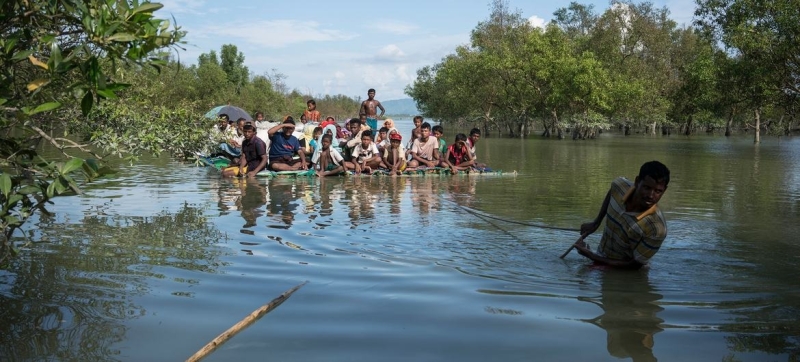
Rohingya refugees from Myanmar arrive by makeshift raft at Noya Para in Bangladesh. The Muslim-minority group has faced decades of oppression from the Myanmar military.
Hearings continued on Thursday at the UN’s top court over The Gambia’s claim that Myanmar committed genocide against the Rohingya people, with allegations that military officials incited violence by calling the ethnic minority “Muslim dogs” who should be made “extinct.”
From The Gambia’s legal team, Jessica Jones highlighted how the Rohingya faced “longstanding denigration” and hate speech from senior and other members of the Myanmar military.
Ms. Jones also referred to a video posted on Facebook in August 2017 showing a soldier giving “clear encouragement of genocidal violence against the Rohingya” – actions that would be a breach of Myanmar’s obligations under the 1948 Genocide Convention.
She quoted the soldier as saying:
“We will clear the villages where those animals live. We have guns, we have bullets. That’s what we came with, with ammunition and the spirit to attack the animals, we have come here. If you can carry a sword, carry a sword. If you can carry a stick, then carry a stick. Carry whatever you can and bravely face these animals.”
The Gambia, a Muslim-majority nation, alleges that Myanmar’s military committed brutal acts of genocide against the Rohingya from 2016 to 2018 in northern Rakhine State. These violations included mass executions, the indiscriminate killing of up to 10,000 civilians including women and children, widespread sexual violence, and the deliberate burning of hundreds of villages.
‘Textbook Ethnic Cleansing’
In 2017, then-UN rights chief Zeid Ra’ad al-Hussein described the violence against the Rohingya as a “textbook example of ethnic cleansing,” which forced around 700,000 people to flee to neighbouring Bangladesh, where most remain today.
In 2020, the International Court of Justice ordered Myanmar to halt its genocidal acts following The Gambia’s request. The country is now seeking to hold Myanmar accountable and secure restitution and compensation for the victims.
Myanmar has long denied intentionally persecuting the Rohingya, claiming its operations were counter-insurgency measures.
Landmark Case
The case is widely regarded as historic, as it is the first time the ICJ judges are set to rule on a dispute brought by a country not directly impacted by the alleged crimes.
Next week, three Rohingya witnesses are scheduled to present testimonies as “members of the wrong group at the wrong time and the wrong place” who witnessed the killing of their spouses and children, Gambia’s Philippe Sands said in concluding remarks.
The International Court of Justice, the UN’s top judicial body, settles legal disputes between states and gives advisory opinions on questions of international law. It does not try individuals but determines state responsibility.
The hearings at The Hague are set to continue until 29 January.