

- Govt Drafts New Model for $1tn Economy by 2034 |
- Middle East Conflict Hits Bangladesh Labour Market |
- Millions face growing hunger as Iran conflict fuels food crisis: UN |
- Bus plunges into Padma from pontoon at Daulatdia |
- Tree logging in Bangladesh has fallen in last two years: Study |
UN Report Calls for New Thinking to Secure a Sustainable Future
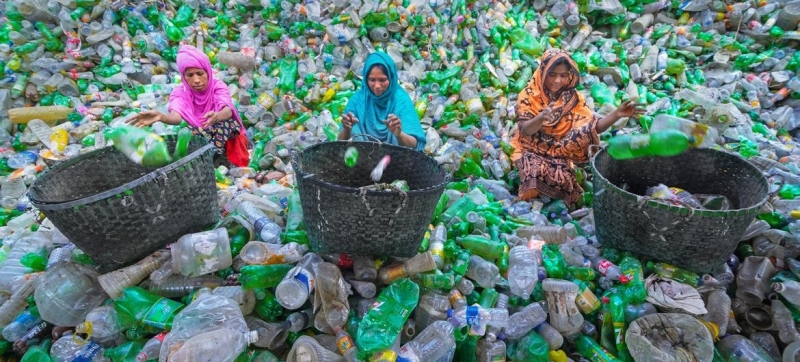
The production, use, and disposal of plastic creates significant greenhouse gas emissions that cause climate change
Fresh approaches to addressing complex environmental challenges are highlighted in the UN Environment Programme’s (UNEP) new global outlook released on Tuesday.
The agency describes the report as the most comprehensive assessment of the global environment ever undertaken, incorporating input from 287 multidisciplinary scientists from 82 countries and spanning more than 1,000 pages.
“The Global Environment Outlook lays out a simple choice for humanity,” said UNEP Executive Director Inger Andersen. “Continue down the road to a future devastated by climate change, dwindling nature, degraded land and polluted air, or change direction to secure a healthy planet, healthy people and healthy economies.”
Looking beyond GDP
The report advocates for interconnected ‘whole-of-society’ and ‘whole-of-government’ approaches to transform the economy and finance, materials and waste management, energy, food systems and the environment.
This pathway begins with moving beyond gross domestic product (GDP) as a measure of economic well-being, using instead inclusive indicators that also track the health of human and natural capital.
It also calls for transitioning to circular economy models; rapidly decarbonising the energy system; shifting towards sustainable diets, reducing waste and improving agricultural practices; and expanding protected areas while restoring degraded ecosystems. These actions must be supported by behavioural, social and cultural shifts that incorporate Indigenous and local knowledge.
Two pathways to change
The report outlines both social and technological pathways to transformation:
Behaviour-focused transformation: changes in lifestyle, behaviour and values, with increased social awareness driving a new worldview.
Technology-focused transformation: innovation and technological solutions in an urbanised world with strong global trade and technological spill-over.
Why it matters
According to UNEP:
The state of the environment will worsen dramatically if the world continues on a business-as-usual trajectory.
Without action, global mean temperature rise is likely to exceed 1.5°C above pre-industrial levels in the early 2030s, rise above 2°C in the 2040s and continue increasing.
Climate change could reduce annual global GDP by 4 per cent by 2050 and by 20 per cent by the end of the century.
The proposed changes could help avoid nine million pollution-related premature deaths, lift 200 million people out of undernourishment and move 150 million people out of extreme poverty by 2050.
The agency urged countries to adopt the whole-of-society and whole-of-government approaches set out in the report to achieve a sustainable future.
“This sounds like, and indeed is, a massive undertaking. But there is no technical reason why it cannot be done,” Ms Andersen said.