

- Two-day ‘Nazrul Dance Festival 2026’ underway at BSA |
- MPO-listed teachers’ eligibility for local polls rests with EC: Shahe Alam |
- How Ganges Treaty 1996 Missed Guarantee, Arbitration Clauses |
- Saudi Arabia, Houthis trade strikes over Bab al-Mande |
- Iraq seizes drone-launching pad used targeting Saudi oil pipeline |
Chinese Technologies Drive Mining Industry’s Green Transition
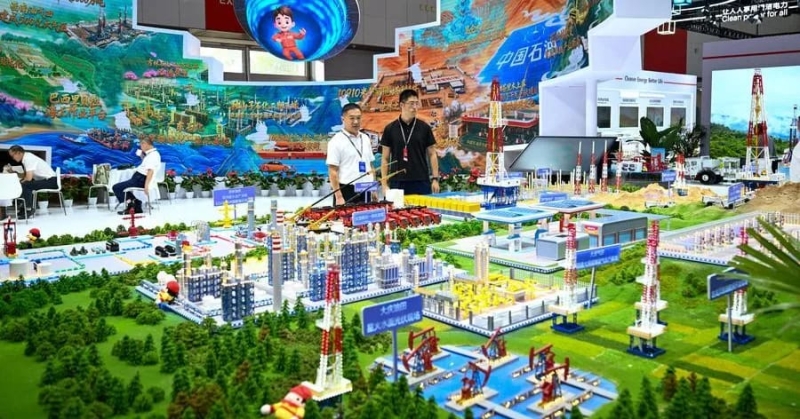
Green technologies, intelligent equipment and smart mining solutions showcased at the 2026 China Mining Conference and Exhibition are highlighting China’s growing role in the global mining industry’s transition towards greener and more sustainable practices.
The conference and exhibition, held in north China’s Tianjin Municipality from Thursday to Saturday, featured autonomous mining trucks, real-time data systems and advanced mineral-processing equipment designed to improve efficiency while reducing energy consumption and environmental impacts.
At the Xinhai Mining booth, a sand-table model demonstrated a smart green mine, with a central control screen displaying real-time data on ore hoisting, equipment loads, tailings pond levels and personnel locations.
“Staff can monitor and control the mineral processing plant remotely from a computer screen,” said Zhang Yunlong, chairman of Shandong Xinhai Mining Group Co Ltd.
The company’s whole-process smart mining solution has been used in more than 100 countries and regions. Zhang cited a gold mine project in Zimbabwe with a daily processing capacity of 500 tonnes, where a clean-energy supply system covering 100,000 square metres had reduced costs by about 75 percent compared with diesel-based power generation.
A new large magnetic separator also drew attention at the exhibition. Without changing processing capacity or beneficiation requirements, the technology reduces equipment size by about 50 percent and operating energy consumption by around 30 percent, while improving beneficiation indicators by approximately 20 percent.
Beneficiation refers to the processes through which raw ore is converted into a concentrated product with greater economic value.
Li Chaopeng, deputy general manager of LONGi Magnet Co Ltd, said the equipment had been deployed in more than 70 countries and regions, most recently at an iron ore project in Brazil.
“Our equipment uses less energy, recovers more resources from tailings and reduces iron ore waste, better meeting the mining industry’s demand for automated and intelligent development,” Li said.
The approach has also attracted attention from mining professionals outside China.
“When I speak to many of our Chinese clients, they take sustainability very seriously. They have very strong sustainability standards,” said Andrew Thake, an Australian mining industry practitioner and divisional director at Beacon Events & Exhibitions.
He said China’s green mining practices, developed over more than a decade, offered useful examples of sustainable development under different resource conditions and levels of economic development.
China has established institutional, standards and evaluation systems for green mining and promoted technologies such as backfill mining, comprehensive utilisation of solid waste and clean-energy substitution in mining areas.
Chinese mining companies are also applying these practices through overseas projects.
Zijin Mining, for example, has developed green mines in the Democratic Republic of the Congo based on China’s ecological civilisation practices. Its green mine in Serbia has also contributed to improved environmental management in mining areas.
“I appreciate the efforts China has made in green development and environmental restoration,” said Patricia, a Zimbabwean geospatial analyst. “I have followed some of the environmental restoration projects that have been carried out in China and I think they have been done quite well.”
Dmitry Tetenkin, deputy minister of natural resources and environment of the Russian Federation, described green and intelligent industrial development as an urgent priority for the mining sector.
“Digital technologies, innovations, rational use of resources and reduction of environmental burden are no longer issues of the distant future, but necessary conditions for the modern mining industry,” he said. “Technological progress must work simultaneously for production efficiency and responsible attitude to the environment.”
China’s green mining approach also extends to ecological research and conservation.
Under the International Big Scientific Plan on Resources and Environmental Effects of Global Karst Dynamic Systems, China has worked with several countries on resource and environmental surveys, carbon-cycle research and ecological protection in karst regions. These efforts have gradually contributed to a global karst monitoring network and explored ways to balance resource development with ecological protection.
In Tanzania, a Chinese technical assistance project at the Ngorongoro Lengai geopark has helped improve infrastructure and promote the integrated development of geological research and tourism.
Orkotete Lesongoyo, a resident of a village at the foot of Mount Lengai, became a local geological guide after receiving training organised by the geopark. He now introduces visitors from around the world to the geological features of the Lengai volcano.
“This project has raised the international profile and influence of Tanzania’s tourism resources and created new livelihoods for surrounding residents,” said Ren Junping, director of the Southern Africa Geological Survey Cooperation Center at the Tianjin Center of the China Geological Survey.
From green mining and environmental restoration to community development, Chinese practices are providing practical examples for the global mining industry’s green transformation, Ren said.
The transition towards green and low-carbon development has become a key direction for high-quality growth in the global mining industry.
The Tianjin Declaration on Green Development of the Mining Industry, issued at the conference, called on countries, international organisations and other stakeholders to accelerate the industry’s transition towards green and low-carbon development and contribute to global sustainable development.
Mohamed Noorain, CEO of Kossel Sudan mining enterprises, said China’s technologies, standards and management experience in green mine development offered valuable lessons.
He expressed hope for stronger exchanges and cooperation between China and other countries, including Sudan, in green mining so that more environmentally friendly technologies and practices could be implemented and contribute to sustainable development in the sector.