

- Bangladesh, Iran Speakers Discuss Bilateral Ties |
- 40 Killed as Bus Plunges Into Ravine in Pakistan |
- Budget steps help stabilize prices of essential commodities |
- Bangladesh likely to face flooding in July-August |
- China open to other countries for economic corridor: Envoy Yao Wen |
Dry Monsoon Raises Fears of Heat and Crop Loss
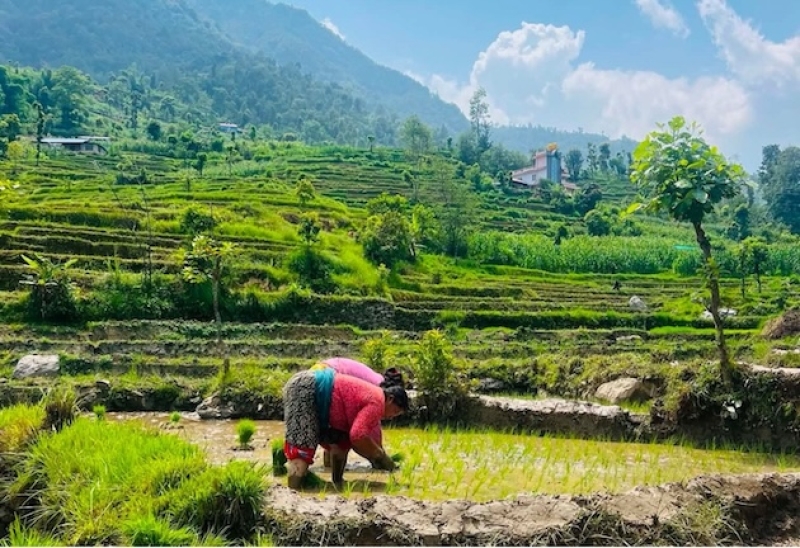
Farmers planting paddy in Helambu, Sindhupalchowk. Their farming is dependent on precipitation and snow-fed rivers in the region.
The monsoon season in South Asia, including Nepal, is typically marked by heavy rainfall, high humidity and a critical period for farmers. Most farmers in the country depend on monsoon rains to cultivate paddy, a staple crop and key source of food security.
A farmer from Pokhara–31, Talbesi in Kaski district of Gandaki Province, said he is preparing for the rice planting season.
“In our area, we mainly grow raithane (a local rice variety), which is more drought-resistant than hybrid seeds, so we are less worried about the forecasted dry monsoon,” he said. “Drought does affect production, but the impact is more severe for farmers using hybrid seeds.”
However, experts warn that a drier monsoon could pose serious risks for most farming communities. The Sundaridanda Community Seed Bank in Kaski, which conserves 53 local rice varieties, has flagged monsoon variability as a growing concern.
According to the regional seasonal forecast for the Hindu Kush Himalaya (HKH) region, also known as the “Third Pole,” South Asia is likely heading toward a dry monsoon. The HKH Monsoon Outlook 2026 projects below-normal rainfall and above-normal temperatures across countries including Nepal, India, Bhutan and Pakistan.
Scientists caution that even in a drier monsoon, risks may intensify due to short bursts of extreme rainfall, rising temperatures and increasing water stress, all of which can trigger floods and landslides.
“The outlook points to a drier monsoon overall, but that does not mean lower risk,” said Manish Shrestha, a hydrologist at the International Centre for Integrated Mountain Development (ICIMOD). “Short, intense rainfall events can still trigger serious hazards.”
The World Meteorological Organization (WMO) has also warned that developing El Niño conditions could influence global weather patterns, increasing the likelihood of extreme heat and erratic rainfall. Such conditions often contribute to weaker monsoon performance in parts of South Asia.
UN Secretary-General António Guterres said El Niño conditions should be treated as an urgent climate warning, calling for stronger global climate action and improved early warning systems.
Experts say the combination of erratic rainfall and rising temperatures could increase both drought and flood risks during the season. Extended dry spells may be followed by sudden heavy downpours, raising the likelihood of flash floods and landslides, especially in mountainous regions.
The outlook also warns that higher temperatures and reduced water availability can cause heat stress in crops and livestock, reduce yields, and shorten growing seasons, particularly in fragile mountain farming systems. Increased evaporation can further reduce soil moisture.
In Nepal and across the HKH region, agriculture largely depends on rain-fed and snow-fed water sources. However, lower-than-average snow persistence last winter has reduced natural water storage, weakening river flows and groundwater recharge.
“Lower snow persistence means the region is entering the monsoon with a reduced seasonal water buffer,” said Sarthak Shrestha, co-author of the outlook.
Farmers are already facing water shortages that are delaying the agricultural calendar. In Sindhupalchowk’s Helambu area, farmers relying on community irrigation systems report difficulties in accessing sufficient water for paddy transplantation.
Experts emphasize that drought and flood risks are interconnected and must be managed together rather than separately. The latest State of the Climate in Asia report by the WMO also highlights how rising temperatures are increasing multi-hazard risks across the region.
Arun Bhakta Shrestha, Senior Adviser at ICIMOD, said early warning systems and locally driven preparedness are essential to cope with increasingly complex climate risks.