

- Trump Extends Iran Ceasefire, Seeks Time for Talks |
- SSC and Equivalent Exams Begin Nationwide |
- US, Iran Signal War Readiness as Talks Hang in Balance |
- Bangladesh, EU Push for FTA, Investment Pact Talks |
- Over 1.14cr workers sent to Middle East in 22 years |
UNESCO Sites Offer Lifeline Amid Global Nature Loss
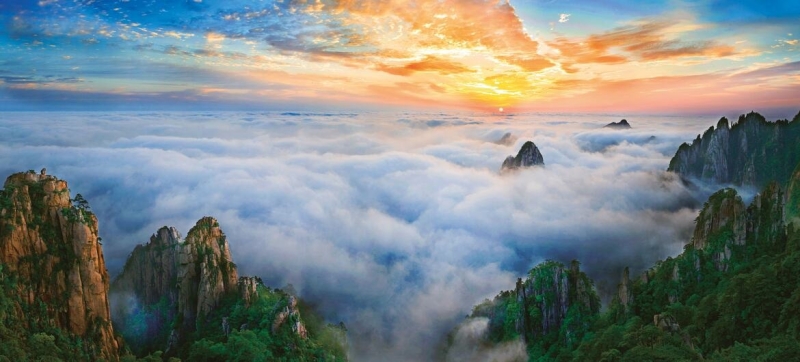
Mount Huangshan Biosphere Reserve in south-east China.
In a world where the drumbeat of environmental loss is growing louder, a landmark report from UNESCO highlights a rare glimmer of hope. While global wildlife populations have declined by a staggering 73 per cent since the 1970s, ecosystems within the UN agency’s protected sites are showing remarkable resilience.
From the mist-covered peaks of Global Geoparks to the rich biodiversity of coral reefs recognised as World Heritage sites, these protected areas are doing more than preserving landscapes. They are functioning as vital systems that support the planet’s ecological balance.
The report, People and Nature in UNESCO-Designated Sites, is the first to assess the organisation’s entire global network as a unified system. Spanning more than 13 million square kilometres—an area larger than China and India combined—the network includes 2,260 sites and demonstrates that protecting nature directly benefits human survival.
A stronghold for biodiversity
The findings are striking. These sites are home to more than 60 per cent of all mapped species on Earth. Even more significantly, around 40 per cent of species found within these areas exist nowhere else. The loss of these habitats would mean permanent extinction for many species.
“These findings show that UNESCO sites are delivering for both people and nature,” said Khaled El-Enany. “Within these territories, communities thrive, heritage is preserved, and biodiversity continues to survive despite global decline.”
Beyond biodiversity, these ecosystems play a major role in climate regulation. They store an estimated 240 gigatonnes of carbon—equivalent to nearly 20 years of current global emissions. If these areas are degraded, the release of this carbon could significantly accelerate climate change.
The human dimension
The report emphasises that these are not isolated wilderness areas. Nearly 900 million people—about one in ten globally—live within or around these sites. They are also centres of cultural diversity, with more than 1,000 languages spoken and significant overlap with Indigenous lands.
In regions such as Africa and Latin America, nearly half of the sites are linked to Indigenous communities. The report underlines that conservation efforts must involve these communities, who have long acted as stewards of the land.
Economically, these areas are equally important. Around 10 per cent of global GDP is generated within or near these zones, showing that environmental protection and economic activity can coexist.
Rising threats
Despite their importance, the report warns that nearly 90 per cent of these sites are under increasing environmental stress. Climate-related risks such as wildfires and floods have risen by 40 per cent over the past decade.
Experts caution that by 2050, one in four UNESCO sites could reach critical tipping points. This may result in disappearing glaciers, degraded forests, and collapsing coral ecosystems.
A call for action
The report stresses that there is still time to act. Reducing global warming could significantly lower the number of sites facing severe disruption.
UNESCO is urging governments to treat these areas not merely as tourist attractions, but as strategic assets in tackling climate change and biodiversity loss.
The recommended approach includes restoring damaged ecosystems, strengthening cross-border conservation efforts, and empowering Indigenous and local communities to lead these initiatives.
The message is clear: protecting these sites today is essential to securing the planet’s future.