

- Human Rights Record ‘Alarming’ Over 17 Months, Says HRSS |
- Tarique Warns of Deep Plot, Urges Vigilance Nationwide |
- Son of late ruler Gadhafi is killed in Libya |
- Special prayers, foods, charity mark Shab-e-Barat in Old Dhaka |
- Exiled Awami League Leaders Plan Political Comeback from India |
Experts Urge National Consensus to Rescue Energy Sector
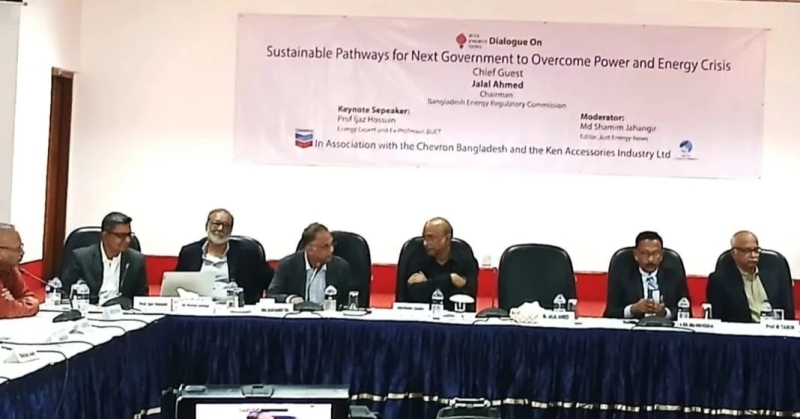
Energy experts, economists and political leaders on Tuesday called for a broad-based national consensus to overhaul Bangladesh’s power and energy sector, warning that chronic overcapacity, heavy reliance on imports and deep governance failures now pose a serious threat to economic stability.
Speaking at a policy dialogue in Dhaka, they cautioned that without cross-party agreement and continuity in core energy policies—irrespective of changes in government—the sector’s growing financial stress could undermine industrial growth, drain foreign exchange reserves and weaken macroeconomic stability in the coming years.
The dialogue, titled Sustainable Pathways for the Next Government to Overcome the Power and Energy Crisis, highlighted how frequent policy reversals have worsened structural problems. Participants argued that power and energy, like education and healthcare, must be treated as national priorities insulated from partisan politics.
They urged future governments to abandon a “business-as-usual” approach and agree on a minimum national framework, warning that reforms without consensus would remain fragile and reversible.
Bangladesh Energy Regulatory Commission (BERC) Chairman Jalal Ahmed said decades of neglect of primary energy development lay at the heart of the crisis.
“Bangladesh invested heavily in power generation capacity but failed to invest adequately in gas, coal and renewable energy,” he said, adding that sustainable electricity supply is impossible without strengthening indigenous energy sources.
He pointed to constraints in liquefied natural gas (LNG) imports, noting that the country’s two floating storage and regasification units are already operating near full capacity.
“In emergencies, LNG imports cannot be increased beyond these limits—a reality often ignored in planning,” he said.
Jalal Ahmed also noted that no comprehensive reservoir management study has been conducted since 2001, while gas exploration has remained stagnant for nearly 16 years. Despite surplus generation capacity relative to actual demand, he said, consumers continue to bear the financial burden.
Keynote speaker Dr Ijaz Hossain, former professor of BUET, said inflated demand projections had led to costly overcapacity and long-term contractual liabilities.
“About 97 to 98 percent of our energy supply is fossil fuel–based, and nearly 60 percent of power and energy is import-dependent,” he said, noting that dependence has increased further in the past year, intensifying pressure on foreign exchange reserves.
He warned that inefficiencies and irregularities in the gas sector have worsened since the shift to imported LNG. According to his analysis, nearly 10 percent of supplied gas is lost due to theft and mismanagement.
“When 30 to 33 percent of gas comes from imported LNG, such losses translate into billions of dollars in foreign exchange wastage each year,” he said.
BNP Standing Committee member Iqbal Hasan Mahmud Tuku said electricity policy must strike a balance between commercial viability and public service obligations, which requires political stability and long-term commitment.
“For years, development was treated as an end in itself. Now people are paying hidden costs through higher electricity bills and rising public debt,” he said.
He criticised capacity payments for idle power plants and warned that continued foreign currency outflows for non-operational projects have intensified economic pressure. “No single government can fix this alone. A national consensus is the only way forward,” he said.
Bangladesh Jamaat-e-Islami Assistant Secretary General Ahsanul Mahboob Zubair said his party would support efforts to build consensus to ensure power and energy as basic rights of citizens, while expressing concern over corruption and alleged gas theft by large industrial units.
Economist Prof Mushtaq Hossain Khan of SOAS, University of London, warned that the power sector required around $5 billion in subsidies last year, much of it in foreign currency.
“These losses cannot be financed indefinitely through borrowing or money printing,” he said, warning of inflation and macroeconomic instability.
He argued that the core problem was not a lack of policy documents but institutionalised corruption. “Power generation increased fourfold, but costs rose elevenfold and capacity charges twentyfold,” he said.
Several speakers, including energy experts Prof M Tamim and Dr Md Rafiqul Islam, stressed the need to diversify energy sources and gradually shift towards renewables. Prof Tamim said domestic gas remains the cheapest source of electricity and warned that power generated without indigenous fuel cannot be supplied below Tk 10 per unit.
At the same time, he cautioned against abrupt cancellation of power contracts without proper review, warning that such moves could disrupt supply and harm consumers.
Former justice Moinul Islam Chowdhury highlighted governance and accountability gaps, saying non-competitive power purchase agreements have saddled the power utility with disproportionate liabilities. Consumer rights advocate Prof M Shamsul Alam said regulatory failures have allowed irregularities to persist, undermining public trust.
In his concluding remarks, BERC Chairman Mohammad Wahid Hossain said the next government would face immense challenges in the energy sector and urged media and academia to help build public understanding.
“Difficult but necessary decisions become easier when people understand the truth,” he said.
The discussion ended with a clear warning: without a durable national consensus that transcends political cycles, Bangladesh’s power and energy sector risks sliding deeper into crisis, with serious consequences for long-term development and economic stability.