

- Remittance Inflow Surges 45% to $3.17bn in January |
- Militant Attacks Kill 33 in Balochistan; 92 Assailants Dead |
- Power generation at Payra Thermal Power Plant 1st unit starts after a month |
- Irregularities, injustice will no longer be accepted in politics: Jamaat Ameer |
- 2 arrested in Jhenaidah for allegedly selling madrasa student |
Election Reporting Shapes Global Confidence: Stefan Liller
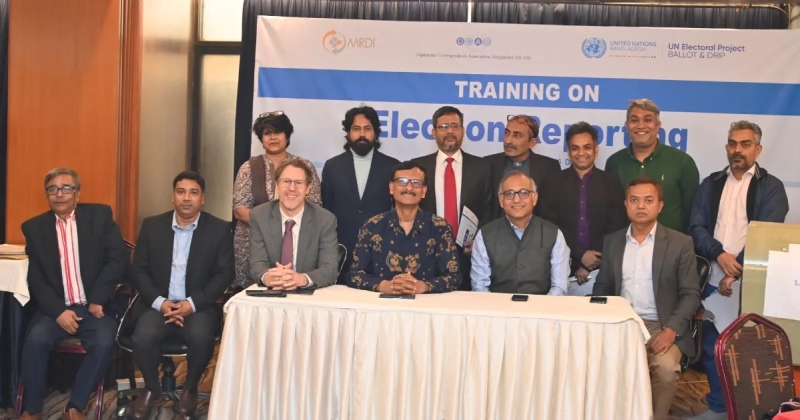
UNDP Resident Representative for Bangladesh Stefan Liller on Sunday said election reporting now extends far beyond national borders, urging journalists to uphold accuracy, neutrality and ethical judgement while covering the polls.
He said election-related reports from Bangladesh are closely followed by diplomats, international observers, development partners, investors and global media, giving such reporting global significance.
“As a result, election narratives can influence international confidence, diplomatic engagement and perceptions of a country’s image and democratic maturity,” Liller said, noting that this places a special responsibility on journalists reporting on elections in a diplomatic context.
He made the remarks at the closing session of a two-day training on election reporting organised by the Diplomatic Correspondents Association, Bangladesh, in collaboration with UNDP and the Media Resources Development Initiative.
Foreign Affairs Adviser Md Touhid Hossain attended the session as chief guest, while veteran journalist Farid Hossain facilitated the training. MRDI Executive Director Hasibur Rahman and DCAB President AKM Moinuddin also spoke at the event, moderated by DCAB General Secretary Emrul Kayesh.
Liller said that as Bangladesh approaches a critical electoral milestone, the role of journalists becomes both demanding and indispensable. “Democracy is sustained not only by laws and institutions, but by informed citizens. Journalists are central to that process,” he said.
He emphasised that electoral developments should be reported within the country’s constitutional and legal framework, as well as its international commitments under the UN Charter, human rights instruments and the Sustainable Development Goals, particularly Goal 16 on peace, justice and strong institutions.
Responsible reporting, he said, helps the international community understand political competition as part of a lawful and rules-based democratic process, while inaccurate or misleading reporting can undermine confidence and heighten tensions.
Describing elections as among the most technically and politically sensitive aspects of democratic governance, Liller said journalists act as a crucial bridge between institutions and citizens by explaining complex processes such as electoral laws, codes of conduct, results tabulation and dispute resolution mechanisms.
He also warned that electoral environments worldwide are increasingly affected by misinformation, disinformation, hate speech and digitally manipulated content, including material generated through artificial intelligence.
“Protecting information integrity is inseparable from protecting journalists themselves,” Liller said, noting that journalists often face harassment, intimidation and threats both online and offline. “Safe journalists are essential to safe elections.”
Liller further highlighted the importance of gender equality and inclusive participation, saying women candidates, activists and journalists are disproportionately targeted by technology-facilitated gender-based violence, including online harassment, intimidation and sexualised disinformation.
He said the media has a vital role in exposing such abuses, framing them as violations of democratic rights and amplifying women’s voices to strengthen participation, accountability and the overall credibility of the electoral process.