

- EU Deploys 56 Long-Term Observers Across Bangladesh |
- Appeals over nomination papers:18 more regain candidacies back |
- More than 100 dead in torrential rains and floods across southern Africa |
- Islami Andolan to Contest Election Alone in 13th Poll |
- 3 killed in Uttara building fire; 13 rescued |
Bangladesh urges collective action to tackle global economic challenges
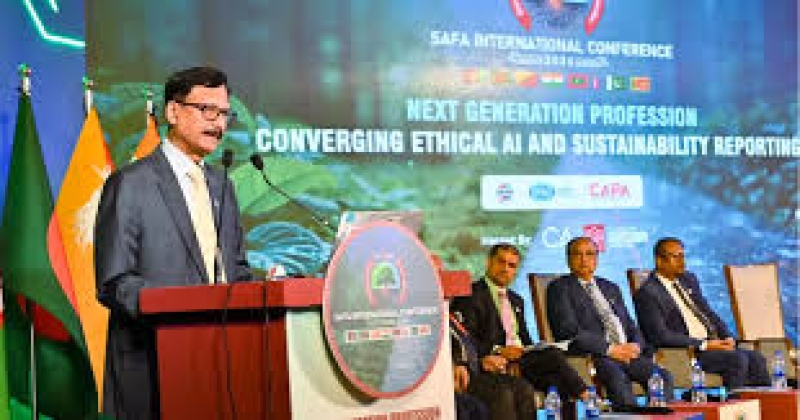
Foreign Affairs Adviser Md Touhid Hossain on Saturday said Bangladesh, as a responsible neighbor and an active member of the United Nations and other international bodies, advocates for a rule-based international order and collective action in addressing global economic challenges.
"We support active engagement to promote dialogue, confidence-building, and cooperative solutions to shared concerns," he said while speaking at the Inaugural session of SAFA (South Asian Federation of Accountants) International Conference in Dhaka.
Chairperson of Bangladesh Competition Commission AHM Ahsan and Chairman of the Financial Reporting Council (FRC) Bangladesh Dr Md Sajjad Hossain Bhuiyan attended the conference as special guests.
Organised by the Institute of Chartered Accountants of Bangladesh (ICAB), the conference was themed “Next Generation Profession: Converging Ethical AI and Sustainability Reporting.”
For Bangladesh, the Adviser said, the proposed convergence of technology and sustainability is particularly significant. "Our pursuit of economic growth and deeper global integration requires that our professionals remain not only technically proficient, but also ethically grounded and socially responsible," he said.
The Adviser said platforms such as this conference play a vital role in facilitating the exchange of knowledge, sharing of best practices, and fostering of meaningful collaborations.
"Such engagements can steer both the region and the global community toward a sustainable, inclusive, and technologically advanced future," he said.
The keynote speech was delivered by Adeeb Hossain Khan FCA, past President of ICAB and Senior Partner at Rahman Rahman Huq, Chartered Accountants.
Khan emphasised that the adoption of AI in sustainability reporting is “no longer a distant concept, but a structural shift already influencing how economic value is created, measured, and disclosed.”
The conference brought together national leadership and international expertise, serving as a platform for thought leadership, knowledge exchange, and strategic dialogue on critical issues set to reshape regional and global professional collaboration.
Delegates from Afghanistan, Bhutan, India, the Maldives, Nepal, Pakistan, and Sri Lanka took part in the event, which featured three technical sessions and a valedictory session.
The global accounting profession is entering a new phase as Ethical Artificial Intelligence (AI) and Sustainability Reporting begin to converge, reshaping business risk, investor expectations, and public trust, experts highlighted at the SAFA international conference.
Organisers noted that their presence demonstrated strong government support for elevating professional excellence, ethical standards, and international collaboration in the accounting and finance sectors.
Adviser Hossain emphasised that the convergence of technology and sustainability is crucial for shaping a ‘new Bangladesh’.
He noted that the country’s aspirations for sustained economic growth and deeper global integration demand professionals who are not only technically competent but also ethically grounded and socially responsible.
AHM Ahsan highlighted that technological advancement presents both opportunities and challenges, and observed that AI-driven systems can boost efficiency, strengthen compliance, and foster innovation.
Without strong ethical frameworks, AI also poses risks such as algorithmic collusion, market dominance abuses, opacity, and exclusionary practices.
He urged that AI be adopted with caution to ensure that Bangladesh can fully and responsibly harness its benefits.
For the first time in Dhaka, ICAB hosted Jean Bouquot, President of the International Federation of Accountants (IFAC), the world’s apex body of the accounting profession, along with Ashfaq Yousuf Tola FCA, Adviser to the South Asian Federation of Accountants (SAFA), as guests of honor.
Bouquot underscored the more transparency in financial disclosure while adopting AI could give additional benefits the professional to deliver the services efficiently.
He also emphasised on global relevance of the discussions and their potential to shape the future of the profession, particularly in sustainability reporting, ethical AI, and next-generation professional practices.
ICAB President NKA Mobin FCA delivered the address of welcome, while Muhammed Farhad Hussain FCA, Past President of ICAB and Chairman of the Conference Organizing Committee, also spoke.
ICAB President said this journey is about leading change. As we navigate ethical AI and sustainability reporting, let our timeless foundation of integrity, objectivity, and public service guide us.
The world needs ethical, competent, and forward-thinking accountants now more than ever, he added.
Muhammed Farhad Hussain said, “Next Generation Profession: Converging Ethical AI and Sustainability Reporting” reflects not only where the world is heading, but also where the profession must lead.
Artificial intelligence and sustainability are no longer emerging concepts—they are already reshaping how organisations operate, how information is produced, and how trust is built.
The keynote speaker noted that modern sustainability reporting now affects capital allocation, regulatory compliance, and market credibility, as climate and governance issues move into mainstream financial considerations.
He also stressed that the profession’s scope has expanded well beyond traditional accounting into risk modeling, valuation, assurance, investigation and policy engagement.
“AI can enhance transparency and predictive insight, but it does not carry ethical accountability or fiduciary duty. These responsibilities remain inherently human, which is why ethical governance is essential,” Khan said.
He highlighted the emerging AI applications, including climate scenario modeling, supply-chain carbon analysis, and real-time ESG performance tracking.
He, however, cautioned that algorithmic opacity, fragmented ESG data, and bias risks could undermine trust without proper ethical safeguards. “Ethical AI should not just automate reporting—it should elevate decision-making,” he said, adding that advanced tools “intensify responsibility rather than eliminate it.”
He also noted that professional accountants are uniquely positioned to govern these developments due to their established role in assurance, public-interest oversight, and standards compliance.
Khan urged the profession, regulators, and standard-setters to work together to ensure that AI-enabled sustainability reporting remains transparent, explainable, and aligned with global standards and investor confidence, reports UNB.
“By governing AI with integrity and public interest at the center, accountants can turn uncertainty into opportunity and contribute to a more resilient and sustainable economy,” he said.