

- Gaza Ceasefire Not Enough as Children Continue to Die |
- Bangladesh Sets Guinness Record With 54 Flags Aloft |
- Gambia Tells UN Court Myanmar Turned Rohingya Lives Hell |
- U.S. Embassy Dhaka Welcomes Ambassador-Designate Brent T. Christensen |
- Survey Shows Tight Race Between BNP and Jamaat-e-Islami |
Global Jobless Rate Steady, Decent Work Still Elusive
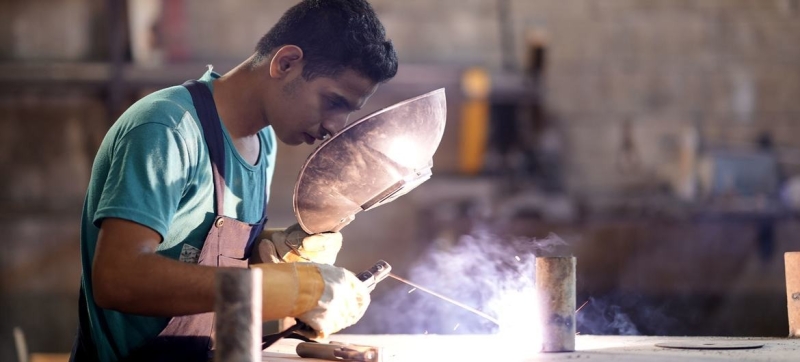
A young unemployed man receives job training in Lebanon.
Global unemployment remains stable, but progress towards decent work has stalled, according to a new report by the International Labour Organization (ILO), which warns that young people continue to struggle in a job market at risk of further disruption from artificial intelligence and trade policy uncertainty.
According to data compiled for the latest Employment and Social Trends 2026 report, the global unemployment rate is projected to remain steady at around 4.9 per cent this year, equivalent to about 186 million people out of work.
The biggest area of employment growth is in poorer countries, reflecting ageing populations in richer economies, where fewer people of working age are available to enter or remain in the workforce.
Job growth is projected at 0.5 per cent in upper middle-income countries, compared with 3.1 per cent in low-income nations.
However, having a job does not necessarily mean having decent work or a living wage. Nearly 300 million workers are living in extreme poverty, earning less than $3 a day.
It is estimated that around 2.1 billion people will be employed in the informal sector this year, with limited access to social protection, workplace rights, and job security.
Youth employment at risk
The global employment situation for young people in low-income countries is described in the report as “daunting”, with more than a quarter (27.9 per cent) neither in education, employment, nor training.
Educated youth in high-income countries are also vulnerable, as the study warns that AI and automation could make it harder for them to find work and calls for “close monitoring” of the technology.
Gender gap remains
The report offers little optimism for those advocating women’s equality in the workplace, showing that social norms and stereotypes remain deeply entrenched.
Previous gains have stalled, slowing progress towards gender equality at work, with women currently about 24 per cent less likely than men to participate in the labour force.
Trade uncertainty
In 2025, the global economy was marked by upheaval in international trade rules and tariff rates, led by the United States.
Trade supports around 465 million workers worldwide—more than half of them in Asia and the Pacific—but growing uncertainty is cutting into wages, particularly in Southeast Asia, South Asia, and Europe.
‘Coherent and coordinated’ response needed
Responding to the findings, ILO Director-General Gilbert Houngbo called for coordinated action and stronger institutions to advance decent work and social justice, especially in poorer economies at risk of being left behind.
“Unless governments, employers, and workers act together to harness technology responsibly and expand quality job opportunities for women and youth—through coherent and coordinated institutional responses—decent work deficits will persist and social cohesion will be at risk,” Houngbo said.