

- Security, sacrifice or opportunity: Climate action visions differ |
- Four New Subjects to Join Curriculum From 2027 |
- Strong children mean a stronger Bangladesh: PM |
- UK All-Party Parliamentary Group on BD Meets Humaiun Kobir |
- World Bank Keeps Bangladesh FY27 Growth Forecast at 3.4% |
Faridpur markets see LPG sold Tk 200-500 above fixed rate
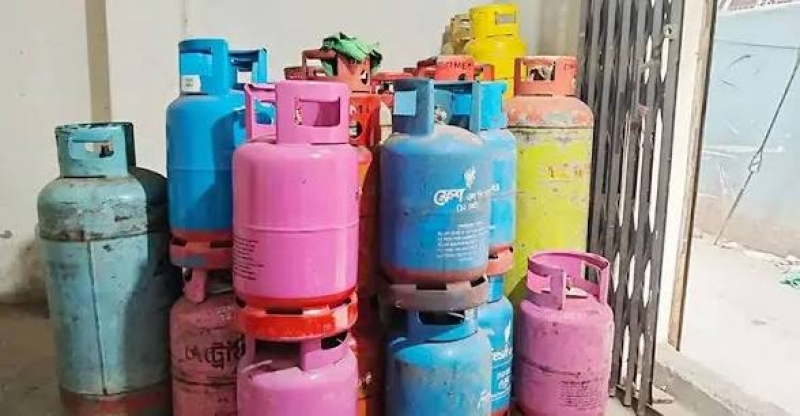
Consumers in Faridpur are being forced to pay Tk 200 to Tk 500 more than the government-fixed price for liquefied petroleum gas (LPG) cylinders, adding to the financial pressure on households and small businesses amid price hikes.
Consumers in different upazilas, including remote markets in Nagarkanda, Bhanga, Saltha and Madhukhali, said they often have to buy LPG cylinders at prices significantly higher than the official rate.
Although LPG cylinders are available in the markets, consumers alleged that many retailers are selling them without adhering to the government-fixed price.
The price of a cylinder varies by brand and size, with some cylinders being sold for around Tk 2,000 to Tk 2,500 in different markets of Faridpur.
The higher prices are particularly burdensome for low- and middle-income families who depend on LPG for cooking.
Two auto-rickshaw drivers, a hotel owner and a homemaker on Mujib Road in Faridpur town said prices of almost all essential commodities have increased, leaving households with little room to absorb additional costs.
The rising cost of LPG is also affecting small businesses that depend on the fuel for cooking.
Owners of hotels, restaurants, food shops and tea stalls said higher gas prices are increasing their operating costs at a time when their revenues have not risen proportionately.
Several people in Nagarkanda Bazar said LPG costs differ significantly between the upazila headquarters and smaller rural markets.
“Gas cylinders cost even more at small shops in villages. Who will control this system?” one local resident asked.
A hotel owner said the rising price of LPG is making it increasingly difficult to maintain business operations.
“As the price of gas rises, so does the cost of cooking. Other products are also expensive. Taken together, it has become difficult to run the business as before,” he said.
Business owners said continued increases in LPG prices could further squeeze their already narrow profit margins, with some fearing that prolonged cost pressures could force small establishments to shut down.
Retailers, however, attributed the higher prices partly to inadequate supply.
They claimed they are often forced to procure cylinders at higher prices because of supply shortages, while transportation and other associated costs make it difficult to sell LPG at the government-fixed rate.
Consumers, however, said supply-related costs should not be used as a justification for routinely charging prices above the official rate.
They also alleged that regular monitoring by the Directorate of National Consumer Rights Protection is not visible in many markets of the district.
They called for regular market drives and stronger enforcement to ensure that LPG is sold at the government-fixed price.
Faridpur Additional District Magistrate Susmita Saha said instructions have already been given to the upazila nirbahi officers and executive magistrates across the district to monitor LPG prices, reports UNB.
“The UNOs and executive magistrates of all upazilas have been instructed to monitor the market over LPG prices. If evidence is found that LPG is being sold above the fixed price, necessary legal action will be taken,” she said.