

- PM calls FY27 budget 'life-friendly', promises relief |
- Govt Backs Off Package VAT After Business Outcry |
- Power Outages Continue to Disrupt Life in Sylhet |
- PM Tarique Makes Surprise Visit to SPARRSO |
- Argentina Beat Jordan 3-1 to Top Group J |
Flash floods, river erosion trigger fresh crisis in Kurigram
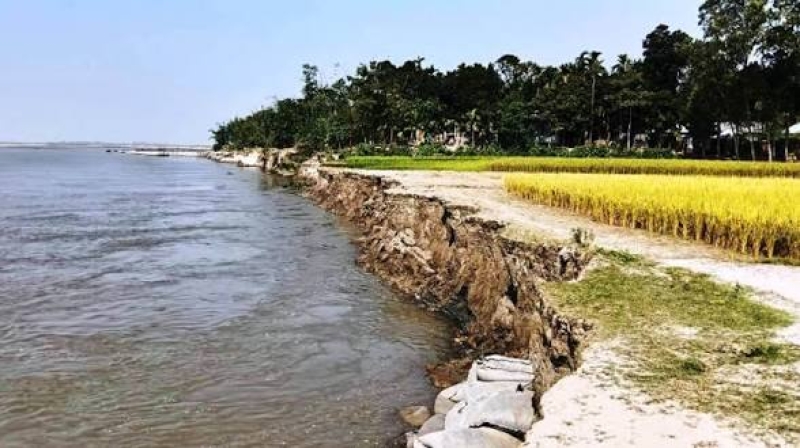
As the monsoon arrives, the country's poorest district Kurigram is already grappling with a severe humanitarian crisis as flash floods and intense river erosion struck a double blow forcing hundreds of families from their homes.
Several major rivers crossing the district are causing the erosion, including the Brahmaputra, Dharla, Dudhkumar, Teesta and Kaljani, damaging homes, farmland, rural roads and trees daily.
According to locals, more than 500 families have already lost everything, even as they moved to safer areas.
The Water Development Board (WDB) said severe erosion is currently occurring at 36 points across a stretch of around 11.245 kilometres in the district.
Fear of further erosion has forced riverbank residents to stay awake at night, guarding their homes.
The Dudhkumar is flowing 23 centimetres above the danger level. Strong currents are continuously swallowing farmland and homesteads in areas of Sadar and Nageshwari upazilas.
Severe erosion is also reported along the Dharla River in Sadar and Phulbari upazilas, while the Brahmaputra is swallowing large chunks of Sadar, Nageshwari, Ulipur, Chilmari, Roumari and Rajibpur upazilas.
Erosion pressure is also rising along parts of the Teesta River in Rajarhat and Ulipur upazilas, while fresh fears have emerged along the Kaljani River in Bhurungamari and Sadar upazilas.
Residents say the river is advancing day by day, leaving them with little time to respond.
“The river is moving a few feet every day. I have already removed the tin roof of my house. My family stays awake at night in fear,” said Abdul Kader, a resident of Satkalua village in Sadar upazila.
Another affected farmer, Nur Islam from Ulipur, said he has already lost his land. “Now our house will go too. There is no way left for us to survive,” he says, resigned to his fate.
WDB Executive Engineer Rakibul Hasan said emergency protection work is ongoing over an area of about 5.35 square kilometres, with around 100,000 sand-filled geo-bags being used at a cost of Tk 3.9 crore.
Rakibul however emphasises that additional funds to tackle the situation.
Char Development and Implementation Council President Prof Shafiqul Islam Bebu said the people of the char areas are facing a “severe humanitarian crisis” due to the combined impact of floods and erosion.
He added that permanent river management solutions and quick compensation are needed for affected families.
District Relief and Rehabilitation Officer Benazir Rahman said lists of affected families are being prepared through upazila administrations. So far, 275 tonnes of rice, Tk 1.62 lakh in cash and 1,000 packets of dry food have been allocated for relief.
Meanwhile, local journalist and general secretary of the Kurigram District Development and Implementation Council Syed Ahmed Babu said stop-gap measures such as geobags are no longer enough, reports UNB.
“Only permanent river management can save Kurigram. Affected families must also receive proper compensation without delay,” he said.