

- El Niño Could Threaten 347 Million Children Worldwide |
- PM Assures Support for Waste-to-Fuel Technology |
- CJP founder Abhijeet Dipke detained after flight lands in Delhi |
- India’s young return to streets as anger against EC and Modi grows |
- Dhaka’s air quality 4th worst in the world this morning |
Dhaka, Riyadh Urged to Expand Strategic Ties Beyond Manpower
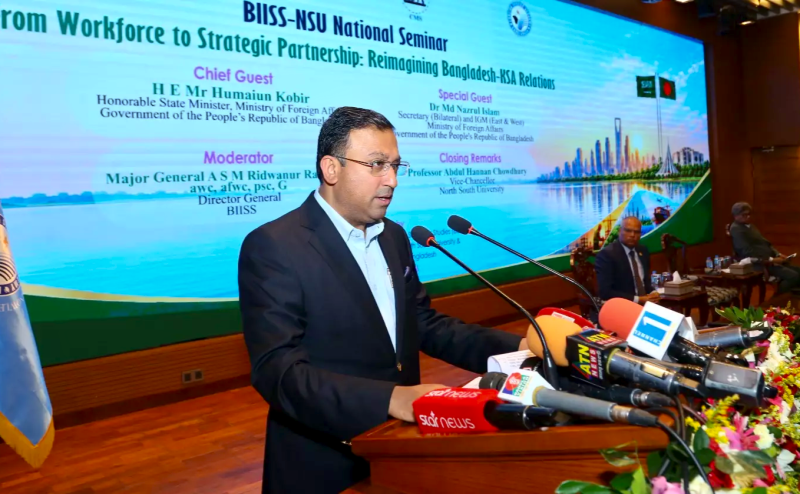
Speakers at a seminar on Saturday said Bangladesh and the Kingdom of Saudi Arabia need to move beyond traditional manpower export and build a broader strategic partnership focusing on skilled migration, investment, trade diversification, technology and human capital development.
They stressed the need to align Bangladesh’s workforce development with Saudi Arabia’s changing labour market demands under its Vision 2030 programme, while ensuring fair recruitment, workers’ rights and better protection for migrant workers.
Bangladesh Institute of International and Strategic Studies (BIISS) and the Center for Migration Studies (CMS) of North South University (NSU) jointly hosted the seminar titled “From Workforce to Strategic Partnership: Reimagining Bangladesh-KSA Relations” at the Foreign Service Academy in Dhaka.
State Minister for Foreign Affairs Humaiun Kobir attended the seminar as the chief guest, while Foreign Ministry Secretary (Bilateral - East & West) Md Nazrul Islam was present as the special guest.
State Minister Humaiun Kobir highlighted the need to build a comprehensive partnership based on mutual trust, investment, technology, innovation, and human capital development.
He encouraged both countries to explore opportunities in agriculture, connectivity, logistics, supply chains, clean energy, and other emerging sectors while ensuring that workers’ rights and skills development remain central to bilateral cooperation.
Dr Nazrul emphasised the importance of transforming Bangladesh-Saudi Arabia relations from traditional labour migration towards a broader strategic economic partnership, with opportunities for investment, skilled employment, and collaboration in artificial intelligence and data centres.
He also stressed the importance of inter-ministerial coordination, effective monitoring, and stakeholder consultation to advance bilateral cooperation while safeguarding Bangladesh’s national interests.
BIISS Director General Major General A S M Ridwanur Rahman delivered the welcome address and moderated the seminar.
He highlighted the longstanding relationship between Bangladesh and Saudi Arabia and emphasised the need to expand cooperation in skilled migration, investment, trade, food security and regional stability.
In his introductory remarks, NSU Vice-Chancellor Abdul Hannan Chowdhury stressed the importance of diversifying bilateral trade and investment and preparing Bangladeshi workers for changing international labour market requirements.
He said greater investment in education, vocational training, language proficiency and professional development would help Bangladeshi workers secure better employment opportunities in Saudi Arabia.
Two keynote presentations were delivered by NSU professors Mohammed Nuruzzaman and Selim Reza, coordinator of the university’s Center for Migration Studies.
Nuruzzaman discussed emerging opportunities and challenges in Bangladesh-Saudi Arabia relations, focusing on economic diversification, Saudi Arabia’s Vision 2030 and the strategic implications of Bangladesh’s potential participation in the Mecca Pact.
Reza stressed the need to transform the traditional manpower-export model into a skills-based partnership, with greater emphasis on fair recruitment, workers’ rights, professional development and effective labour protection.
He said a more sustainable bilateral relationship would require preparing workers with skills that match the evolving needs of the Saudi labour market.
During the panel discussion, University of Dhaka International Relations Professor Rashed Uz Zaman discussed changing geopolitical dynamics in the Middle East and the importance of maintaining Bangladesh’s strategic autonomy while strengthening relations with Saudi Arabia.
He also highlighted opportunities for cooperation in emerging sectors, including artificial intelligence, renewable energy and data infrastructure.
BIISS Senior Research Fellow Benuka Ferdousi emphasised the importance of diversifying Bangladesh’s overseas employment destinations and understanding Saudi Arabia’s evolving labour market policies, including the Nitaqat Programme.
She stressed the need to develop a skilled workforce capable of responding to changing global employment demands.
The open discussion and question-and-answer session brought together representatives of government institutions, migrant workers’ rights organisations, development partners, academia, youth organisations and civil society.
Participants exchanged views on labour migration, investment, trade diversification and workforce development, stressing the need for coordinated policy action to ensure that closer bilateral engagement delivers tangible benefits for both countries.
NSU School of International and Public Affairs Director Sk. Tawfique M. Haque underscored the dignity and economic contributions of Bangladeshi migrant workers.
He called for stronger measures to protect their rights, safety and well-being throughout the migration process, reports UNB.