

- 3,156-pound pumpkin grown in Rhode Island is possible world record |
- Explosions rock Riyadh as Iranian strikes on vessels in Hormuz intensify |
- Nobel Peace laureate defends international justice amid US criticism |
- Litton sets Bangladesh wicketkeeping record in Afghanistan Test |
- Oil Prices Fall Despite Fears of Saudi Supply Disruptions |
Dhaka Wants Conducive Environment For PM Tarique’s India Visit
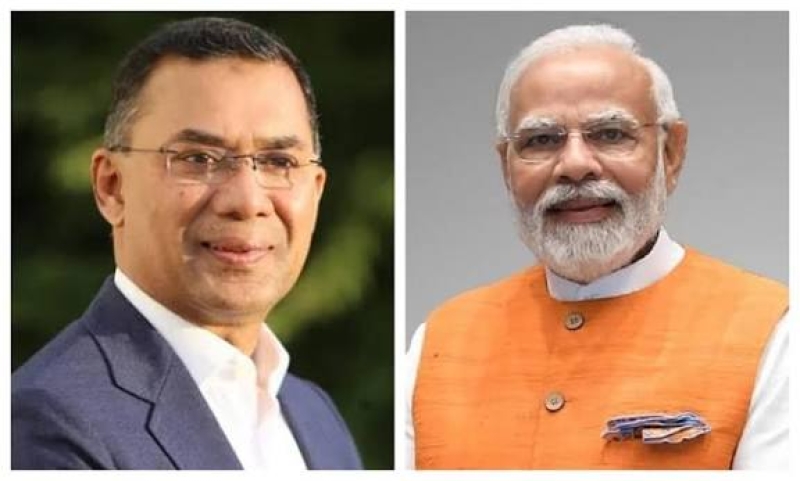
Prime Minister Tarique Rahman and Indian Prime Minister Narendra Modi are on a tough task of repairing strained relations.
By Imtiaz Ahmed and Samia Tabassum
Uncertainty looms over Bangladesh Prime Minister Tarique Rahman’s proposed visit to India as Dhaka has urged New Delhi to develop a conducive environment with some terms and conditions.
Bangladesh-India multilateral relations reached a historic low during one and half a years’ tenure of the last interim government, headed by Nobel laureate Professor Muhammad Yunus. Efforts are now on to inch the relations forward.
Indian Prime Minister Narendra Modi formally invited Bangladesh Prime Minister Tarique Rahman to visit India at a mutually convenient time after the February polls.
The Indian Prime Minister has also invited the Bangladesh Prime Minister to attend the 18th BRICS Summit scheduled to be held in New Delhi on September 12-13 as a special guest, said State Minister for Foreign Affairs Shama Obaed Islam.
BRICS comprises Brazil, China, Egypt, Ethiopia, India, Indonesia, Iran, Russia, Saudi Arabia, South Africa and the United Arab Emirates, while its partner countries include Belarus, Bolivia, Cuba, Kazakhstan, Malaysia, Nigeria, Thailand, Uganda, Uzbekistan and Vietnam.
India on August 4, 2026, said it has extended an invitation to Bangladesh Prime Minister Tarique Rahman to attend the outreach session of the upcoming BRICS summit in his capacity as the current chair of the BIMSTEC grouping.
India is hosting the annual BRICS summit in New Delhi. The summit is expected to deliberate extensively on a number of pressing global challenges, including the economic consequences of the West Asia crisis.
Both Dhaka and New Delhi have expressed desire to rebuild and regroup the relations based on mutual trust, respect and dignity after the Bangladesh Nationalist Party (BNP) swept a two-thirds majority in the parliament election held on February 12,2026.
The relations between Dhaka and New Delhi that suffered heavily through the ungracious departure of former Prime Minister Sheikh Hasina on 5 August 2024 is most likely to get an impetus through the maiden visit of Bangladesh Prime Minister Tarique Rahman to India in September, diplomatic sources in Dhaka, New Delhi, Kolkata and Mumbai said.
Former chairman of the Bangladesh National Board of Revenue Badiur Rahman now taking part in TV talkshows has said that Prime Minister Tarique Rahman’s visit to India will help normalize and stabilise multilateral relations between two neighbouring countries.
Former Bangladesh Ambassador to Poland Mahfuzur Rahman has expressed the views that Prime Minister Tarique Rahman should visit India to repair and improve the relations that suffered damage as Sheikh Hasina regime fell through the political change of August two years ago.
Former Bangladesh Ambassador to USA Humayun Kabir said the visit of Prime Minister Tarique Rahman to India seems uncertain in the present conditions.
However, in spite of political tension over Prime Minister Tarique Rahman’s proposed visit to India, economic relations between the two countries remain strong compared to the ties with the rest of the countries of the world.
The economic engagement with India is hovering around 25-30 billion US dollars considering the bilateral trade, spending by Bangladeshi tourists, patients and several thousand Bangladeshi students pursuing education, said Bangladesh diplomats in Kolkata, New Delhi and Mumbai.
Bangladesh Bank, National Board of Revenue and the Bangladesh Bureau of Statistics don’t have the capacity and necessary resources on the estimation of expenses by Bangladeshi tourists, patients and students. The expense is likely 10-15 billion US dollars, said a number of bankers and economists.
Besides, thousands of Indians working in Bangladesh send home 3—4 billion US dollars every year as trained, experienced, skilled Indians, Sri Lankan, Chinese and Filipinos are working in the service sectors of Bangladesh, reliable sources said
The Indian policymakers should come to the reality, engage with the mainstream society of Bangladesh and work on reaching Dhaka-New Delhi relations to a new height, said diplomats, policymakers, business leaders and civil society members.
India has strong trade relations with Bangladesh, which is among its top 10 export destinations. In the last financial year, it sold goods including textiles, tea, coffee, auto parts, electricity, agriculture, iron, steel and plastics worth $11.1bn and imported readymade garments, leather and leather products, among other items, for $1.8bn.
Bangladesh is hugely dependent on India for raw cotton to supply its $47bn (exports) garment industry and Indian traders have said they expect to help meet their export targets.
Indian policymakers and business leaders should not be worried about the political change in Bangladesh and should remain engaged with Bangladesh positively to help flourish economic relations, business leaders expressed this view while talking to this correspondent.
However, leaders of the Federation of Bangladesh Chambers and Commerce and Industry (FBCCI), Metropolitan Chamber of Commerce and Industry (MCCI), Dhaka Chamber of Commerce and Industry (DCCI), Bangladesh Knitwear Manufacturers and Exporters Association and Bangladesh Garment Manufacturers and Exporters Association said India, China, the USA and EU countries are important trading partners of Bangladesh.
While talking to this correspondent, a leader of the BGMEA said that Bangladesh imports Indian cotton, fabrics and raw materials, produces garments and exports to the USA, Canada, Australia, Japan, UK and EU countries.
The economic engagement between Bangladesh and China are hovering at 17-18 billion US dollars and the Bangladesh–USA economic relations are hovering around 10-11 billion dollars, according to Bangladesh Bank (BB), Bangladesh Bureau of Statistics (BBS) and National Board of Revenue (NBR)
The Indian high commission in Bangladesh before Covid-19 used to issue 8,000-10,000 visas to Bangladeshis per day. The political change in Bangladesh in August, 2024 prompted the Indian government to cut tourist visas to Bangladeshis during the later part of 2024 and 2025. Bangladeshis usually retained top position in terms of tourist arrivals in India, followed by the USA, the UK, Canada and Australia.
India recorded approximately 4.34 million foreign tourist arrivals (FTAs) during the first half of January to June 2026, reflecting a 3.6% growth compared to the same period in 2025.
Data from the Ministry of Tourism indicated that the U.S. maintained a leading share of roughly 18% to 19.5% of total monthly foreign arrivals, driven heavily by leisure travel, cultural circuits, and the Indian-American diaspora.
Between January and June 2026, general tourist travel from Bangladesh to India was heavily restricted because regular tourist visas remained suspended following political changes in August 2024. General leisure tourism was paused during this six-month window, with issuance largely limited to urgent medical and select essential travel until India officially announced the resumption of regular tourist visas starting on June 28, 2026.
Meanwhile, Bangladesh on Sunday said a conducive environment needs to be created before Prime Minister Tarique Rahman’s proposed visit to India, linking it to Dhaka’s pending extradition requests to New Delhi.
“We are of the view that a propitious environment needs to be created for the visit,” Foreign Ministry Spokesperson and Additional Foreign Secretary A.K.M. Shahidul Karim told reporters at the foreign ministry here.
Karim said officials of Bangladesh and India had remained engaged over the possibility of the Prime Minister’s bilateral visit to India.
“Officials of Bangladesh and India have been in touch with each other over several weeks on the possibility of a bilateral visit by Hon'ble Prime Minister Mr. Tarique Rahman to India,” he said.
“However, this process was vitiated by the open press interaction in New Delhi on 5th August by Sheikh Hasina who has been convicted by the International Crimes Tribunal for committing crimes against humanity. We have made our position clear on this matter,” he added.
“To this end, we have requested the Indian authorities to expeditiously act on our request to extradite Sheikh Hasina and other fugitive criminals, and to hand over to Bangladesh the accused killers of Shaheed Sharif Osman Hadi in compliance with our bilateral extradition treaty. We are awaiting their response,” he said.
The spokesperson reiterated that Bangladesh would continue pursuing its “Bangladesh First” foreign policy while maintaining friendly relations with other countries, including its neighbours.
“We reiterate that we will continue to pursue our "Bangladesh First" policy to promote friendly bilateral relations with other countries, including our neighbours, on the basis of sovereign equality, national dignity, non-interference in each other's internal affairs and mutual benefit,” he said.