

- CCEA approves 3 key proposals on fertiliser, power |
- Cybersecurity more important than “Sindhuk”: Swapan |
- Mbappe fires France into World Cup last 16, Norway advance |
- JS passes Tk 9.38 lakh crore budget for FY27 |
- Court ruling blocks Aslam Chowdhury’s MP oath |
Dhaka urges Asia-Pacific cooperation to build climate-resilient green economy
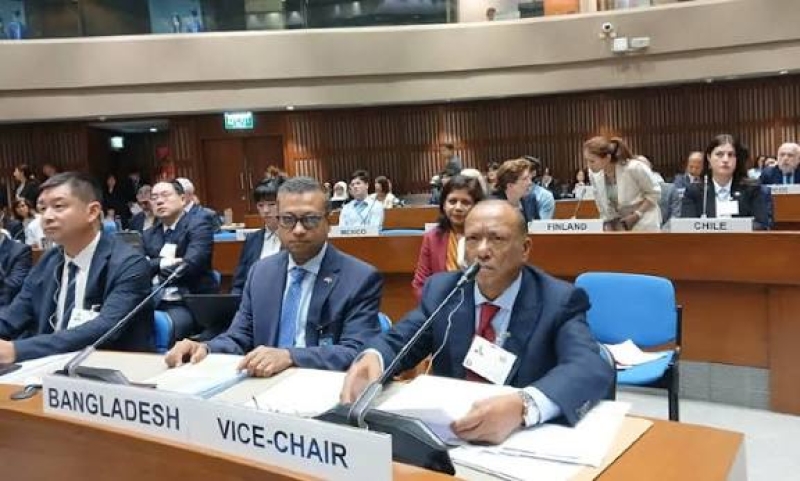
Environment, Forest and Climate Change Minister Abdul Awal Mintoo has called for coordinated and robust regional cooperation among Asia-Pacific member states to build a climate-resilient green economy for present and future generations and to promote an eco-friendly sustainable bioeconomy.
He made this call today during his Ministerial Roundtable Intervention at the 9th Session of the Committee on Environment and Development, organized by the United Nations Economic and Social Commission for Asia and the Pacific (UNESCAP) in Bangkok, Thailand, according to a message received here.
In response to a query from UNESCAP Deputy Executive Secretary Lin Yang during the session, the Bangladesh minister highlighted Bangladesh’s practical experiences and outlined national and regional action plans in this regard.
In his speech, he noted that the global bio-economy market has currently reached approximately US$ 4 trillion and is projected to rise to US$ 7.7 trillion by 2030.
However, he emphasised that this economic potential must be eco-friendly and inclusive to ensure the actual well-being of farmers, fishers, women, and marginal communities vulnerable to climate change.
The minister added, "Recent World Bank findings reported by Reuters showed that rising heat cost Bangladesh up to US$ 1.78 billion in 2024 and caused around 25 million workdays to be lost. Therefore, we cannot treat climate action and economic development separately. A sustainable bio-economy can connect both."
Another discussion jointly organised by the Government of Bangladesh, ESCAP, FAO, ADPC, and UNEP at the United Nations Conference Centre (UNCC) in Bangkok, Abdul Awal Mintoo stated that Bangladesh's golden fiber, jute, is transitioning from traditional sacks into high-value diversified green products.
He highlighted that Bangladesh has set a successful example by manufacturing the eco-friendly 'Sonali Bag' as an alternative to plastic.
He also highlighted the country's unique experience in delivering renewable electricity to around 18 million people in remote coastal areas by installing over 4.13 million Solar Home Systems, alongside implementing biogas and improved cook stove programs to mitigate rural energy crises and manage waste.
The minister also emphasised the importance of the blue bio-economy and mangrove afforestation in protecting coastal population from natural disasters and preserving the biodiversity of the Sundarbans, the world's largest contiguous mangrove forest recognised by UNESCO.
In this context, he stated that under the visionary leadership of Prime Minister of Bangladesh Tarique Rahman, and as part of the current government's electoral pledges and policy priorities, crucial initiatives are in full swing, reports BSS.
These include planting 250 million trees nationwide over the next 5 years, creating green jobs, generating power from waste, and developing integrated waste management through the 3R (Reduce, Reuse, Recycle) approach and the Circular Future Model, he said.