

- 11-Party Alliance Begins Dhaka-Rangpur Long March |
- Iran claims it hit an oil tanker in the Strait of Hormuz |
- Dhaka Air Quality Unhealthy for Sensitive Groups Saturday |
- Trump signs bill extending Iran sanctions to 2031 |
- Bangladesh officially enters global nuclear energy community |
High Court Disposes of More Writ Cases Than Filed
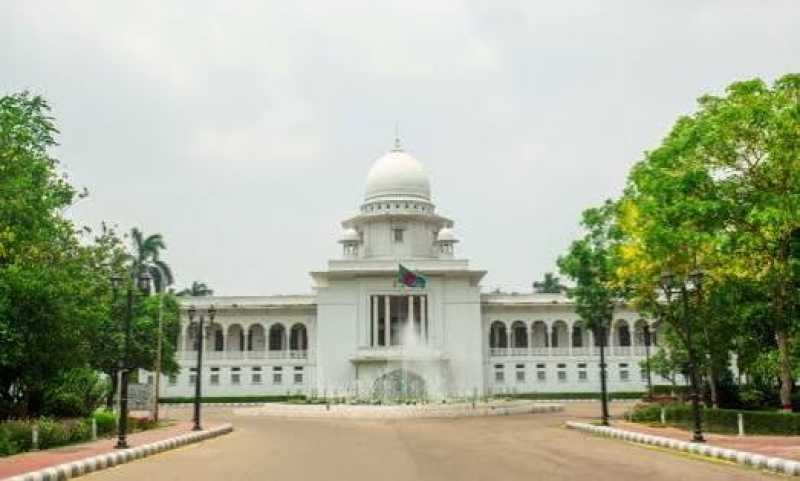
The disposal of writ petitions in the High Court Division of the Supreme Court has increased significantly this year compared with the number of new cases filed, according to the latest figures.
Attorney General Barrister Md Ruhul Quddus Kajal said the backlog could be reduced further if judicial discipline was strengthened and writ petitions involving purely personal interests or private disputes were discouraged.
He said Chief Justice has been working to bring greater discipline to the courts since assuming office.
“If judicial discipline can be ensured, the number of writ petitions will come down. In my view, when there is discipline in the courts, people can truly receive justice,” he said.
According to the latest figures provided by Supreme Court Public Relations Officer Shafiqul Islam, there were 127,960 writ petitions pending before the High Court at the beginning of 2026.
Between January 1 and March 31, 4,112 new writ petitions were filed, while 2,213 were disposed of during the same period.
From April 1 to June 30, another 4,729 writ petitions were filed, while 9,590 were disposed of. Thus, during the second quarter, the number of cases disposed of was more than double the number of new petitions filed.
By the end of June, the number of pending writ petitions had fallen to 124,999.
Speaking about the large backlog, the attorney general said some petitions were being filed in the name of public interest litigation (PIL) even when they primarily involved personal interests.
“In many cases, writ petitions are filed in the name of public interest litigation for personal interests, with self-promotion being the main objective,” he said, adding that some petitioners approach the media immediately after filing a writ, which he described as undesirable.
He also referred to Article 111 of the Constitution, under which the law declared by the Appellate Division is binding on the High Court Division. The Supreme Court has similarly stated that the law declared by the Appellate Division is binding on the High Court Division.
Kajal said legal principles have already been established through numerous Appellate Division judgments regarding which matters can and cannot be entertained through writ petitions.
He cited petitions against private banks as an example, saying that despite Supreme Court judgments on the issue, writ petitions against private banks are sometimes entertained by High Court benches, creating what he described as “judicial disorder.”
He said greater adherence to established judicial principles could help reduce the number of writ cases.
The attorney general also pointed to the filing of writ petitions over private disputes involving land possession, boundaries and disputes over water bodies.
“Private disputes should not ordinarily be brought directly to the High Court through writ petitions. The law provides for seeking remedies before the lower courts in such matters. But some people are bypassing the established process and coming directly to the High Court, increasing the number of writ cases,” he said.
Under Article 102 of the Constitution, the High Court Division has the power to issue directions and orders in specified circumstances, including for the enforcement of fundamental rights.
The five traditional writ remedies are habeas corpus, mandamus, certiorari, prohibition and quo warranto.
A writ of habeas corpus may be sought when a person is allegedly detained unlawfully, while mandamus can require a public authority to perform a legal duty. Certiorari may be used to challenge certain unlawful decisions or proceedings of lower courts or tribunals, while prohibition can prevent a lower court or tribunal from acting beyond its jurisdiction. Quo warranto challenges a person's legal authority to hold a public office.
The legal foundation for public interest litigation in Bangladesh developed significantly through the landmark case of Dr Mohiuddin Farooque v Bangladesh. The case helped establish that a person or organisation could seek judicial remedies over matters affecting the public interest even without being directly and personally affected.
Over the decades, public interest writ petitions have played a significant role in addressing a wide range of issues. High Court judgments arising from such petitions have contributed to the recognition of rivers as legal or “living entities”, action against encroachment on rivers, closure of illegal brick kilns and efforts to prevent hill cutting.
Writ petitions have also been used in matters concerning public health, food safety, compensation for families of accident victims, and protection of the constitutional rights of women, children and marginalised groups.
In some cases, a judgment or order resulting from a writ petition filed by an individual has benefited thousands of people across the country.