

- PM Welcomes Visa Investment in Bangladesh’s Digital Economy |
- PM Tarique inaugurates three pilot SDG villages |
- Indian High Commissioner Trivedi meets PM Tarique |
- SSC, Equivalent Exam Results Published, Pass Rate 62.25% |
- Global Oil Prices Rise Again Amid Hormuz Uncertainty |
Mojtaba Khamenei’s Rise Signals Hardliners Will Stay in Power
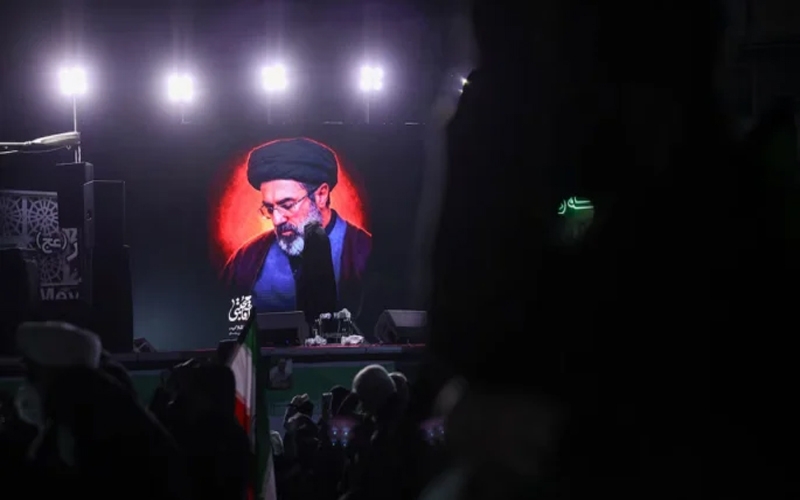
Iran has appointed Mojtaba Khamenei as supreme leader, succeeding his father, signaling that hardliners remain firmly in control and closing the possibility of a swift end to the Middle East war.
The move has intensified fears of prolonged disruption to global energy supplies, sending oil prices sharply higher and causing global stock markets to fall.
Khamenei, 56, a Shi’ite cleric with strong ties to security forces and their business networks, has been rejected by U.S. President Donald Trump, who has demanded Iran’s unconditional surrender.
Despite U.S. warnings, Tehran remains defiant. Ankara reported that NATO air defences had shot down a ballistic missile fired from Iran that entered Turkish airspace, the second such incident during the conflict.
Iranian state media showed large crowds in multiple cities supporting the new leader, waving flags and portraits of his late father, Ali Khamenei, who was killed on the first day of the war. In Isfahan, explosions from apparent airstrikes were reported near the historic Imam Square as loyalists chanted in support of the Khamenei family.
Political institutions and military councils pledged loyalty to the new leader. A defence council statement declared, “We will obey the commander-in-chief until the last drop of our blood.”
Iranians are divided over the appointment. Supporters see it as defiance against external pressures, while critics fear it reduces hopes for change. “His selection ensures the system continues despite foreign threats,” said student Zahra Mirbagheri from Tehran.
Many Iranians had celebrated the elder Khamenei’s death, but anti-government protests have remained muted due to the ongoing conflict and security concerns.
Israel has stated its aim is to overthrow Iran’s clerical regime, while Trump initially focused on Iran’s missile and nuclear capabilities. Both have warned they will act against any successor unless Iran alters its hostile policies.
The war has effectively closed the Strait of Hormuz, through which a fifth of global oil and seaborne liquefied gas passes. Tankers have been unable to sail for over a week, forcing producers to halt pumping due to full storage.
Brent crude futures rose nearly 12.5% to $104.44 per barrel, earlier spiking to $119.50. The threat of a prolonged energy crisis has sent Asian and European share markets sharply lower.
Trump posted on Truth Social, describing short-term oil price rises as a “small price to pay for USA, World Safety and Peace.”
Tehran suffered heavy damage after an oil refinery strike, while attacks extended to Bahrain, forcing the state oil company Bapco to declare force majeure. Iran has not yet commented on the missile incident in Turkish airspace.
Israel’s military launched strikes in central Iran and Beirut, responding to attacks from Iran-backed Hezbollah. U.S.-Israeli operations have killed at least 1,332 Iranian civilians and wounded thousands, while Lebanon has also reported significant casualties. In Israel, one man was killed by shrapnel near Tel Aviv’s airport, bringing the local toll from Iranian strikes to 11.