

- Uncertainty over possible US-Iran talks as Trump extends ceasefire |
- Bangladesh eyes broader bilateral engagements with African nations |
- Trump Extends Iran Ceasefire, Seeks Time for Talks |
- SSC and Equivalent Exams Begin Nationwide |
- US, Iran Signal War Readiness as Talks Hang in Balance |
Guterres Warns of ‘Wider War’ as Middle East Crisis Deepens
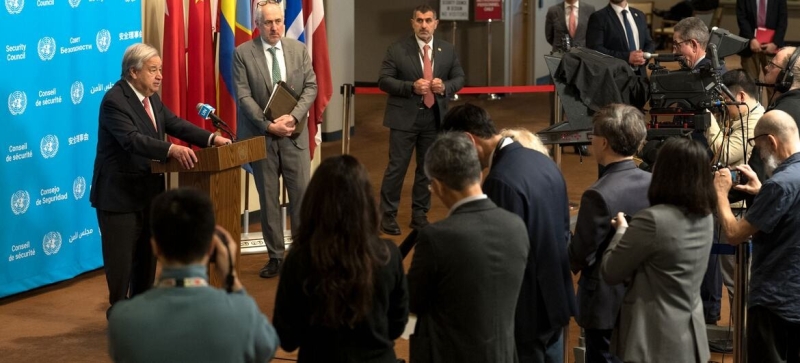
Secretary-General António Guterres speaks to the press on the continuation of the US-Israel-Iran conflict and its impact on the Middle East.
The Middle East crisis has entered its second month, prompting UN Secretary-General António Guterres to issue a stark warning on Thursday that the world is “on the edge of a wider war” with potentially catastrophic global consequences.
Speaking to the press outside the Security Council in New York, Guterres painted a grim picture of the rapidly deteriorating situation. He noted that Israel and the US continue to bomb Iran, while Tehran attacks neighbouring Gulf States and threatens ships it deems hostile in the crucial Strait of Hormuz.
“Every day this war continues, human suffering grows. The scale of devastation grows. Indiscriminate attacks grow,” Guterres said, highlighting the mounting threats to civilians, infrastructure, and the global economy, especially for societies dependent on energy imports.
Risk of global conflict
He emphasised that the crisis’s impacts are no longer confined to the region, pointing to severe disruptions in international shipping. “When the Strait of Hormuz is strangled, the world's poorest and most vulnerable cannot breathe,” he warned. He added that rising food and energy costs are already affecting people from the Philippines to Sri Lanka to Mozambique.
Diplomatic efforts
To prevent escalation, Guterres announced he is sending his Personal Envoy, Jean Arnault, to support ongoing peace initiatives. “The spiral of death and destruction must stop,” he said, urging leaders to allow diplomacy to succeed.
Guterres stressed that any resolution must adhere to international law and the UN Charter, calling for peaceful dispute resolution, respect for sovereignty, and protection of civilians and nuclear installations.
Message to the combatants
Directly addressing the US, Israel, and Iran, he declared: “To the United States and Israel, it is high time to stop the war causing immense human suffering and economic damage.” He added that Iran must cease attacks on its neighbours.
Reaffirming the Security Council’s condemnation of attacks and the importance of navigational rights in key maritime routes, Guterres reminded leaders that ending the crisis remains in their hands. “Conflicts do not end on their own. They end when leaders choose dialogue over destruction. That choice still exists—and it must be made now.”
Gulf States respond
Assistant Secretary-General Khaled Khiari told the Council the Middle East is “at a dangerous precipice,” stressing the need for closer UN-Arab State cooperation. Jassim Albudaiwi, Secretary-General of the Gulf Cooperation Council, condemned Iranian attacks on civilian infrastructure, saying the GCC seeks peace, security, and stability, not war.
Humanitarian crisis in Syria and Lebanon
Meanwhile, UN aid chief Tom Fletcher highlighted the immense needs in Syria, where some 180,000 nationals and 25,000 Lebanese have returned since the war began. Fletcher reported that families are fleeing with “virtually nothing” and stressed that UN teams are working to rebuild markets, restore services, and support those displaced. In Lebanon, over one million people have been uprooted amid ongoing Israeli-Hezbollah clashes, leaving critical infrastructure “shattered” and lives “upended.”