

- Measles Outbreak Claims 17 Lives in Single Day |
- Trump says US holding ‘very positive discussions’ with Iran over war |
- Dhaka ranks 4th among the world’s most polluted cities Monday |
- Cabinet approves tax relief for brand new electric vehicle imports |
- Energy prices surge to highest in 4 years as conflict spreads |
Deep hole in the heart of Bangladesh Press and media
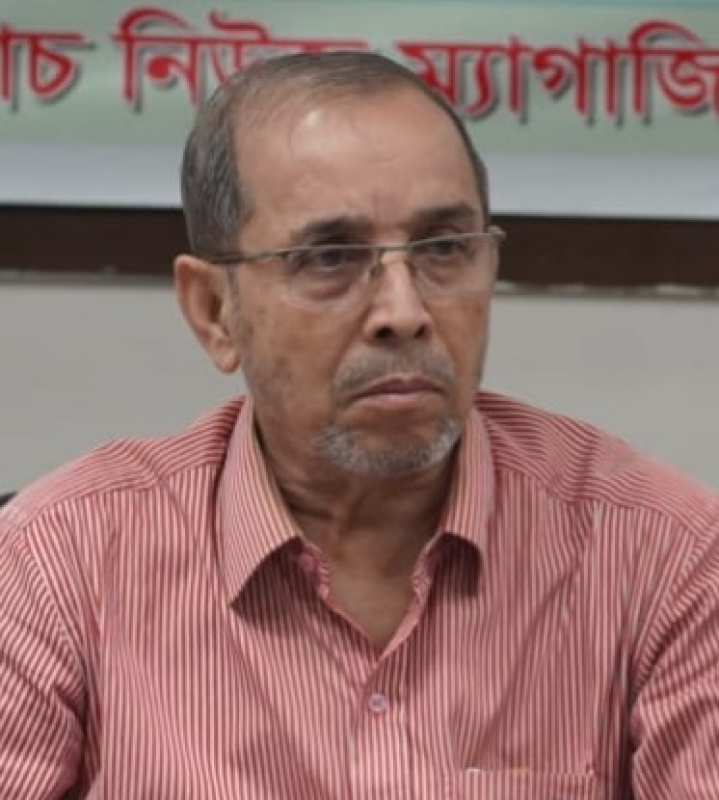
Mostafa Kamal Majumder
Mostafa Kamal Majumder
Bangladesh's sliding in Press Freedom Index by three points of the Reporters Sans Frontiers (RSF) 3 days before the World Press Freedom Day on Sunday 3 May had mixed reactions among the people.
RSF index for 2026 places Bangladesh in 152nd position from 149 in 2025 out of 180 countries. It is based on the press freedom situation recorded in 2025.
The average score for all countries and territories worldwide has never been so low. For the first time in the Index’s 25-year history, more than half the world’s countries now fall into the “difficult” or “very serious” categories for press freedom.
Freedom of the press around the world has fallen to its lowest level in a quarter of a century, according to the leading Paris-based press NGO - RSF.
Every year, RSF publishes a World Press Freedom Index used to compare the level of freedom enjoyed by journalists and media outlets. Its ranking uses a five-point scale to assess a country’s level of press freedom, ranging from “very serious” to “good”.
Out of the five indicators used to assess press freedom worldwide — which determine the economic, legal, security, political and social environments for journalism — the legal indicator has seen the sharpest decline this year.
The United States has fallen seven places and other countries in the Americas, such as Ecuador and Peru, have plummeted in the ranking.
Norway holds the top spot for the tenth consecutive year, while Eritrea comes in last for the third year in a row.
Post-Assad Syria has seen the biggest improvement in press freedom of all the countries and territories in the 2026 Index, climbing 36 places in the ranking.
For the first time since RSF started producing the index in 2002, more than half of the world’s countries fall into the “difficult” or “very serious” categories for press freedom – “a clear sign that journalism is increasingly criminalised worldwide”.
Only seven mostly Nordic countries are ranked with “good” press freedom, with Norway, the Netherlands and Estonia in the top three. France ranks 25th with a “satisfactory” score, while the United States ranks 64th with a “problematic” score, falling seven places since President Donald Trump took office.
RSF reports that Trump “has turned his repeated attacks on the press and journalists into a systematic policy”, citing the detention of Salvadoran journalist Mario Guevara, who was later deported, while he was documenting a protest against immigration raids, as well as the suspension of several notable public media institutions.
In Bangladesh, it has been for little over two months that a new government is in charge following the 12 February elections after the mass upsurge of July 2024, and visibly newspapers, news agencies and the media hardly face governmental barriers that existed before in the collection and disseminaion of news.
It is sad that some journalists are now behind the bars for their alleged complicity with the of last autocratic regime. Actions against them were taken primarily because the students who spearheaded July 2024 movement wanted them to face justice and demanded actions against them from organisations journalists as well as the government.
Students leaders made lists of such journalists based on their activities that were recorded in black and white or videos aired by television channels of appeasing government leaders even when students and masses were being killed on the street by the police as well as student and youth associates of the then ruling party - the Awami League.
After the changeover of 5 August 2024 some journalists who were dismissed or were without jobs because of banning of their newspapers or media during the AL regime have got back their jobs or taken charge of some media houses.This has not by and large deterred the flow of news, but gaps remain.
Meanwhile, journos have been urged to self-regulate their work to restore public trust in the media which should function within a supportive environment created by government organisations whose functions would be to extend legal recognisation and facilitate the running of media that conform to ethical standards.
They cautioned against some people who set up media houses to secure their personal or business interests instead of serving the community, and wanted media to function under guidelines to be set by an Independent Media Commission.
However, an important point that has been missing in the discussion on press freedom in Bangladesh is the pitiable pecuniary situation that compels many journalists to compromoise their freedom. A survey will reveal that out of about 1,500 daily newspapers, television centres and radio stations now functioning in Bangladesh only about two dozen are financially stable and pay adequate remunerations to journalists at the end of the month.
How the other press and media outlets function can be the subject of an independent research to suggest remedial measures. It is said that a democratic and corruption-free society cannot be established without a free press and media. On the other hand an independent and free press and media is impossible without a solid economic fundation.
The Minister for Information and Broadcasting Zahir Uddin Swapan has urged the media to prioritise community service over profit. He has hinted at a move to form an independent media commission for a healthy growth of the media. This alone is not enough for the growth an development of the Press and Media. The government should romove the barriers, created by autocratic rulers of the past, to economic growth and sustenence of the Press and Media.
A sustainable model is there in the Nordic countries which are famous not only for their democratic traditions but also their media enabling environments. In Sweden, for instance, profitable news organisations function without any let or hindrance. On the other hand standard, committed and reliable but financially weak newspapers are given support by local authorities. To start with, the government may undo the barriers to the growth of press and media and prevent non-qualified people from owning newspapers or media.
(The writer is a former editor of The New Nation currently editing GreenWatch newsmagazine and GreenWatch Dhaka online daily.)