

- Garment Workers’ Protest Shuts Five Metro Rail Stations |
- Govt Forms Six-Member Wage Board for Garment Workers |
- Dhaka ranks 4th among world's most polluted cities this morning |
- Dhaka Launches Company-Operated Buses on Six Routes Today |
- FBI Blames North Korea for Record $6.3bn Binance Hack |
Upstream Water Diversion, Climate Change Turning BD Coastal Hubs into 'Dead Cities'
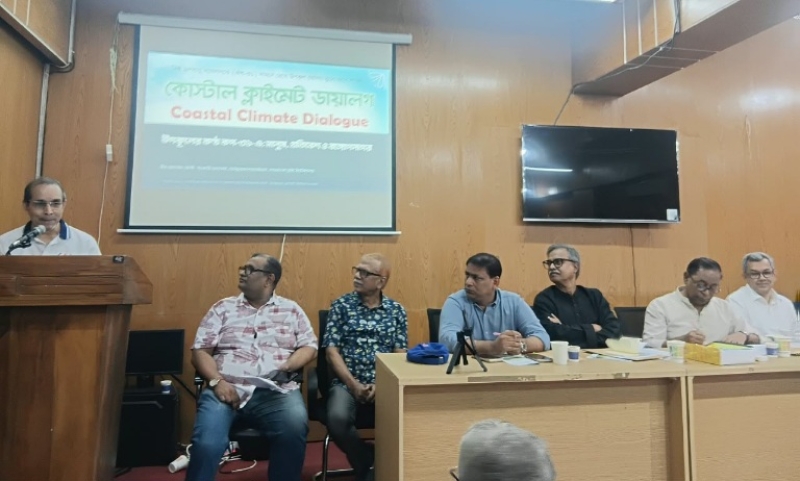
Mostafa Kamal Majumder, editor, GreenWatch addressing a coastal climate dialogue organised at SAU by the Climate Action Forum on Sunday 1 Nov 2026.
DHAKA, Nov 1 – Speakers at a dialogue today stressed that the crisis in Bangladesh's coastal region cannot be resolved without addressing its root cause: the drastic reduction of upstream freshwater flows that has allowed sea salinity to aggressively advance inland.
The Coastal Climate Dialogue, organized by the Climate Action Forum, was held today at the M Mahbubuzzaman Academic Building of Sher-e-Bangla Agricultural University (SAU). The event brought together academics, political leaders, and environmental activists to deliberate on the escalating ecological and humanitarian crises in the country's coastal belt.
Inaugurating the event as the chief guest, SAU Vice-Chancellor Professor Abdul Latif highlighted that proper rehabilitation of the coastal region could significantly boost agricultural output and fortify national food security. Presenting the keynote paper, Mir Mohammad Ali, Assistant Professor at SAU's Department of Aquaculture, underscored a critical gap in current efforts, calling for immediate and robust research to map out the actual "state of life" and everyday realities of coastal communities.
Delivering a sharp analysis at the dialogue, GreenWatch Editor Mostafa Kamal Majumder asserted that studies on food, water, and health in coastal areas will remain futile without addressing unsustainable upstream water diversion across the border. He explained that rivers are running dry because of this diversion, eliminating the natural freshwater barrier that has pushed back marine salinity for millennia.
While describing Bangladesh’s plan to construct a barrage on the Ganges as a necessary defensive measure to revive its distributaries, Majumder emphasized that the ultimate solution lies in the sustainable management of shared rivers in accordance with international laws, conventions, and protocols.
The dialogue also served as a platform for intense political reflection. Bazlur Rashid Firoz, General Secretary of the Socialist Party of Bangladesh (SPB), criticized the current administration’s lack of distinct policy differentiation from the ousted Hasina government. He noted that past regimes prioritized symbolic projects, like model mosques, over critical public infrastructure like hospitals and schools, urging the current authorities to fix national priorities.
Representing the Bangladesh Nationalist Party (BNP), Anisur Rahman Talukdar Khokan MP lamented the ecological legacy being left for future generations. Khokan warned that the current generation is acting selfishly by destroying canals and rivers instead of leaving a livable environment. He pointed out that environmental degradation is already causing severe health issues, including kidney diseases, in small children. Khokan highlighted the BNP's 31-point structural outline, which features strict environmental provisions, committing that a future BNP government would launch extensive canal-digging and tree-plantation programs, establish 1,000-bed children's hospitals in every division, prosecute environmental polluters, and heavily support frontline climate fighters.
Saiful Huq urged the government to take immediate preparatory steps for climate adaptation and mitigation, citing recent ecological disasters in Nepal as an eye-opener. He proposed establishing a dedicated Coastal Board to centralize governance, mandating public hearings for mega-infrastructure projects like the proposed Padma Barrage, and forcing local government candidates to sign binding commitments toward coastal climate action. Huq also noted grimly that major economic hubs like Khulna have effectively become "dead cities" due to environmental neglect.
The dialogue was presided over by Aminur Rasul, President of the Climate Action Network, and conducted by Nikhil Chandra Bhadra, Coordinator of the Sundarban and Upokul Surakha Andolan. A wide array of civil society representatives also addressed the event, including Shah Israt Ajmeri (Chairman, Children Watch Foundation), Md Shamsuddoha (CEO, Center for Participatory Research and Development), Mihir Biswas (Chairman, CDP), Faisal Ahmed (Editor, River Bangla), and Humayun Kabir Suman (Coordinator, Greenvoice). Senior journalists including Rafiqul Islam Azad, Kamal Parvez, and Kefayet Sakil (Secretary, Marine Journalist Network) also shared their insights. The consensus of the dialogue remained clear: saving Bangladesh's coast requires shifting away from superficial adjustments and moving toward aggressive water diplomacy, domestic river restoration, and direct support for vulnerable coastal populations. – GreenWatch Desk