

- PM Inaugurates July Mass Uprising Memorial Museum |
- Bangladesh Observes July Mass Uprising Day Today |
- BGMEA, OCAIB move to attract Chinese investment in RMG sector |
- BSTI finds dangerously high mercury levels in 8 skin creams |
- JCD, Shibir Clashes Spread Across Dhaka Campuses |
Media Urged to Push Policies for Climate Migrants
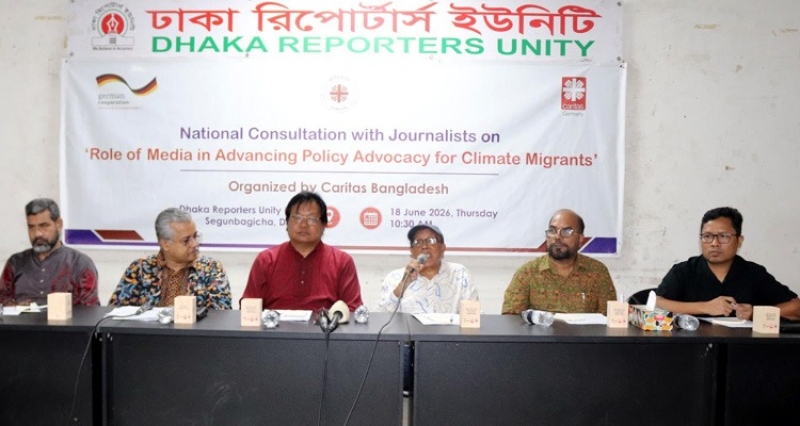
Speakers at a consultation with journalists on Thursday called for stronger media engagement in shaping policies for climate-displaced people, saying Bangladesh needs coordinated action to protect millions forced from their homes by climate change and ensure their access to basic rights and public services.
The national-level consultation, organised by Caritas Bangladesh at the Dhaka Reporters Unity (DRU) auditorium, brought together journalists from leading print and electronic media outlets to discuss the role of the media in advancing policies for climate migrants and raising awareness of their growing challenges.
Addressing the meeting, Caritas Bangladesh Director Theophil Nokrek welcomed participants and outlined the organisation’s work to reduce risks and improve the livelihoods of disaster-affected, vulnerable and marginalised communities, including those displaced by climate change. The session was moderated by Dr Jamil Ahmed, while Alexander Tripura, Head of the Disaster Management Department of Caritas Bangladesh, delivered the closing remarks.
Prominent journalist and Editor of Charcha.com Sohrab Hassan said the crisis of climate-induced displacement is becoming increasingly complex and often remains invisible despite its expanding impact.
He suggested that the government consider establishing a separate ministry dedicated to climate displacement and urged authorities to reduce waste in public development projects so that more resources could be directed towards climate adaptation.
“Nobody leaves their ancestral home willingly,” Hassan said, noting that many climate migrants who move to cities continue to have their permanent addresses registered in their native villages. As a result, they are often excluded from urban social protection programmes and face barriers to housing, healthcare, education and other essential services.
He stressed that the state has a responsibility to safeguard the fundamental rights of climate-displaced people through effective policies and better coordination between government agencies and non-governmental organisations.
Former President of the Dhaka Reporters Unity Rafiqul Islam Azad described climate-displaced people as “climate warriors”, highlighting the daily struggles of communities in Bangladesh’s coastal regions that continue to battle cyclones, tidal surges, salinity and erosion while trying to sustain their livelihoods.
He proposed creating a dedicated network or forum of journalists to regularly report on climate migration issues and suggested introducing fellowship programmes for interested reporters to encourage more in-depth and sustained coverage.
Bangladesh Federal Union of Journalists Executive Member Shaheen Hasnat observed that while people can easily migrate to Dhaka, many cannot return to their villages because of the lack of employment opportunities. He also noted that declining foreign assistance, following Bangladesh’s classification as a lower middle-income country, has created new challenges in responding to climate-related disasters.
Alexander Tripura of Caritas Bangladesh said the country contributes only a small share of global carbon emissions but suffers disproportionately from the impacts of climate change. He emphasised the importance of ensuring that international climate finance and donor support are used effectively to strengthen resilience and support affected communities.
He argued that while infrastructure development remains important, Bangladesh must also prioritise addressing the broader and more complex challenges posed by climate change.
Journalist Dr Dipu Siddiqui pointed out that climate migration receives comparatively little attention in the media despite its growing significance. He said many journalists lack access to reliable information on government policies and planning related to climate-induced displacement, making comprehensive reporting more difficult.
Several journalists attending the consultation, including Zahida Parvin Chhanda, Al Amin Towhid, Zahid Al Amin, Latif Rana, Lokman Kabir and KM Ashraf Uddin, also shared their views on improving media coverage of climate migration and related policy issues.
Participants highlighted that climate change is driving increasing internal migration in Bangladesh, particularly from coastal districts affected by cyclones, tidal flooding, salinity intrusion and riverbank erosion. Many displaced families have moved to cities such as Dhaka, Khulna and Chattogram in search of safety and livelihoods, only to encounter new challenges including insecure housing, inadequate access to water, healthcare and education, and widespread social exclusion.
The consultation concluded that government policies need to become more integrated and responsive to these realities, with greater coordination among public agencies to ensure displaced populations can access services and social protection.
Speakers also encouraged media organisations to undertake more investigative reporting and policy analysis to support the development of comprehensive strategies for climate migrants.
Caritas Bangladesh shared details of its longstanding work in disaster risk reduction and climate resilience, stating that it has reached more than 47 million people through housing construction, sanitation improvements and community infrastructure projects. The organisation has also supported around 3,000 disaster management committees and trained approximately 14,000 community volunteers to strengthen local preparedness and response capacities.
In disaster-prone coastal and flood-affected areas, Caritas has helped establish 329 cyclone and flood shelters aimed at reducing risks for vulnerable populations.
The organisation also highlighted its ongoing work in Khulna and Satkhira districts under a project jointly funded by the German government’s BMZ and Caritas Germany to promote the dignified inclusion of climate migrants in urban areas.
Research cited during the meeting indicates that between 16 million and 26 million people in Bangladesh could be internally displaced by climate change between 2011 and 2050. A 2023 study by GIZ found that 57 percent of climate migrants settling in urban areas originated from the coastal district of Satkhira, underscoring the growing scale of climate-driven migration and the urgent need for effective policy responses.