

- 8 workers burnt in N’gan Akij Cement factory boiler blast |
- Ex-Shibir activist shot dead in Fatikchhari |
- Class X student brutally murdered in capital’s Banasree |
- 'Bodycams' to be used at risky polling centres: IGP Baharul |
- 7,359 people killed in road accidents in 2025: Road Safety Foundation |
US Tariffs Cut Bangladesh Garment Exports to America by 11%
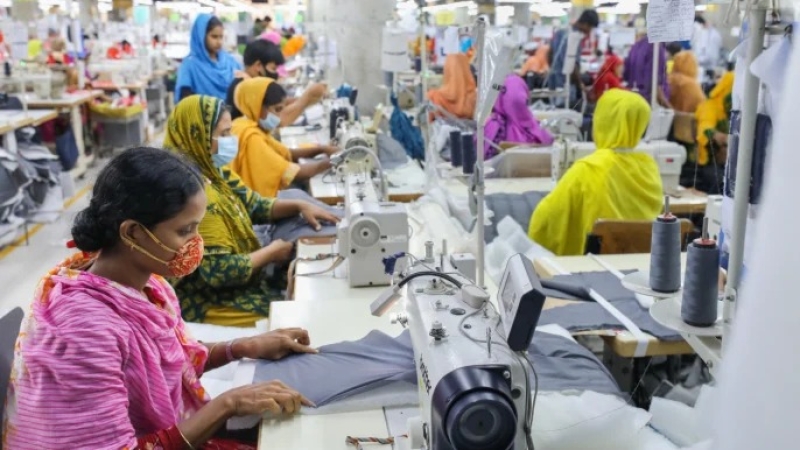
Representational Image of workers at an RMG factory.
Bangladesh’s ready-made garment (RMG) exports to the United States declined by nearly 11% year-on-year in October, as higher tariffs imposed by the Trump administration weakened consumer demand and disrupted purchasing patterns in the world’s largest apparel market.
The impact of the administration’s reciprocal tariff measures is being felt across most apparel-exporting countries, largely due to shrinking US consumption driven by rising import duties and higher retail prices.
Data from the Office of Textiles and Apparel (Otexa) shows the downturn was widespread, with apparel shipments to the US falling from almost all major exporting nations. Overall US apparel imports dropped by around 19% in October, reflecting subdued demand amid inflationary pressure.
Under the revised tariff structure introduced in August, Bangladeshi apparel products are now subject to an additional 20% duty, raising the total tariff burden to 36%. China and India face even steeper duties, resulting in sharper export declines. In October alone, US apparel imports from China plunged by 53%, while shipments from India fell by nearly 29%.
Shehab Udduza Chowdhury, vice-president of the Bangladesh Garment Manufacturers and Exporters Association (BGMEA), said higher tariffs have intensified inflation in the US apparel market. He noted that rising prices are forcing consumers to cut back on purchases, reducing overall demand.
He also pointed to frequent policy shifts under the Trump administration, which have increased uncertainty for US buyers and global brands. As a result, many buyers reduced inventories and avoided long-term commitments, while some rushed to place orders before the new tariffs took effect on 7 August, leading to a subsequent drop in shipments.
According to Otexa, US apparel imports showed growth from January to July but began declining after the tariffs were enforced in August. China, the largest supplier to the US market, has been the most affected by the policy shift.
Bangladeshi exporters, however, say the country has been relatively less affected than China and India, alongside Pakistan and Cambodia. Between January and October, total US apparel imports slipped by about 1% year-on-year to $66.63 billion.
Despite the recent slowdown, Bangladesh’s garment exports to the US still grew by more than 15% during the first ten months of the year, although this was lower than the nearly 22% growth recorded between January and July. In contrast, US apparel imports from China fell by 32% over the same period.