

- $7.3 Trillion Fuels Nature Destruction, Guterres Warns |
- Infantino apologizes for World Cup furore but critics unhappy |
- Teesta irrigation project: Water in canals inadequate to enter fields |
- Biodiversity Targets Lag as UN Warns of a War on Nature |
- 18 railway coaches made in India set to arrive this afternoon |
$7.3 Trillion Fuels Nature Destruction, Guterres Warns
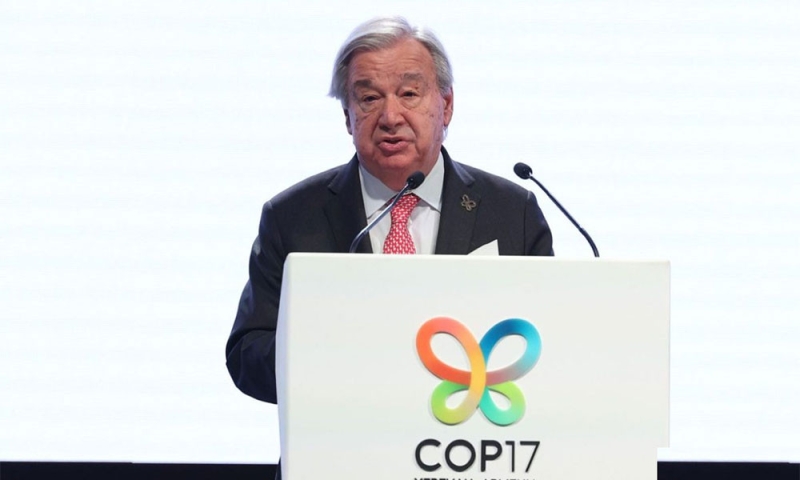
The world spends $30 on activities that destroy nature for every $1 invested in conservation, with an estimated $7.3 trillion flowing into nature-harming activities globally in 2023, UN Secretary-General António Guterres has warned.
Progress in halting biodiversity loss remains far too slow, he said while addressing the leaders’ summit at the 17th Conference of the Parties to the Convention on Biological Diversity (COP17) in Yerevan, Armenia, on Friday.
Thanking the Armenian government for hosting the conference, Guterres said biodiversity was the foundation of human life, providing food, water and clean air.
However, climate change, invasive alien species, overgrazing, overfishing and pollution are accelerating the destruction of nature and threatening the planet’s future.
More than one million species are now at risk of extinction, he said, warning that the world is moving towards a future in which human life could become increasingly difficult.
Guterres noted that the Kunming-Montreal Global Biodiversity Framework, adopted in 2022, had established a roadmap for protecting nature. However, much greater action was needed to achieve its targets.
With the world halfway through the period leading up to the 2030 targets, he said COP17 in Yerevan was an opportunity to demand accountability and assess whether countries were doing enough to fulfil their commitments.
According to the UN chief, nearly 90% of parties to the Convention on Biological Diversity have established national biodiversity targets, while more than half have developed national action plans to implement them.
Since 2022, an additional 1.3 million square kilometres of land and six million square kilometres of ocean have been formally designated as protected areas. However, progress remains uneven and insufficient.
Even if current national commitments are fully implemented, only 26% of terrestrial areas and 12% of marine areas are projected to be protected by 2030. The global target is to conserve at least 30% of both land and sea by that year.
Guterres also highlighted the funding gap in biodiversity conservation. The Global Biodiversity Framework aims to mobilise $200 billion annually, but actual financing remains well below the required level.
He called for stronger leadership in three areas: government action, financing and the participation of people across society.
On government action, he urged countries to work towards protecting 30% of land and sea by 2030. He also called for an end to policies that damage ecosystems, greater promotion of circular economies and sustainable agriculture, stronger environmental monitoring and transparency, and effective enforcement of existing laws.
Welcoming the Yerevan Declaration adopted at COP17, Guterres said it aimed to make the conference a turning point in efforts to protect the planet. He stressed the importance of integrating biodiversity conservation into government policies, budgets and regulations.
On financing, he warned that global financial flows continued to favour activities harmful to nature.
“For every dollar invested in protecting nature, $30 is spent destroying it,” he said, citing an estimated $7.3 trillion directed towards nature-harming activities in 2023.
He urged governments to end subsidies for activities that damage nature, including fossil fuels, and redirect public spending towards conservation and sustainable development.
To meet global targets on biodiversity conservation, climate action and land restoration, annual investment in nature-based solutions must rise to $571 billion by 2030, Guterres said.
He stressed that governments could not address the challenge alone and called on businesses to contribute to biodiversity conservation.
In this context, he highlighted the Cali Fund, which is intended to ensure that companies benefiting from genetic resources and their digital sequence information contribute to biodiversity conservation and its sustainable use.
Guterres also pointed to progress in renewable energy, noting that the costs of solar power and battery storage had fallen significantly while investment in clean energy was increasing.
However, developing countries continue to face heavy debt burdens, limited public resources and an unequal international financial system. These pressures force them to make difficult choices between protecting nature and meeting people’s immediate needs.
To address these challenges, he called for increased domestic and international development financing, greater investment by multilateral development banks and reforms to the international financial architecture. Such reforms, he said, should give developing countries a stronger voice in global decision-making.
The third priority he identified was participation across society, particularly by young people, civil society, women, Indigenous peoples and local communities.
Guterres said communities most affected by environmental degradation often possessed valuable knowledge and experience for protecting nature.
By placing Indigenous knowledge at the centre of biodiversity conservation, the world could draw on what he described as one of its most powerful forms of “AI”—ancestral intelligence, or knowledge passed down through generations.
Traditional practices and knowledge developed over thousands of years could help restore the relationship between people and nature, he added.
Reflecting on his time as UN secretary-general, Guterres emphasised the need to protect the planet for future generations. Biodiversity loss, climate change and pollution are interconnected crises that require collective action, he said.
“We must become stewards of nature,” he urged world leaders, calling for immediate action for children, future generations and all life on Earth.