

- 14 lakh Yaba pills seized in Teknaf; two detained |
- UNGA can rebuild trust, good faith now missing from geopolitics: Guterres |
- Parliament scraps controversial bank ownership provision |
- Smokescreen in India over Ganga Treaty extension Alarming: Farakka Committee |
- What 1.5°C Overshoot Means for Small Islands |
Digital lending can expand financial inclusion in BD, BIBM seminar told
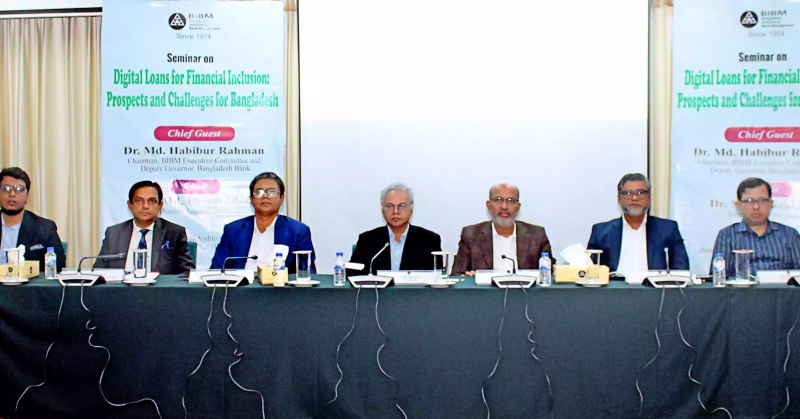
Speakers at a BIBM seminar in Dhaka on Wednesday 9 September 2026.
Digital lending can play a significant role in expanding financial inclusion in Bangladesh by making formal credit more accessible, affordable, and convenient for underserved segments of the population, experts and financial sector leaders said at a seminar on Wednesday.
The seminar, titled “Digital Loans for Financial Inclusion: Prospects and Challenges for Bangladesh,” was organized by the Bangladesh Institute of Bank Management (BIBM) at its auditorium in Mirpur. A research team presented a keynote study examining the prospects, challenges, and future directions of digital lending in the country.
The keynote paper was presented by Md. Nehal Ahmed, Selection Grade Professor at BIBM. The research team also included Dr. Md. Shahid Ullah, Associate Professor at BIBM; Ms. Rexona Yesmin, Assistant Professor at BIBM; Md. Emon Arefin, Lecturer at BIBM; and Abrar Shahriar, Head of eLending, Products, Acquisitions & Bancassurance at City Bank PLC.
According to the study, digital lending can make small-ticket loans commercially viable by cutting transaction costs, overcoming geographical barriers, and using digital and alternative data to assess borrowers lacking conventional credit histories. The paper noted that operating costs of digital lending can be less than 1 to 2 percent of the costs associated with traditional lending.
Although digital lending accounts for a substantial share of retail loan disbursements and accounts, its share of the total outstanding loan portfolio remains relatively small. The study revealed that the default or classification ratio of digital loans stands at around 3 to 4 percent. Rural borrowers represent approximately 30 to 40 percent of observed digital borrowers, repeat borrowers account for 45 to 60 percent, and female participation ranges from 3 to 25 percent across institutions.
The report highlighted that digital lending could particularly benefit underserved households, microentrepreneurs, farmers, women, and micro, small, and medium-sized enterprises (MSMEs).
However, the researchers cautioned that genuine financial inclusion should be evaluated by credit quality, affordability, sustainability, and responsible use, rather than loan volume alone.
Attending as the Chief Guest, Dr. Md. Habibur Rahman, Chairman of the BIBM Executive Committee and Deputy Governor of Bangladesh Bank, emphasized that digital lending can reduce barriers to accessing formal credit for small borrowers and underserved groups.
He stressed the need for responsible and sustainable expansion to prevent new financial risks.
Chairing the seminar, Dr. Md. Ezazul Islam, Director General of BIBM, noted that technology can shorten turnaround times and lower costs, but warned that rapid expansion could amplify risks such as over-borrowing, credit risk, data misuse, fraud, and consumer harm.
“The way forward is not to choose between innovation and regulation, but to make the two reinforce one another,” Dr. Ezazul Islam said, calling for proportionate regulation, real-time credit information systems, AI governance, robust cybersecurity, and digital-literacy initiatives.
The event opened with a welcome address by Mr. Md. Shihab Uddin Khan, Professor and Director at BIBM. Designated discussants included Md. Ali Hossain Prodhania, Supernumerary Professor at BIBM; Debdulal Roy, Executive Director of Bangladesh Bank and Senior Faculty at BIBM; Mr. Ahmed Rashid Joy, Additional Managing Director and Chief Risk Officer at BRAC Bank PLC; and Mr. Md. Ashanur Rahman, Deputy Managing Director and Chief Economist at City Bank PLC. - UNB