

- Dhaka ranks 6th among world’s most polluted cities |
- Journalism Plays Critical Role in Disaster Response: UN |
- Iran Launches Fresh Ballistic Missile Attack On UAE |
- Only tourist police box on Kuakata beach about to disappear into sea |
- High Court Rejects Plea to Suspend Presidential Poll |
Dhaka ranks 9th among world’s most polluted cities
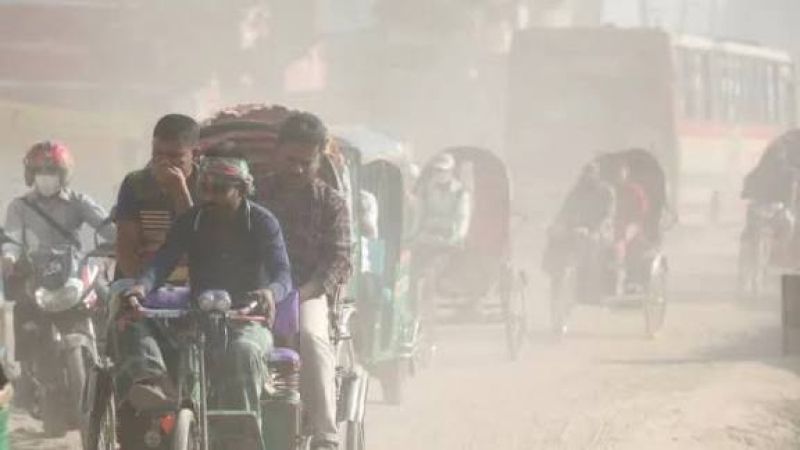
Dhaka, the densely populated capital of Bangladesh, ranked ninth among the world’s most polluted cities on Thursday morning, recording an Air Quality Index (AQI) of 160 at 10:45 am.
Today, the city’s air was classified as ‘unhealthy’, indicating a serious health threat, according to the AQI report.
Kathmandu in Nepal, Tashkent in Uzbekistan, and Karachi in Pakistan occupied the first, second, and third spots on the list, with AQI scores of 197,192 and 186 respectively.
According to the AQI scale, a reading between 50 and 100 is considered ‘moderate’, with generally acceptable air quality, though sensitive individuals should limit prolonged outdoor exertion. AQI levels of 101–150 are ‘unhealthy for sensitive groups’, 151–200 is ‘unhealthy’, 201–300 is ‘very unhealthy’, and readings above 301 are considered ‘hazardous’, posing severe health risks.
The AQI, which reports daily air quality, informs residents how clean or polluted the air is and highlights potential health effects. In Bangladesh, the AQI is calculated based on five key pollutants: particulate matter (PM10 and PM2.5), nitrogen dioxide (NO2), carbon monoxide (CO), sulfur dioxide (SO2), and ozone.
Dhaka has long struggled with air pollution. Air quality usually deteriorates in winter and improves during the monsoon season.
The World Health Organization (WHO) estimates that air pollution causes about seven million deaths worldwide each year, primarily from stroke, heart disease, chronic obstructive pulmonary disease, lung cancer, and acute respiratory infections, reports UNB.