

- Trump Extends Iran Ceasefire, Seeks Time for Talks |
- SSC and Equivalent Exams Begin Nationwide |
- US, Iran Signal War Readiness as Talks Hang in Balance |
- Bangladesh, EU Push for FTA, Investment Pact Talks |
- Over 1.14cr workers sent to Middle East in 22 years |
Dhaka's air ranks world's 7th polluted city on Wednesday
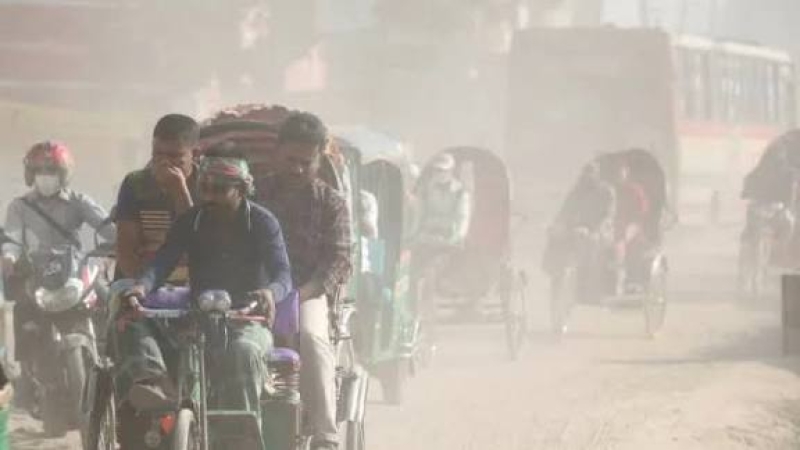
Dhaka, the densely populated capital of Bangladesh, ranked 7th among the world’s most polluted cities on Wednesday morning, with an Air Quality Index (AQI) of 109 at 08:53 am.
The air was classified as ‘Unhealthy for sensitive groups’, means air quality is poor enough to cause health effects in vulnerable people, such as breathing discomfort, but the general public is unlikely to be affected, according to the AQI scale.
India’s Delhi, Pakistan’s Lahore and Nepal’s Kathmandu were the three most polluted cities, with AQI scores of 273, 208 and 190.
An AQI between 101 and 150 is considered ‘unhealthy for sensitive groups’, while 151–200 is ‘unhealthy’, 201–300 is ‘very unhealthy’, and anything above 301 is ‘hazardous’ and can cause serious health problems.
The AQI measures daily air quality, showing how clean or polluted the air is and what health effects people might experience.
In Bangladesh, the AQI is based on five main pollutants: particulate matter (PM10 and PM2.5), nitrogen dioxide, carbon monoxide, sulphur dioxide and ozone.
Dhaka has long faced serious air pollution. The situation usually gets worse in winter and improves during the monsoon season.
The World Health Organization says air pollution causes around seven million deaths worldwide each year, mainly due to stroke, heart disease, chronic respiratory illness, lung cancer and acute infections, reports UNB.