

- Five Killed in Bandarban Landslide After Heavy Rain |
- US launches fresh strikes on Iran as conflict escalates |
- 42-Year Rainfall Record Broken as Chattogram Floods |
- Flash Flood Risk Rises as Rivers Swell: FFWC |
- Switzerland Beat Colombia to Reach World Cup Last Eight |
US launches fresh Iran strikes as Tehran hits Gulf states
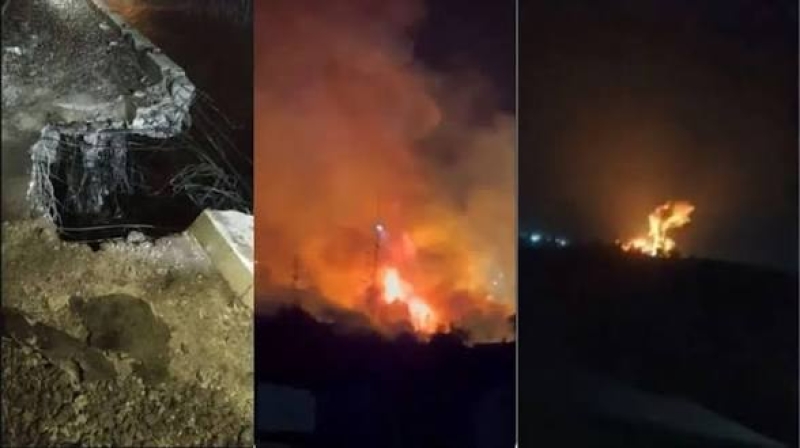
The United States launched a fresh wave of airstrikes on Iran early Thursday, prompting Tehran to retaliate by targeting Bahrain, Kuwait and Qatar, further straining an interim agreement aimed at ending the war in the Persian Gulf.
The latest attacks came hours after US President Donald Trump declared that recent Iranian strikes on ships in the Strait of Hormuz had effectively ended the fragile ceasefire.
The US had already carried out strikes on a range of Iranian military sites and port facilities early Wednesday after Iran targeted several commercial vessels off the coast of Oman, triggering an earlier round of Iranian retaliation.
Thursday's exchanges appeared to be more intense. Air raid sirens sounded at least twice in Bahrain, where the US Navy's 5th Fleet is based. There were no immediate reports of damage in Bahrain, Kuwait or Qatar. Kuwait's military said it was intercepting incoming drones and missiles.
In a social media post, US military officials said the latest operation was intended to "further degrade" Iran's ability "to threaten freedom of navigation" in the Strait of Hormuz, through which about one-fifth of the world's traded oil and natural gas passed before the conflict began with US and Israeli strikes on February 28.
Iranian state media reported explosions in several areas, including Bushehr, home to the country's nuclear power plant, as well as the southern port cities of Chabahar, Konarak, Bandar Abbas and Sirik.
Trump warns of stronger response
After leaving a NATO summit in Turkey, Trump shared videos on social media that he said showed explosions in Iran and warned Tehran against further attacks.
"This is in retribution for yesterday's bombing of ships by Iran. If it happens again, it will get much worse!" Trump wrote.
Earlier in the day, Trump had said the latest exchanges would not lead to prolonged military action.
"Anything that happens is going to happen very fast," he said, while also suggesting the US military could "just finish the job."
Trump also repeated earlier threats to target Iran's civilian infrastructure, including power stations and desalination plants, and to seize the country's key oil export hub on Kharg Island.
Following attacks on three tankers on Tuesday, the US launched strikes against Iran, and Iranian forces responded by targeting American military sites across the Persian Gulf.
Iran has maintained that the interim ceasefire allows it to regulate traffic through the Strait of Hormuz. Parliament Speaker Mohammad Bagher Qalibaf, who is involved in negotiations for a permanent peace agreement, struck a defiant tone in a post on X.
"America still hasn't learned that bullying and breaking promises are no longer cost-free. Let me put it plainly: if you strike, you'll get hit," he wrote.
Fears grow over collapse of ceasefire
Trump's remarks that the temporary ceasefire was "over" raised fresh concerns that the conflict could escalate again, although he said diplomatic talks would continue.
Repeated attacks have already put the fragile agreement under pressure, and Trump's comments added to uncertainty. Oil prices rose sharply after his remarks amid fears of renewed fighting that could disrupt energy supplies through the Strait of Hormuz.
"For me, I think it's over," Trump said when asked about the ceasefire. While he said US officials could continue negotiations, he expressed little confidence in their success.
"They can talk, but I think they're wasting their time," he said.
Iranian Deputy Foreign Minister Kazem Gharibabadi, who is also involved in the negotiations, responded on X by saying Trump's comments "are not a sign of power but an admission of the failure" of US policy toward Iran.
Trump has repeatedly threatened to seize Kharg Island, through which around 90% of Iran's oil exports pass, including last month when he questioned whether the US "has the stomach for it."
The latest attacks on shipping, despite ongoing diplomatic efforts, may reflect divisions within Iran's leadership. Hard-liners favour maintaining long-term control over the strategic waterway, while more pragmatic officials seek a permanent agreement that would reopen the strait, ease sanctions and revive the country's economy.
Formal negotiations on a lasting peace were scheduled to begin after the funeral of Iran's Supreme Leader Ayatollah Ali Khamenei, who was killed on February 28 during the opening phase of the war. The funeral, which concludes Thursday, had been expected to provide a brief period of reduced tensions.
The planned talks are expected to focus on the most contentious issues, including the full reopening of the Strait of Hormuz and restrictions on Iran's disputed nuclear programme, reports UNB.