

- Rivers Must Remain Alive Until They Meet Seas – Basin Summit |
- Monsoon Sets In Bangladesh With Erratic Signals |
- Freeing Bourses From Evil Grips of Cronies And Oligarchs |
- Uneasy Calm In BD Political Arena Over Amendment Or Reform |
- UN experts for urgest action to support Rohingya Refugees in BD |
Sundarbans Gets A Badly Injured Tigress Back Home After Cure
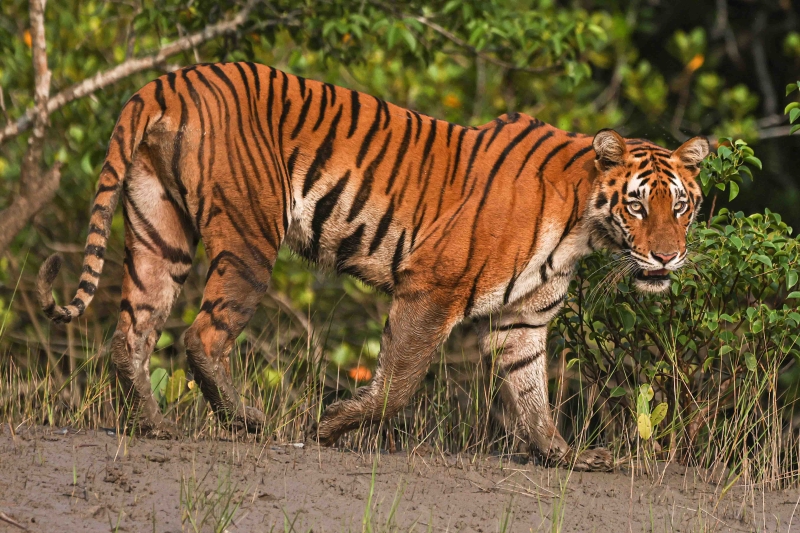
A Royal Bengal Tiger inside the Sundarbans. - Photo collected
GreenWatch Desk
For months, she lay weak, traumatised, and unable to walk — a Royal Bengal tigress whose life had been violently interrupted by a poacher’s snare deep inside the Sundarbans. On 12 July, she leapt back into the mangrove shadows of her ancestral home, marking the first successful full-cycle rescue, rehabilitation, and release of a big cat by the Bangladesh Forest Department. It was a moment that blended science, patience, and hope — and one that may reshape the country’s approach to wildlife conservation.
Her story began on 3 January, when a fisherman spotted the critically injured tigress about half a kilometre inside the forest. Forest officials later found her trapped in a deer snare near the Baidyamari Forest Patrol Outpost under the Chandpai Range. “Forest officials received information about the trapped tiger on January 3 and launched a rescue operation the following day using a tranquiliser gun before bringing it to the rehabilitation centre.” What followed was a long, uncertain battle against trauma, infection, and the fear that captivity might erase her instincts for survival.
When the tigress arrived at the Wildlife Rescue and Rehabilitation Centre in Khulna, she was barely clinging to life. Her leg injury was severe, her body dangerously weak, and her behaviour unpredictable. “She is extremely weak and remains under trauma. Small pieces of meat are being given, and she shows aggression when people come close,” said Professor Dr Mohammad Abu Hadi Noor Ali Khan, who led the four-member expert medical board overseeing her treatment. Veterinarians feared wound decomposition, cell death, and skin separation around the injury. Electrolyte imbalance — involving sodium, potassium, calcium, magnesium, and phosphate — left her unable to walk. When her medical treatment began Gazipur Safari Park Veterinary Officer Dr Julkarnaine said, “There is concern about wound decomposition on her leg, death of some cells and the separation of skin around the wound.”
Her diet had to be rebuilt from scratch. “Initially, it refused to eat and underwent several medical examinations, including blood tests. Its diet was gradually adjusted from liver and small pieces of meat to small animals, and later goats and wild boars,” said veterinary surgeon Hatem Sajjat Mohammad Julkarnaine. The tigress was treated with vitamin C, painkillers, analgesics, saline, electrolytes, and antibiotics. Every day was a negotiation between her trauma and her will to survive. By late June, she had regained strength, mobility, and appetite. The medical board finally declared her fit for release — but the question remained: would she remember how to be wild again?
On the night before her release, the tigress was sedated at the Khulna rehabilitation centre. At dawn, under tight security, she was transported to Mongla and then loaded onto the Forest Department vessel ML Swachh 2. Forest officials, senior department leaders, and wildlife experts accompanied her on the journey to the Andharmanik patrol outpost area under the Sundarbans East Forest Division. The vessel reached the release site around 11:30 am. After completing procedures, officials opened the iron cage at noon — but the tigress refused to step out. She stayed inside for nearly an hour, hesitant, perhaps confused by the sudden proximity of her old world.
Finally, the vessel was moved closer to the forest edge. One side of the cage was raised. The tigress paused, then leapt — a single fluid motion — disappearing into the dense mangroves. Forest vessels had surrounded the release point to ensure she moved directly into the forest and not toward nearby human settlements. It was a controlled, cautious operation, reflecting both the fragility of her recovery and the unpredictability of a tiger returning to the wild.
Environment, Forest and Climate Change State Minister Shaikh Faridul Islam, Chief Conservator of Forests Amir Hossain Chowdhury, Khulna Region Conservator Imran Ahmed, DFO Rezaul Karim Chowdhury, and wildlife researcher Prof Dr Md Anwarul Islam were present — a testament to the significance of the moment. “This is the first time a tiger rescued from outside the forest has been rehabilitated and released back into the Sundarbans. It is a significant achievement for the Forest Department,” said DFO Rezaul Karim Chowdhury. The State Minister called it “a historic moment,” adding, “Wild animals belong in the wild, and today a new chapter has been written in the Sundarbans.”
The tigress’s release is not the end of her story — it is the beginning of a new chapter. To monitor her movements and ensure her survival, the Forest Department has installed 20 camera traps covering about 90 square kilometres of forest. These cameras will track her hunting patterns, territorial behaviour, and interactions with other wildlife. The monitoring is crucial. After six months in human care, there were fears she might struggle to hunt or defend herself. Tigers rely on stealth, strength, and territorial awareness — skills that captivity can dull. The camera traps will help determine whether she successfully reintegrates into the wild.
Her release also comes at a time when tiger conservation in the Sundarbans is showing signs of progress. According to Forest Department data, the number of tigers in the Bangladesh Sundarbans stood at 125 in October 2024, up from 114 in 2018 and 106 in 2015. But threats remain: poaching, climate change, rising salinity, and habitat loss continue to endanger the species.
The Sundarbans — the world’s largest mangrove forest — is the last refuge for tigers in Bangladesh. Once, tigers roamed Gazipur, Sylhet, Modhupur, and other regions. Today, only the Sundarbans remains. As Prof Dr Md Anwarul Islam explained in an interview, the term “Royal Bengal tiger” refers not to a subspecies but to the habitat — the mangrove-adapted Bengal tiger (Panthera tigris tigris). Globally, tiger numbers hover around 5,500, with India hosting about 70% of the population. The Sundarbans, shared between Bangladesh and India, holds an estimated 225–250 tigers — the only mangrove habitat in the world where tigers live.
The tigress’s rescue highlights both the resilience of the species and the fragility of its environment. Poachers’ snares remain a deadly threat. In the same week she was rescued, forest officials recovered 19 abandoned traps and saved a Chital deer caught in one. Experts like Dr Khan have urged stronger veterinary presence in the forest, modern wildlife treatment systems, and intensified anti-poaching patrols.
Her leap into the mangroves was more than a physical act — it was a symbol of what coordinated conservation can achieve. It demonstrated that with expertise, patience, and resources, even severely injured big cats can return to the wild after treatment under human acre. It also marked a turning point for the Forest Department. For years, tigers taken out of the Sundarbans were never returned. This tigress changed that history.
Her survival now depends on the forest — and on the continued vigilance of those who protect it. Rising tiger numbers in the Sundarbans offer hope, but hope alone is not enough. The forest is changing, the threats are evolving, and conservation must keep pace. For now, though, a tigress walks again inside the mangroves. Her story is a reminder that every rescued animal is a chance to restore balance, reclaim heritage, and reaffirm the bond between a nation and its wild heart.
(From the GreenWatch print edition, July 2026)