

- Rivers Must Remain Alive Until They Meet Seas – Basin Summit |
- Monsoon Sets In Bangladesh With Erratic Signals |
- Freeing Bourses From Evil Grips of Cronies And Oligarchs |
- Uneasy Calm In BD Political Arena Over Amendment Or Reform |
- UN experts for urgest action to support Rohingya Refugees in BD |
Monsoon Sets In Bangladesh With Erratic Signals
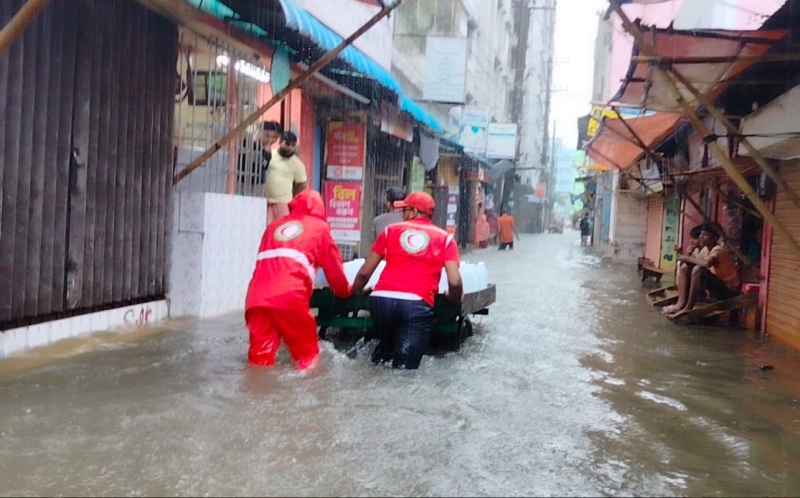
Floods and landslides in Chattogram caused by unusual cloudbursts in early July 2026. Photo - Bangladesh Red Crescent Society.
Special Correspondent:
The southwest monsoon has long been the pulse of Bangladesh, dictating everything from farming calendars and river navigation to urban life and food security. For generations, people could almost predict its arrival with remarkable accuracy but that rhythm is rapidly changing.
The monsoon this year has demonstrated how climate change and large-scale ocean-atmosphere interactions are reshaping one of South Asia's most important weather systems. Instead of the familiar pattern of steady rains beginning in early June, Bangladesh experienced an unusually dry start to the season, followed by devastating cloudbursts, flash floods, urban flooding and deadly landslides that affected millions across the country.
At least 60 people died in landslides and floods with people floating dead bodies on rafts made with banana shrubs as no land was above water in some areas of Chattogram district. More than 50,000 dwelling houses were damaged. Loss to crops was colossal.
Meteorologists and climate scientists say this year's erratic weather is not an isolated anomaly but another sign that Bangladesh is entering a new climatic reality where prolonged dry spells, extreme rainfall and rapid weather transitions may become increasingly common.
The southwest monsoon normally arrives over Bangladesh in the first week of June before gradually spreading across the country. Traditionally, it brings several days of moderate, widespread rainfall that replenishes rivers, cools temperatures and prepares farmland for Aman rice cultivation.
This year the monsoon unfolded differently. June remained unusually hot and dry, with repeated heatwaves affecting much of the country. Rainfall remained significantly below average in many districts, delaying agricultural activities and increasing irrigation demand.
Dr. Bazlur Rashid, a senior meteorologist at the Bangladesh Meteorological Department (BMD), said the onset of the southwest monsoon has gradually shifted later by two to five days compared to long-term averages. Although such changes may appear minor, they have major implications for agriculture, water resources and disaster preparedness.
He said this year's monsoon deviated noticeably from its normal pattern. "The southwest monsoon usually sets in over Bangladesh between July 5 and 10, but this year it became fully established only around July 12 or 13," he said. "When the monsoon sets in late, it is generally weak during its initial phase."
The delayed onset left much of the country unusually dry in June, when rainfall was about 30 per cent below the seasonal average. The prolonged dry spell was followed by an abrupt reversal as the monsoon suddenly gathered strength, unleashing torrential rain over large parts of the country.
Dr. Rashid attributed the unusually intense rainfall over a short period largely to the influence of El Niño, which, combined with warmer sea surface temperatures in the Bay of Bengal, created favourable conditions for extreme precipitation. Chattogram region alone received about 1,400 millimetres of rainfall in just one week between July 5 and 13, an extraordinary amount even by Bangladesh's standards.
"This was an exceptional rainfall event," he said, noting that the previous record for weekly rainfall was about 1,700 millimetres, recorded in Sandwip in 2001.
The delayed monsoon arrival was followed by a dramatic reversal. By the first half of July, deep monsoon systems formed over the Bay of Bengal, producing extremely heavy rainfall within short periods. Areas that had experienced weeks of water scarcity suddenly faced flooding.
Meteorologists describe this phenomenon as increasing "rainfall concentration"—where seasonal rainfall occurs over fewer days but with much greater intensity.
The abrupt transition from drought-like conditions to flooding became one of the defining characteristics of the season.
Instead of receiving rainfall evenly over several months, Bangladesh accumulated a substantial share of its seasonal rainfall within just a few weeks.
In Dhaka, roads disappeared beneath water after several hours of intense rainfall. Traffic ground to a halt, businesses closed early and thousands of commuters spent hours stranded.
The capital's chronic drainage problems once again came under scrutiny. Urban planners argue that uncontrolled development, shrinking wetlands, blocked canals and inadequate storm-water drainage have greatly reduced the city's capacity to absorb heavy rainfall.
Climate change, they say, is exposing weaknesses that have accumulated over decades. One of the biggest questions surrounding the 2026 monsoon is why Bangladesh experienced severe rainfall despite the influence of El Niño, which is generally associated with weaker monsoons in South Asia.
Professor Dr. Rashed Chowdhury, a Bangladeshi climatologist and former professor at California State University, explains that not all El Niño events behave identically.
The conventional Eastern Pacific El Niño typically suppresses monsoon rainfall over Bangladesh and neighbouring regions.
However, another form known as the Central Pacific El Niño, or El Niño Modoki, often produces different atmospheric circulation patterns that can enhance rainfall over parts of South Asia.
According to Dr. Chowdhury, although ocean temperatures during 2026 resembled a conventional El Niño, the atmosphere behaved more like a Modoki event.
"This explains why Bangladesh has experienced wetter conditions than many seasonal forecasts initially suggested," he has said in recent discussions on regional climate variability.
Scientists also note that global warming is increasingly altering the relationship between El Niño and regional weather.
Higher sea surface temperatures in the Bay of Bengal provide additional moisture to developing weather systems, allowing storms to produce heavier rainfall than in previous decades.
At the same time, rising temperatures accelerate evaporation during dry periods, making droughts more severe.
This explains why Bangladesh is increasingly experiencing both prolonged heatwaves and devastating floods within the same season.
Nowhere has the changing monsoon been more evident than Sylhet. Situated below the Meghalaya Plateau, Sylhet receives some of the highest annual rainfall in Bangladesh due to orographic lifting, where moisture-laden air rises over mountains before releasing heavy rain.
Farmers preparing Aman cultivation watched young seedlings drown before transplantation could be completed. Roads, schools and local markets were inundated.
Experts say flash floods are becoming increasingly difficult to predict because rainfall events are becoming shorter but far more intense.
The Chattogram Hill Tracts and Cox's Bazar experienced another familiar but deadly combination: torrential rainfall and landslides.
The steep hills become unstable after prolonged rainfall, especially where forests have been cleared for settlements, agriculture or infrastructure. Entire hillsides collapsed in several locations during July.
According to disaster management authorities, landslides and flooding contributed significantly to nationwide fatalities, with Cox's Bazar among the worst-affected districts with 19 deaths in the Rohingya camps.
A delayed monsoon postpones transplanting, Sudden floods destroy seedlings, Heavy rainfall damages fertiliser application schedules, Excess moisture encourages crop diseases, Meanwhile, prolonged dry spells increase irrigation costs.
Agricultural economists warn that weather uncertainty now affects every stage of crop production.
The Bangladesh Rice Research Institute (BRRI) has been developing flood-tolerant, drought-tolerant and saline-resistant rice varieties to help farmers adapt.
However, scientists caution that improved seeds alone cannot offset increasingly erratic weather.
Farmers also require better weather forecasts, crop insurance, improved water management and timely extension services.
The financial consequences of extreme weather extend well beyond agriculture.
As climate extremes become more frequent, those losses are expected to rise substantially unless adaptation measures accelerate.
Floodwater creates ideal conditions for disease outbreaks. Contaminated drinking water increases the risk of diarrhoea, cholera and typhoid.
Climate records indicate that Bangladesh's total seasonal rainfall has not changed dramatically over recent decades.
Researchers have documented fewer rainy days but more intense rainfall events.
In other words, the country is receiving similar amounts of rain within much shorter periods.
This trend overwhelms rivers, drainage systems and flood-control structures that were designed for historical rainfall patterns.
Climate experts argue that Bangladesh has already made significant progress in disaster risk reduction through cyclone shelters, community preparedness and early warning systems.
However, monsoon adaptation now requires a broader approach.
Experts say such forecasts could significantly reduce agricultural losses if communicated effectively at the local level.
For policymakers, the lesson is clear: planning based on yesterday's weather patterns is no longer sufficient.
Infrastructure, agriculture, public health systems and disaster management strategies must all be redesigned for a future defined by greater uncertainty.