

- Gas Crisis Deepens as LNG Outage Hits Supply |
- Microplastics Found in 26 of 34 Toothpaste Brands in Bangladesh |
- Shahabuddin Set to Leave Bangabhaban, Hafiz Takes Charge |
- Rail Expansion Planned for 16 Unconnected Districts |
- Rescued elephant Badsha Bahadur gets a second chance to survive |
Trump vows to destroy Iranian warships that get near US blockade
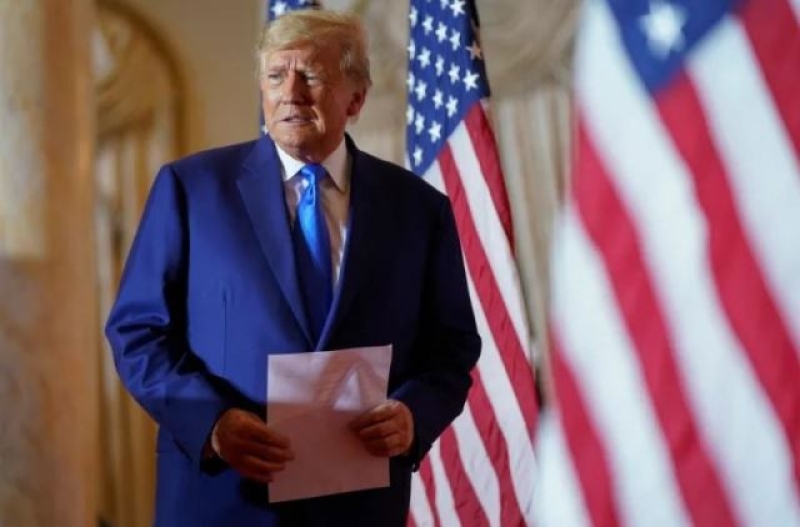
Donald Trump
President Donald Trump said Monday that the U.S. military has begun a blockade of all Iranian ports and coastal areas and Iran responded with threats on ports in the Persian Gulf and the Gulf of Oman. Trump had vowed earlier to block the Strait of Hormuz entirely.
Trump later suggested he was willing to engage with Iran, saying he had spoken to “the other side.” This came after he warned on social media that Iranian warships coming “anywhere close” to the U.S. blockade would be destroyed.
Ceasefire talks between the U.S. and Iran ended Sunday without an agreement, raising questions about what happens when the current two-week truce expires on April 22. The Israeli military, meanwhile, pushed ahead with its offensive in southern Lebanon, engaging in fierce fighting with Hezbollah militants over a strategic town, while the group fires rockets and drones at northern Israel.
China’s export growth slows as war raises uncertainty
China’s exports grew 2.5% in March from a year ago, significantly slowing from the previous two months as uncertainties rose from the Iran war and its impact on energy prices and global demand.
The March export data released by China’s customs agency Tuesday missed analysts’ estimates and was sharply down from the 21.8% export growth recorded for January and February.
Technology-related exports including a jump in shipments of semiconductors from China on the global artificial intelligence boom have powered its robust exports in early 2026, but economists say impacts from the prolonged Iran war could affect overall global demand for Chinese exports this year.
Israeli military says soldier killed in Lebanon
Israel’s military said a reserve soldier was killed and three others wounded in fighting in southern Lebanon.
The military said late Monday that the reservist killed was a firefighting vehicle driver.
The death brought the number of Israeli soldiers killed in the current war in Lebanon to 13.
Pakistan proposes second round of talks in Islamabad
Pakistan has proposed hosting a second round of talks between the United States and Iran in Islamabad in the coming days, before the end of the ceasefire, two Pakistani officials said.
The officials, who spoke on condition of anonymity because they were not authorized to discuss the matter with the press, said the proposal would depend on whether the parties request a different location.
One of the officials said that, despite ending without an agreement, the first talks were part of an ongoing diplomatic process rather than a one-off effort.
Vance says Iranians made ‘some progress’ in talks on nuclear issues
U.S. Vice President JD Vance said in an interview with Fox News Channel’s “Special Report” that negotiations “did make some progress” in the Islamabad talks on the U.S. insistence on the removal of nuclear material from Iran as well as a mechanism to ensure uranium cannot be enriched in the future.
“They moved in our direction,” Vance said in the interview. He said he thought Iranian negotiators were “unable to cut a deal” and needed to get approval from others in Tehran.
Vance also said that U.S. negotiators made clear that Trump “would be very happy if Iran was treated like a normal country, if it had a normal economy,” but he did not go into details about what he meant.
“There really is, I think, a grand deal to be had here. But, it’s up to the Iranians, I think, to take the next step,” Vance said.
The White House won’t say if talks are in the works
The White House was not responsive to queries about whether new talks were being weighed.
“President Trump, Vice President Vance and the negotiating team have made the U.S. red lines very clear. The Iranians desperation for a deal will only increase with President Trump’s highly effective Naval blockade now in effect,” White House press secretary Karoline Leavitt said.
US and Iran could be headed toward a second round of talks, AP sources say
The sides are weighing new in-person negotiations in a bid to reach a deal aimed at ending their six-week war before the ceasefire expires next week, two U.S. officials and person familiar with the development said.
The three said discussions were still underway about a new round of talks, while a diplomat from one of the mediating countries went further to say Tehran and Washington have agreed to it.
All four spoke on condition of anonymity to discuss sensitive diplomatic negotiations.
It’s unclear if the same level of delegation would be expected to attend, the diplomat and U.S. officials said.
The diplomat and U.S. officials said Islamabad, Pakistan, was once again being discussed as the host location. The U.S. officials also said Geneva was a possibility, and that while the venue and timing had not been decided, the talks could happen Thursday.
The White House didn’t immediately respond to a message seeking comment.
Trump told reporters earlier Monday that “we’ve been called by the other side” and “they want to work a deal.”
Official says Iran is seeking compensation from 5 Middle East countries
Iran’s representative to the United Nations has demanded compensation from countries it says participated in the U.S. and Israeli war effort against Iran.
Iran’s state media report the nations include Bahrain, Saudi Arabia, Qatar, the United Arab Emirates and Jordan.
Iran’s official news agency, IRNA, said that the U.N. representative, Amir-Saeid Iravani, claimed the countries had violated international law and had to “make full compensation for the damages caused to the Islamic Republic of Iran, including payment of compensation for all material and moral damages resulting from their international violations.”
Many US Catholics dismayed by Trump’s verbal attack on Pope Leo
A majority of U.S. Catholic voters supported Trump in his 2024 presidential victory.
Yet across the broad Catholic political spectrum – even among conservative-leaning bishops – there is dismay over Trump’s unprecedented verbal assault on Pope Leo XIV, the first American to lead their church.
Leo says he is sharing a Gospel message and not directly attacking Trump or anyone else with his appeals for peace and criticism of attitudes fueling the Iran war.
Criticism of Trump came from Archbishop Paul Coakley, head of the U.S. Conference of Catholic Bishops, and from Minnesota-based Bishop Robert Barron, who only a few days ago was applauding Trump as an Easter guest at the White House.
Barron called the president’s remarks “entirely inappropriate and disrespectful” and urged him to apologize. - UNB