

- Weak Revenue, Not Debt, Bangladesh's Main Challenge: Minister |
- Dhaka Ranks Third Globally as AQI Reaches 206 |
- CI Launches Global Renewables Finance Readiness Index at COP31 |
- Bangladesh Targets $1 Billion in Fish Exports by 2030 |
- US Lifts Nationwide Flight Restrictions After Four Hours |
SpaceX Makes History With First Starship Midair Capture
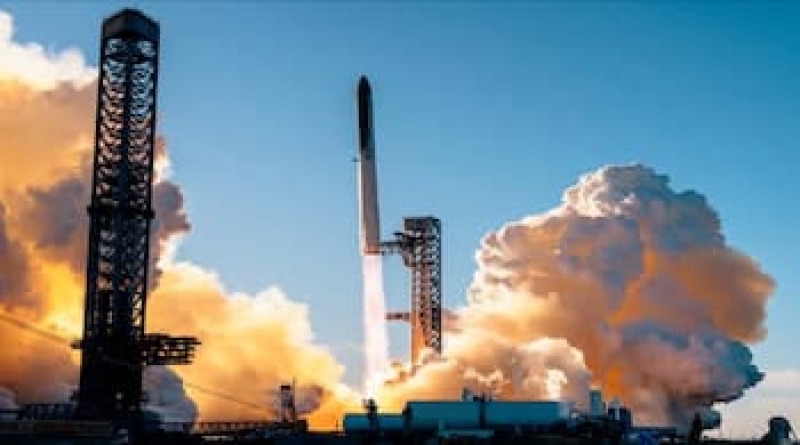
SpaceX achieves first-ever midair catch of Starship returning from orbit
SpaceX's Starship spacecraft made a historic return to Earth on Saturday, completing the first-ever midair capture of a Starship returning from space with the help of giant mechanical arms at its launch tower in Texas.
The successful recovery marked a major milestone for the company, although it fell short of its goal of catching both the spacecraft and its first-stage booster.
The booster failed to complete its return after Friday's liftoff from SpaceX's Starbase facility near the US-Mexico border. Its engines shut down too early during the return attempt, and its guidance system triggered a self-destruct sequence over the Gulf of Mexico.
However, the stainless-steel spacecraft completed its journey and returned to the launch site about 22 hours after liftoff.
In a spectacular final manoeuvre, the spacecraft descended vertically and was caught by two enormous mechanical arms attached to the launch tower. It remained suspended above the ground as cameras captured the historic moment.
“Can you believe it? Look at her! Baby, she’s back!” SpaceX commentator Dan Huot exclaimed during the live broadcast.
Company CEO Elon Musk later described the achievement as an “epic day” and climbed the launch tower to film the spacecraft at close range. He also hugged the vehicle and posted on X: “Looks great.”
SpaceX officials said the successful recovery demonstrated Starship's potential for full reusability, a key requirement for reducing launch costs and increasing flight frequency.
Although the latest booster recovery attempt failed, SpaceX had previously completed three successful midair catches of its first-stage booster, helping validate the recovery system.
NASA welcomed the achievement, describing it as an important step towards its lunar exploration programme. The US space agency is investing billions of dollars in Starship's development as a lunar lander for astronauts under its Artemis programme, which aims to return humans to the Moon later this decade and support the establishment of a permanent lunar base.
NASA Administrator Jared Isaacman called the achievement “almost magic” in a post on X, adding that it was bringing more people around to the possibilities of space exploration.
Musk has even more ambitious plans for Starship, envisioning a fleet of spacecraft carrying people and equipment to Mars to establish a city there.
The 407-foot (124-metre) Starship, described as the world's largest and most powerful rocket, lifted off late Friday afternoon. Its upper-stage spacecraft separated successfully from the booster before the latter failed to complete its return.
The spacecraft then entered orbit and deployed 26 advanced Starlink satellites. It travelled around Earth at an altitude of about 165 miles (265 kilometres), completing 14 orbits while transmitting live footage of the planet and its journey through the Starlink network.
The 14-orbit flight marked a significant improvement over the previous mission, which completed only one to two orbits.