

- Global turmoil shadows Bonn climate talks |
- Dhaka's air quality recorded ‘moderate’ Tuesday morning |
- Court seeks Interpol red notices for 2 fugitives in Tonu killing |
- Bangladesh wastes 3.5mn tons of food a year: State minister |
- Xi, Kim pledge closer China-North Korea ties |
New Evidence Questions Whether Universe’s Expansion Is Slowing
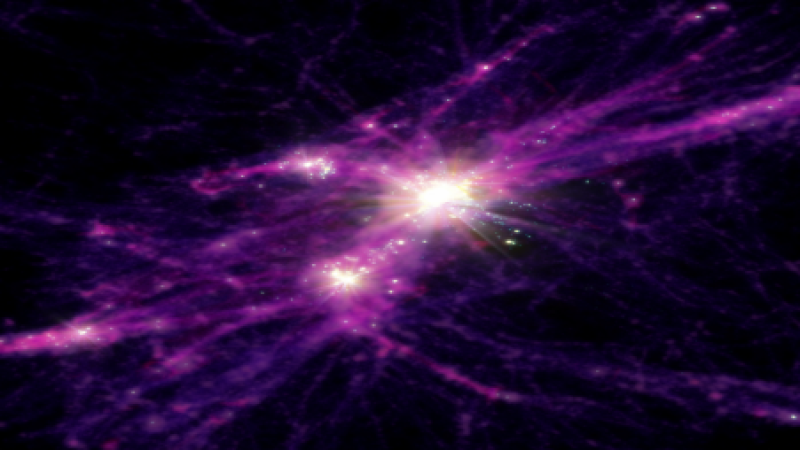
New scientific research is raising fresh questions about whether the universe’s expansion is continuing to accelerate or gradually slowing, challenging long-held assumptions about dark energy—the mysterious force thought to drive cosmic growth.
For decades, scientists have believed that dark energy causes the universe to expand at an ever-increasing rate, potentially ending in a dramatic “Big Rip,” where galaxies, stars and even atoms are torn apart. However, recent analyses of astronomical data suggest this acceleration may be weakening.
The findings are based on observations from the Dark Energy Spectroscopic Instrument, along with research led by Professor Young Wook Lee of Yonsei University. His team reanalysed supernova data after accounting for the ages of the galaxies in which the stellar explosions occurred, a factor they argue was not fully considered in earlier studies.
This reassessment suggests that dark energy may not be constant, a result that challenges a core pillar of modern cosmology. If dark energy continues to weaken, gravity could eventually slow, stop, or even reverse the universe’s expansion, potentially leading to a collapse known as the “Big Crunch.”
The conclusions remain the subject of debate. Some scientists warn that uncertainties in supernova behaviour, stellar evolution, or measurement techniques could explain the results without requiring new physics. Others argue the data may still hold hidden complexities.
Lee’s team, however, says the statistical probability of their findings being a coincidence is extremely small, describing it as a near-impossible fluke.
If confirmed by further observations, the research could point to a previously unknown mechanism shaping the universe and force revisions to existing cosmological models. Scientists stress that more data will be crucial to determine whether the apparent shift reflects a true change in dark energy or limitations in current measurement methods.
For now, the study highlights how much remains unknown about the force that governs the universe’s large-scale behaviour—and how future discoveries could reshape understanding of its ultimate fate.