

- Scientists find climate change is reducing oxygen in rivers |
- Bhasani's Farakka Long March still relevant to protect Ganges flow: IFC |
- Integrated Ganges Management Will Save River, Benefit People |
- Net FDI in Bangladesh jumps 39.36% to $1.77 billion in 2025 |
- Bangladesh, US sign energy cooperation MoU in Washington |
BNP govt will resolve Farakka issue with support of domestic, in'l stakeholders: Swapon
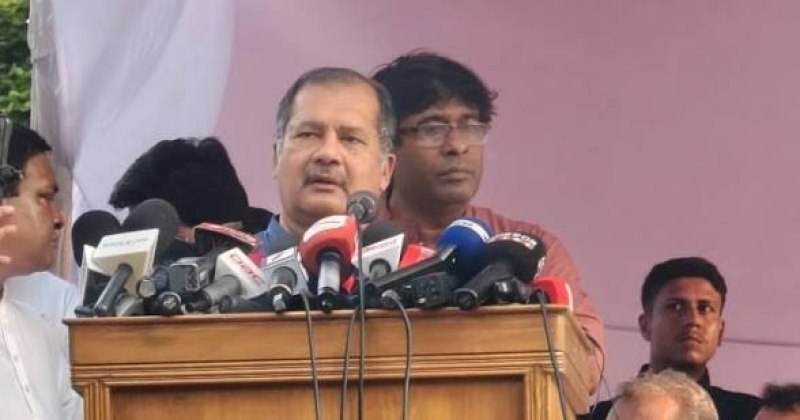
BNP Chairperson’s Adviser and Information and Broadcasting Minister Zahir Uddin Swapon on Saturday expressed optimism that the ruling BNP government would be able to resolve the long-standing Farakka issue with support from both domestic and international stakeholders.
“As the Sheaf of Paddy symbol received the people’s spontaneous mandate in the national election and gained support from all domestic and foreign forces, in the same continuity the Sheaf of Paddy will, InshaAllah, resolve the Farakka problem,” he said.
Farakka Barrage harming both Bangladesh and India: Rizvi
He made the remarks while speaking as the chief discussant at a discussion organised by Bhashani Janashakti Party marking Maulana Bhashani’s historic Farakka Long March Day at the Central Shaheed Minar in the afternoon.
Local Government, Rural Development and Cooperatives Minister and BNP Secretary General Mirza Fakhrul Islam Alamgir attended the programme as the chief guest.
Paying tribute to Maulana Abdul Hamid Khan Bhashani, Swapon said the veteran leader’s Farakka march reflected not only political resistance but also his far-sighted patriotism and deep commitment to the welfare of the people.
“Despite being physically ill, he carried out his final political programme to prove that there was no greater mission in his life than serving the people of this country,” he said.
Swapon said Bhashani had correctly anticipated the devastating consequences that could emerge if upstream and downstream countries failed to ensure fair distribution of water resources.
“He understood that even if treaties existed, actual water sharing would depend on proper diplomatic relations between the two countries,” he added.
The minister described Bhashani as one of the most visionary political leaders in Bangladesh’s history and said his politics was rooted in uniting people around common welfare and democratic values.
Swapon said Bhashani believed democratic struggles in Bangladesh could not succeed without the foundation of religious values and cultural identity.
“Without religious values, secularism cannot be practised, fascism cannot be resisted and the people of this land cannot be united,” he said.
He said BNP under Chairman Tarique Rahman carries forward Bhashani’s political philosophy through the party’s electoral symbol, the Sheaf of Paddy.
“The Sheaf of Paddy contains within it the future of democracy, independence and sovereignty,” he said.
Swapan referred to remarks by the Prime Minister in Tangail, saying Bhashani had symbolically handed over the Sheaf of Paddy to martyred President Ziaur Rahman in 1976, which later passed to Begum Khaleda Zia and now to Tarique Rahman.
“That is why the Sheaf of Paddy knows how to resolve the Farakka issue,” he said.
He said BNP Secretary General Mirza Fakhrul Islam Alamgir had earlier today called for a national consensus to renew the Ganges water-sharing treaty before its expiry in December.
Swapon urged all democratic forces to unite behind that effort.
“Through united diplomatic efforts and by strengthening the government, we will renew the Ganges treaty in line with Bangladesh’s national interests,” he said.
He expressed hope that under the leadership of Prime Minister Tarique Rahman and with guidance from Mirza Fakhrul Islam Alamgir, the process could be completed successfully.
Speaking at the event, Revolutionary Workers Party General Secretary Saiful Haque said environmental concerns and possible negative impacts of the proposed barrage and water management projects must be carefully evaluated before implementation.
“We want proper environmental assessments and public participation before any project is implemented,” he said.
He alleged that India has unilaterally withdrawn water from 54 transboundary rivers for decades in violation of international norms.
“This is not an example of friendship or brotherhood,” he said.
Saiful Haque also expressed concern over reports that India is planning new dams in upstream regions near Meghalaya.
He said Bangladesh must continue to demand its fair share of water from India regardless of whether projects like the Padma Barrage or Teesta water management plans are implemented domestically.
“There is no question of giving up our rightful share of water from India,” he said.
Referring to the Teesta agreement issue, Saiful said the Indian central government had long used West Bengal Chief Minister Mamata Banerjee as an excuse for delaying the treaty.
“Now there is no scope for playing the Mamata card again. The agreement must be between the governments of Bangladesh and India,” he said.
He urged the Bangladesh government to prioritise the issue and pursue a sustainable long-term water management strategy.
The programme was chaired by Bir Muktijoddha Sheikh Rafiqul Islam Bablu, chairman of Bhashani Janashakti Party and Bhashani Followers Council.
Among the special guests were former minister and BNP leader Nur Mohammad Khan, former Jahangirnagar University vice-chancellor and adviser to Bhashani Sangram Parishad Dr Jasim Uddin Ahmed, BNP Chairperson’s Adviser Nazmul Haque Nannu, International Farakka Committee Bangladesh President Mostafa Kamal Mujumdar, Bangladesh Muktijoddha Sangsad Central Command Council Convener Naim Jahangir, senior Supreme Court lawyer Fariduzzaman Farhad, Gono Forum President Advocate Subrata Chowdhury Papri, Ganosamhati Andolon Executive Coordinator Abul Hasan Rubel, and Mahmoodul Haque Sanu, a member of the Bhashani family, reports UNB.
Leaders from different units of Bhashani Janashakti Party also attended the programme.