

- International Day of Persons with Disabilities celebrated at Barura |
- Bangladesh achieves 97% typhoid vaccine coverage for children |
- Jeddah welcomes global stars to Red Sea Int’l Film Festival |
- Exports earn $3.9 billion in Nov, up 1.8% from Oct |
- Air ambulance delay delays Khaleda Zia’s departure for London |
Palestinians Still Denied Self-Determination After 78 Years
Credit: UN Photo
For seventy-eight years, the question of Palestine has remained on the agenda of this General Assembly, almost as long as the institution itself.
Resolution 181 (II), adopted by the General Assembly on 29 November 1947, laid the foundation for the two-State solution, calling for the establishment of both an Arab State and a Jewish State in Palestine.
But while the Jewish State — the State of Israel — is a recognised Member State of the United Nations, the Arab State — the State of Palestine — is not.
Seventy-eight years later, Palestine has still not been admitted to the UN as a full Member.
For seventy-eight years, the Palestinian people have been denied their inalienable rights — in particular, their right to self-determination. It is now high time to take decisive action to end this decades-long stalemate.
The atrocities committed by Hamas on 7 October triggered one of the darkest chapters in this conflict. Two years of war in Gaza have left tens of thousands of civilians dead, including many women and children. Countless more have been injured, maimed and traumatised for life.
Communities are starving, civilian infrastructure lies in ruins, and almost the entire population is displaced — children, mothers, fathers, families like us.
Hostages who have finally been released and reunited with their loved ones are slowly recovering from captivity under extremely harsh conditions, while other families are mourning the return of bodies. Again, children, mothers, fathers — families like us.
While the horrors in Gaza have dominated global attention for two years, settlement expansion, demolitions and increased settler violence in the occupied West Bank, including East Jerusalem, continue to undermine prospects for a sovereign, independent, contiguous and viable Palestinian State.
Palestinian communities are being fragmented by the rapid expansion of settlements. Movement, communication and access to essential services and livelihoods are severely restricted by checkpoints, confiscations and demolitions.
In my previous capacity, I visited a small village in the West Bank and met Palestinian farmers and teachers who wished to show what settlement expansion and settler violence meant in their daily lives. As we stood on a hillside overlooking their farmland, a drone from a nearby settlement hovered above us, circling and monitoring our presence.
We know what happens when foreign visitors and cameras are not there. It is not just surveillance — it is outright violence, including farmers being attacked as they try to go to work or harvest their crops.
Beyond the violence are the daily indignities affecting West Bank residents — children trying to reach school, or thousands of pregnant women attempting to reach hospitals for care or to give birth, only to be stopped at checkpoints or blocked by road closures.
Everything that has happened in the past two years has underscored what we have known for decades: the Israeli–Palestinian conflict cannot be resolved through illegal occupation, de jure or de facto annexation, forced displacement, recurrent terror or permanent war. These actions only fuel grievances and deepen the conflict.
Israelis and Palestinians will live in lasting peace, security and dignity only when they live side by side in two sovereign and independent States with mutually recognised borders and full regional integration — as outlined in the New York Declaration and Security Council Resolution 2803, which endorsed the “Comprehensive Plan to End the Conflict in Gaza”.
Yet, these remain words on paper unless we act. Even since the ceasefire, at least 67 children have been killed. Once again, we see children left without parents or trapped under rubble. This must end.
As winter approaches in New York, imagine what it means for the people of Gaza: tents collapsing under rain, families shivering without shelter, children facing freezing nights with nothing but thin fabric against the wind, and countless people still going to sleep hungry.
To live up to our commitments, humanitarian agencies must be able to operate on the ground without hindrance or excuses. Humanitarian aid must be delivered throughout Gaza in a full, safe, unconditional and unhindered manner, in accordance with international humanitarian law and humanitarian principles. This includes delivery through UNRWA.
As highlighted in the advisory opinion of the International Court of Justice on Israel’s obligations relating to UN operations in the Occupied Palestinian Territory, allowing UNRWA to fulfil its mandate is not a gesture of goodwill — it is a legal obligation.
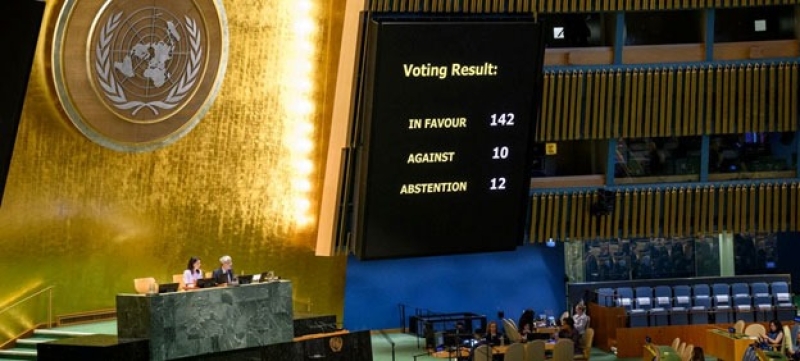
Both the General Assembly and the Security Council have consistently upheld the parameters that must guide any peaceful resolution. These principles are reiterated in the draft resolution before this Assembly today concerning the New York Declaration, endorsed by a vast majority of Member States. It identifies a comprehensive and actionable framework with tangible, time-bound and irreversible steps for implementing the two-State solution. It emphasises that Gaza must be unified with the West Bank, and that there must be no occupation, siege, territorial reduction or forced displacement.
It stresses that Hamas must end its rule in Gaza and hand over its weapons to the Palestinian Authority.
It also makes clear that the Palestinian Authority must continue implementing its credible reform agenda, focusing on good governance, transparency, fiscal sustainability, combating incitement and hate speech, service delivery, improving the business climate and promoting development.
Furthermore, it calls on Israeli leadership to immediately end violence and incitement against Palestinians and to halt all settlement activity, land seizures and annexation attempts in the Occupied Palestinian Territory, including East Jerusalem. It makes clear that settler violence must stop.
We all know how difficult this work is. Therefore, I want to be frank and clear:
The quest for peace, stability and justice in the Middle East needs the United Nations. It needs this Assembly to play a meaningful role.
It requires every Member State to act — to engage in this process, to uphold the UN Charter, to adhere to international law, and to honour the promise this institution made to the world’s people eighty years ago.
Let us recall once more: self-determination — the right to live in one’s own State in peace, security and dignity, free from war, occupation and violence — is not a privilege to be earned. It is a right to be upheld.