

- UN, partners appeal for USD 710.5 mn for Rohingya response in BD |
- Govt to Build Ganga, Teesta Barrages for Water Security |
- Bangladesh Warned Repeatedly Over Measles Vaccine Gap |
- 163 Olive Ridley turtle hatchlings found on Kuakata beach |
UN Vote May Advance Global Climate Justice Shift
United Nations General Assembly resolutions rarely make front-page news. As non-binding and largely symbolic instruments, they are often seen as statements of principle rather than decisions with enforceable consequences.
However, there are exceptions, and today’s (May 20) vote at the UNGA is one of them. A positive outcome could mark a significant step in the development of international environmental law. To understand its importance, it helps to revisit recent legal developments.
In recent years, a landmark climate-related case in Germany drew global attention when a Peruvian farmer brought action against a major German energy company, arguing that its emissions contributed to climate-related harm affecting his livelihood. The case, known as Lliuya v. RWE, was ultimately dismissed in May 2025, but it helped shape the growing field of climate litigation.
Legal experts at the Grantham Research Institute noted that the case set an important precedent, reinforcing the idea that major emitters can, in principle, be held accountable for their contribution to climate change impacts.
Climate litigation is expanding globally as courts are increasingly asked to address issues of climate equity, environmental rights, and the right to a healthy environment linked to life, health, and living standards.
In 2019, the Dutch Supreme Court ruled that the state must reduce emissions, stating that adaptation alone is not sufficient. In Ecuador, the Constitutional Court’s Los Cedros ruling strengthened the legal recognition of nature’s rights over extractive activities.
These decisions have encouraged broader climate activism and legal action across both developing and developed countries.
Within the Paris Agreement framework, vulnerable nations, particularly small island states, have consistently pushed for stronger action against greenhouse gas emissions, mainly from industrialised economies.
However, progress under the UN climate regime has remained limited. Last year’s COP30 in Brazil ended without major breakthroughs, raising doubts about the effectiveness of upcoming negotiations, including COP31 in Türkiye.
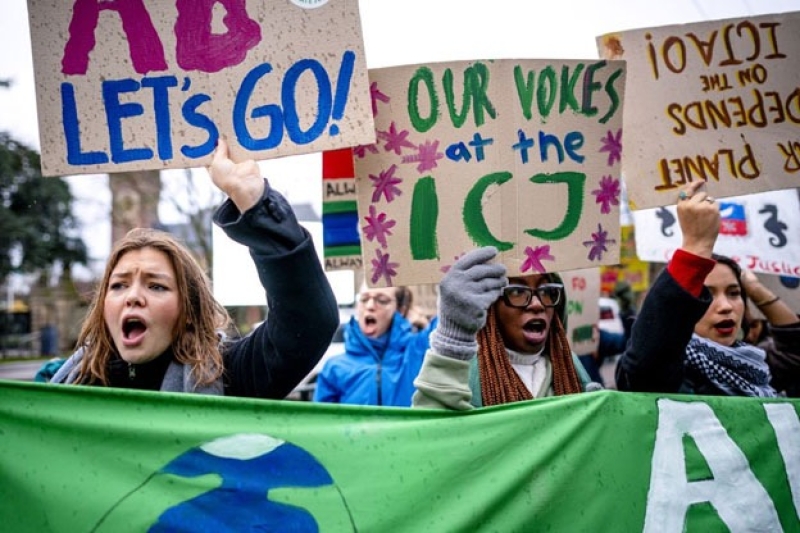
The major turning point came when the International Court of Justice issued an advisory opinion on states’ obligations regarding climate change. Although non-binding, it clarified that countries have both procedural and substantive duties under international law.
The court rejected the idea that climate obligations are limited only to the Paris Agreement, stating that states must take all reasonable measures within their capacity to reduce emissions, including regulating private-sector pollution.
It also stated that failure to meet these obligations could constitute an internationally wrongful act under international law.
Against this backdrop, Vanuatu has led efforts at the UNGA to adopt a resolution reaffirming the ICJ advisory opinion and strengthening the global understanding of state responsibility in climate action.
While non-binding, the resolution seeks to reinforce accountability principles in international climate governance.
According to the Climate Litigation Database at the Sabin Center for Climate Change Law, more than 3,000 climate-related lawsuits have already been filed worldwide against governments and private companies, including financial institutions.
The resolution has gained support from a wide coalition of countries, including several small island developing states and developing nations.
As global climate negotiations face increasing political friction, many experts argue that courts are becoming a critical arena for advancing climate justice and accountability.
At the same time, analysts note growing inconsistencies among countries that publicly support climate action but resist stronger legal obligations in international proceedings.
While UN climate negotiations remain important, the growing role of legal action suggests that courts may increasingly shape the future of climate accountability.
The outcome of today’s UNGA vote is expected to signal whether states are ready to further align international law with climate justice principles and strengthen accountability for emissions.
Observers say the challenge ahead is not only about diplomatic commitments, but also about ensuring that legal frameworks keep pace with the urgency of climate change.