

- Govt to Build Ganga, Teesta Barrages for Water Security |
- Bangladesh Warned Repeatedly Over Measles Vaccine Gap |
- 163 Olive Ridley turtle hatchlings found on Kuakata beach |
Strengthening Beekeeping For Food Security And Growth
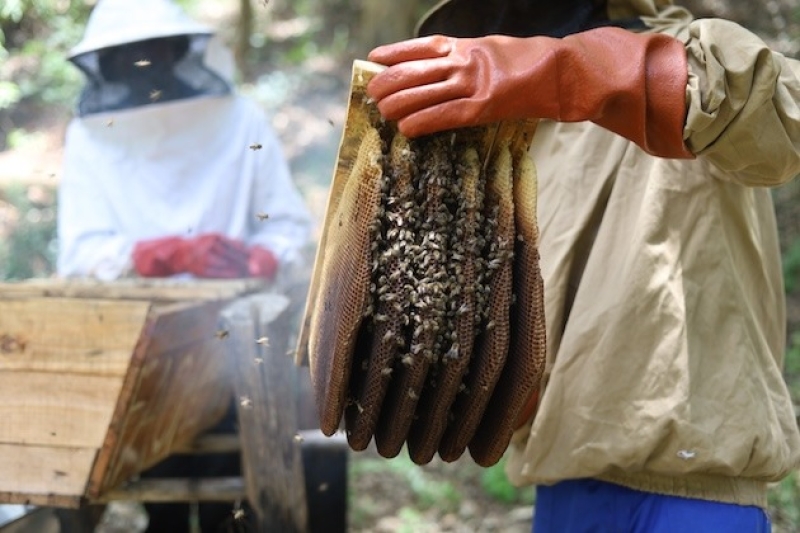
Sustainable beekeeping is increasingly recognized as a key asset for not only farming communities but for sustainable agrifood systems, the environment and the global community as a whole.
For thousands of years, humans have kept bees. Beekeeping is a key agricultural activity, yet its full potential remains largely unrealised. It produces far more than honey and can generate significantly higher income than is often recognised.
The contribution of bees to global agrifood systems amounts to hundreds of billions of dollars annually, a figure that should inform national policy and investment decisions rather than remain a footnote in environmental discussions.
The case for greater investment in sustainable beekeeping and pollinator conservation has been demonstrated at the farm level. When agricultural practices support pollinator health through crop diversification, reduced agrochemical use, and biodiversity-friendly habitat management, the results are measurable and often significant.
For example, in cashew cultivation in South India, agroecological farming practices increased the number of insect pollinators visiting flowers by nearly 400 percent, with yields rising substantially as a result.
Beekeeping requires relatively low capital investment, generates income from multiple product streams, and is well suited to the resource constraints of small-scale producers. In increasingly fragile and climate-stressed environments, it has shown notable resilience compared to other agricultural activities.
Of the roughly 25,000 bee species on Earth, only 8 to 11 are honeybee species. Around these, humanity has developed highly advanced management systems refined over millennia and now increasingly supported by modern science. Many countries have made beekeeping a central part of rural livelihoods, and in 2017, World Bee Day was officially added to the United Nations calendar.
Celebrated each year on May 20, it marks the birthday of Slovenian beekeeper Anton Janša, a pioneer of modern apiculture. While awareness of the importance of bees and other pollinators has grown, there is still a need to scale up action to protect and support them.
One important step is to recognise bees as a valuable natural asset. When governments include beekeeping in national agricultural investment strategies and support its role in generating income, they can strengthen domestic value chains for a range of hive products.
This also enables beekeepers to earn better prices in international markets by producing sustainable and traceable honey. FAO’s “Good Beekeeping Practices for Sustainable Apiculture” offer guidance on colony management, pest and disease control, habitat protection, and value chain development that allows beekeepers to earn beyond raw honey.
These practices, tested in multiple developing country contexts, can improve both hive productivity and beekeeper income.
Another key step is strengthening extension services, input support, and training programmes to help small-scale producers integrate beekeeping into farming systems. This allows them to benefit from both pollination services and income from hive products that are often overlooked in conventional agricultural support.
It is also essential to ensure that the benefits of beekeeping are accessible to those who need them most. Women and young people are an expanding part of the global beekeeping community and stand to benefit from diversified income opportunities. When they have equal access to training, equipment, and markets, productivity and hive health tend to improve.
The partnership between humans and bees has lasted for thousands of years and continues to evolve.
From the forests of Ethiopia to the pine slopes of Turkey, from the clover fields of Argentina to the manuka-covered hills of New Zealand, farmers and beekeepers have long understood what agricultural policy is only beginning to fully recognise: sustainable beekeeping and pollinator conservation are essential to resilient farming systems, environmental health, and global food security.