

- ‘Antalya Pact’ at COP31 falls as EU brinkmanship derails plan |
- Beyond Israel’s Election: Palestine’s Self-determination and the ME |
- Gaza war has undone 77 years of human development, UN warns |
- Hasina Plans to Return Home on 16 December |
- 5.3-Magnitude Quake Hits Nepal, Tremors Felt in Bangladesh |
‘Antalya Pact’ at COP31 falls as EU brinkmanship derails plan
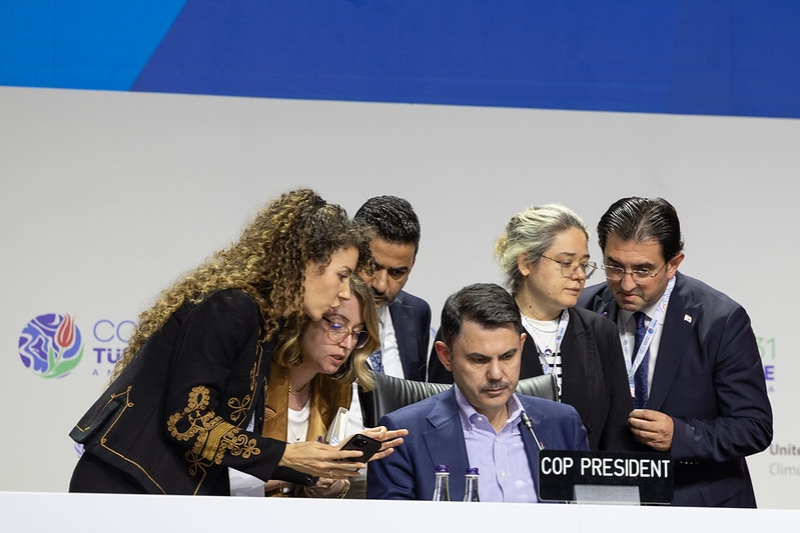
Delegates crowd around COP31 President Murat Kurum as the climate talks stretch on beyond the deadline. Credit- Kiara Worth-UN Climate Change
Antalya, 24 Nov (Radhika Chatterjee/Hilary Kung+): The Antalya climate talks came to a dramatic close on Sunday, 22 Nov, two days behind schedule, after negotiators failed to adopt the conference’s overarching “cover decision” known as the ‘Antalya Pact’, which was intended to capture the key political messages and outcomes of COP31.
The collapse of the cover decision was largely driven by a high-stakes brinkmanship strategy employed by the European Union (EU), which threatened to walk out of the negotiations unless the text explicitly referenced the need to “transition away from fossil fuels” (TAFF). The failure to secure agreement on the Antalya Pact exposed deep divisions among Parties. (See the inside story below on what transpired behind closed doors.)
In their closing plenary interventions, many developing countries and their groupings indicated their willingness to adopt the Pact despite its significant shortcomings, particularly on climate finance, the commitment to triple adaptation finance, just transition, and the adverse impacts of unilateral trade measures such as the EU’s Carbon Border Adjustment Mechanism (CBAM). Many recognised that the Pact was already heavily skewed towards the mitigation priorities favoured by the EU and its allies.
Ultimately, the EU’s insistence on securing agreement on the TAFF became the straw that broke the camel’s back, pushing many developing countries beyond what they were prepared to accept, and preventing consensus from being reached.
The last leg of the closing plenary began only in the afternoon of Sunday and was presided over by Murat Kurum, the COP 31 Turkiye Presidency, who gaveled decisions where consensus prevailed. Chris Bowen (Australia) was the President of Negotiations.
Although Parties were unable to reach consensus on the cover decision, they adopted decisions on several key mandated negotiating items (although weak in their outcomes, and leaving much to be desired due to the resistance from developed countries). These items included the Climate Finance Work Programme (CFWP), Just Transition Work Programme (JTWP), Adaptation Fund, Article 2.1(c) of the Paris Agreement (PA) (on the goal of making finance flows consistent with a pathway towards low greenhouse gas emissions and climate-resilient development), Global Goal on Adaptation (GGA), National Adaptation Plans (NAPs), Adaptation Fund, and seven decisions adopted on matters related technology, the most significant of which was the one related to the finalisation of the host of Climate Technology Centre (CTC).
However, Parties failed to reach consensus on the Mitigation Ambition and Implementation Work Programme (MWP), guidance to features of Nationally Determined Contributions (NDCs), the forum on the impact of the implementation of Response Measures (RM) and Report of the Global Environment Facility (GEF) and guidance to the GEF, and decision-making in the UNFCCC process. Of these, Rule 16 of the UNFCCC’s draft Rules of Procedure (RoP) were applied to MWP, NDC features and the decision-making process in UNFCCC. [Rule 16 of the draft RoP states that “Any item… consideration of which has not been completed at the session, shall be included automatically in the agenda of the next ordinary session, unless otherwise decided by the COP”]. (Further details on several of these matters will be forthcoming).
Two sessions of the closing plenary had been held on the nights of Nov 20 and 21st to adopt decisions on those items where consensus prevailed. On Saturday, Nov 21st, with the talks overrunning already by a day and as many delegations were already leaving, huge tensions amongst countries were palpable, as they tried to progress work across multiple negotiation tracks, including on the cover decision. The intervening night of Nov 21-22 was particularly marked by high pressure as new iterations of various negotiation texts were made available by the COP31 Presidency, after consultations with various groups and countries. Some of the key issues that were being worked on were: the cover decision, the JTWP, RM, MWP, matters relating to Finance, and the GGA.
After much wrangling, the final iterations of draft decisions across various negotiations issues were made available in the early hours of Sunday, Nov 22nd, alongside the ‘Antalya Pact’, which had two texts: a shorter two page for the COP and a longer version for the CMA (Conference of Parties to the PA). However, with the continuous delay in starting the closing plenary due to wrangles behind the scenes, it soon became clear that all issues could not have been resolved completely. With no time remaining and concerns of losing quorum, the COP31 Presidencies had no option but to convene the plenary, which began early afternoon of Sunday.
FLASHPOINTS OVER THE COVER DECISION
BEHIND THE SCENES
According to reliable sources, late evening on Saturday, 21st Nov, developing countries led by the Like-minded Developing Countries (LMDC), the Arab Group and the African Group put considerable pressure on the Presidency teams to release texts on the various negotiating issues including on the cover decision, as no texts were available since Thursday, 19th Nov. As people waited for texts, a common question in the corridors was whether the Presidency had consulted with negotiating groups. Several developing country groups had not been consulted since 19th Nov, which created further discomfort, giving rise to the speculation if only developed countries were being consulted.
On the evening of 21st Nov, there was much hullabaloo in the corridors where it was learnt that the EU, along with a few developing countries from the Alliance of Small Island States (AOSIS), and Least Developed Countries (LDCs) under their ‘High Ambition Coalition’ banner, went to meet with the Presidency to express that they would reject any outcome that did not feature the roadmap on TAFF in the cover decision. Sources also said that the EU at a ministerial level had pressured and used a “threatening tone” on a developing country to agree to their proposal of including the TAFF roadmap, and had claimed that 130 countries were behind that ask. It seems that the claim of “130 countries” supporting the roadmap fell flat because it soon became clear in the room that the LMDC, the Arab Group, the African Group, some countries in the LDCs, AOSIS as well as Groupo Sur did not support the ask. (These countries add up to being more than 100 developing countries).
Following the meeting of the EU with select developing country negotiators, several developing country negotiators from the LMDC, Arab Group, LDCs, and AOSIS went to meet with the Australian Presidency first to convey the message that they must not include anything in the cover decision that did not enjoy consensus, and asked for the texts to be released. In the meeting, according to sources, some of the countries expressed concern on the process and said that if the cover decision includes any voluntary initiatives, they would not be able to join consensus. (The TAFF roadmap is a voluntary initiative of the Brazilian COP 30 Presidency. The issue had created deep divide during COP 30 in Belem, Brazil, and there was no agreement to include it in the final decision. See related update).
Sources said that a developing country negotiator told the Presidency that they could have a ‘Presidency declaration’ if they wanted, but that any formal decision should reflect only issues of consensus. Another developing country negotiator from a G77 sub-group said the Presidency should not assume there is consensus within the sub-group on the issue of the roadmap just because some of their group members had met with the Presidency earlier along with the EU. Another developing country requested the Presidency to end the practice of the cover decision, sources said. The Australian Presidency assured Parties that they were genuinely trying not to cross red lines and that they were trying their best to release texts soon.
Sources also said that this meeting with the Australian Presidency was followed by a meeting of G77 and China with the Turkish Presidency. During the meeting, it appeared that except for Panama, several other developing country groups as well developing countries from LDCs and AOSIS reinforced the importance of consensus, not crossing Parties redlines in decisions as well as keeping voluntary initiatives out of the process and not giving any signals that would hurt their economies. Another developing country said that the EU has turned to African countries for gas and even at COP 31, developed countries were making fossil fuel deals with developing countries, and so their call for phasing out fossil fuels smacked of hypocrisy. It seems that out of frustration, there was even a suggestion by a developing country negotiator for the Turkish Presidency to take over the negotiations!
Following these events, the decision texts were finally released in the early hours of 22nd Nov. and after that, sources said there was a huddle to further resolve the contentious issues in the cover decision. Sources said that the United Kingdom (UK), EU, Switzerland, Fiji, and Panama were part of this huddle along with the LMDC and the Arab Group countries. According to sources, the LMDC and the Arab Group said the while the text contained a lot of things they did not like, including very weak language on finance, it was too late to open the text. However, the UK said that the text had several elements on finance, including a process on adaptation finance. (Para 54 of the cover decision draft referred to the launch of the “Antalya–Addis Ababa roadmap on adaptation and resilience finance aiming to promote predictable and scaled-up finance for adaptation, including innovative sources, and mechanisms for access thereto…”.) As the huddle progressed, there was a suggestion by the developed countries to delete para 54, but a developing country said since the decision to delete the reference could not be taken without the consent of the African group. (The African Group was not present in the huddle). The Australian Presidency it seems agreed to the approach.
Sources also said that Germany said it would walk out if the issue of fossil fuels did not find mention in the text, and the other developed countries, along with Panama and Fiji wanted a stronger reference to the ‘UAE Consensus’ (which refers to the decision taken in Dubai at COP 28 relating to the Global Stocktake [GST] in the preamble, as well as operative parts of the cover decision text. There were also disagreements about the carbon capture, utilization and storage (CCUS) targets (referring to “Increasing CCUS deployment with an aim to achieve gigatonne scale globally by 2035 as a collective global aspiration…,” which was advanced by Saudi Arabia). Sources said developed countries (EU, Germany and Switzerland) were mainly concerned about the CCUS target being too large and impossible to achieve, giving wrong market signals. They also thought the text was imbalanced given reference to CCUS but no mention of TAFF. The huddle ended with matters remaining deadlocked.
AT THE CLOSING PLENARY
At the closing plenary, the main faultlines persisted over the cover decision on the issue of TAFF, CCUS, and addressing limiting the period of overshoot of 1.5°C. Several developed countries, led by the EU, Environmental Integrity Group (EIG) UK, Canada and Norway objected to the adoption of the cover decision and said they cannot accept the documents as they did not advance work related to TAFF.
Some small island developing countries like Panama, Marshall Islands, Vanuatu, and Belize, explicitly stated their objection to the cover decision. Amongst developing country groups, the LDCs acknowledged the lack of consensus in the plenary after hearing other delegations. The adoption of the cover decision was supported by various developing countries like the LMDC, the Arab Group, African Group, Land Locked Developing Countries (LLDC), China, Iraq, Iran, Oman, Qatar, Egypt, Pakistan, Nepal, Indonesia, Kenya, Paraguay, and Venezuela. Even as they expressed support for the cover decision, they made it clear that the Antalya Pact did not reflect their views fully; that the language related to finance, especially adaptation finance, was very weak but they expressed a willingness to adopt it for building multilateralism and sending a collective message to the world about dealing with the climate crisis.
HIGHLIGHTS OF INTERVENTIONS ON THE COVER DECISION
Murat Kurum invited Parties to adopt the Antalya Pact and said the PA has a 1.5°C target which needs to be taken as a compass, adding further that the Presidency had put forward its perspective for advancing the implementation through electrification targets and tripling adaptation finance. “These meetings have to have a purpose” and the Antalya Pact was a way to reflect “determination and willingness to deal with the climate crisis.” He also said that the decision of adopting the text however, would be with the Parties.
The EU said it “objects to the entire [Antalya] Pact” and that “we will not endorse a decision that does not respond to the science; that disregards the implementation gap and that actually deepening the chasm between global commitments and the action required to correct the overshoot and bring 1.5°C back to within reach”. It added that “we will not endorse a cover decision that does not even mention fossil fuels, which is the key driver of climate change,” stressing that it will not accept a COP which greenwashes fossil fuels” or one “that does not address the climate emergency” and strongly “objected to this text.”
Ghana for the African Group said that it “acknowledges the text for what it is; it is not the best [and] reflects partial views of different Parties.” Commenting on how the text falls short on adaptation finance, it noted that, “[while] the [draft] decision reaffirms the goal to at least tripling adaptation finance by 2035, it gives no baseline and no figure – both deferred to [next year’s] CMA9.” On the proposed Antalya–Addis Ababa roadmap on adaptation and resilience finance in the draft text, Ghana commented that “it leads to a report, but not to delivery (of finance)”. On loss and damage, Ghana said the text has “no resource targets”. As for trade and climate, it noted there are “dialogues and information sharing” but “no dedicated agenda item and no firm treatment of unilateral cross-border measures”. Further, it stated that the text on just transition “doesn’t reflect African reality” and that “[there is] no work programme to back it”.
Speaking for those who have contributed the least and yet suffered the most in climate change, Ghana warned that “These are not small gaps”, adding that “a commitment [on tripling the adaptation finance] without a baseline cannot be called finance.” Explaining why it still chose to allow the text to be adopted despite these serious concerns, Ghana said the group “has always chosen to build multilateralism, rather than walk away from it,” adding, “we do so in good faith in the spirit of defending the PA”. Ghana also said that “our acceptance is not the end of our task”, emphasising that it “expects the baseline (on tripling adaptation finance) to be delivered on time”, so that the “roadmap [will provide] concrete numbers [and by] CMA9, (and that) it can turn the goal into funded and variable pathways. It ended with a clear message: “Africa came to COP31 for delivery, and we leave it ready to move forward and fighting for its delivery”.
India for the LMDC supported the African Group and noted that while it was “also unhappy about some of the elements of the cover decision, we do not support opening it at this late stage in the process”. It also noted that the cover decision “has taken away our attention from the mandated items on the agenda which we had to deliver”, reiterating its “concern about the principles of equity and common-but differentiated responsibilities and respective capabilities not being adequately reflected, particularly in paragraphs that introduce new global targets,” as well as “the dilution of the historical responsibility and obligations of developed countries in the text”. On the threshold of crossing 1.5°C warming, India commented that “the cover decision does not reflect (why we are here) and only repeats agreed paragraphs from previous decisions to reflect responsibility and does not connect this with the imminent prospect of exceeding 1.5°C.” “Whose emissions? – both past and continuing, have exhausted the global carbon budget?” asked India.
On the climate finance issues, India noted that, “our partners have refused to engage on the issue of climate finance across different negotiating rooms. In fact, we were told that despite the increasing needs of developing countries due to a problem that we have not caused, we should not expect our developed country partners to even engage on the issue of climate finance, since it was “dead in the water”. (India was referring to a statement by EU’s Climate Commissioner Wopke Hoekstra ahead of the COP, that negotiations over new climate finance commitments were “dead in the water”). The LMDC said that, “Everyone has worked tirelessly, and despite our unhappiness, we are willing to move forward, without opening this text”.
Saudi Arabia for the Arab Group stated that multiple requests were made related to the tripling of outflows for the Green Climate Fund to reach USD 16 billion in the next replenishment, noting that “this was removed from the text due to lack of flexibilities from some Parties to mention any quantitative aspect of the climate finance”. It further recounted that “At the outset, developing countries called for the tripling adaptation finance to the level of USD 120 billion by 2035, but they were told quite clearly that this is not going to happen….We were told this is a red line; this is not on the table; this is out of the question.” It also noted that language calling for some Parties responsible for the historical emissions driving climate change to achieve net zero emissions and net negative emissions early in the next decade – and thereafter – was removed from the text. It also noted that the cover decision should acknowledge “how did we get here (in a situation of) exceeding the 1.5°C” and that “four-fifth of the carbon budget was already consumed, leaving only one fifth of the carbon budget for those countries that have not consumed it”. It then said “its 22 members states – represent less than 2% historical emissions; whereas other groups are responsible for 55% of the emissions”.
Additionally, Saudi Arabia stated that it had requested a discussion “on unilateral measures that are causing economic impact in developing countries, impeding climate action in the pursuit nationally determined pathways to implement the PA”. “One of these measures is set to lead to a USD 141 billion welfare gain in some Parties, while leading to a USD 100 billion welfare loss in developing countries,” It also stressed that “This is serious matter. We were told again that this is a matter that is completely off the table.”
“Despite all of these matters, we continue to engage in good faith because what we had in text a package of solutions that would advance climate action and implementation on the ground solution, [and these include] renewable energy, energy efficiency, carbon dioxide removal, abatement of methane emissions and CCUS.” Saudi Arabia pointed out that the Intergovernmental Panel on Climate Change (IPCC) 6th Assessment Report (AR6) is clear that the current deployment rates of CCS are well below levels needed to keep 1.5°C within reach”, adding that “we cannot reconcile a position that we need to keep 1.5 C within reach, and yet calling CCUS technologies greenwashing. Is the IPCC calling for greenwashing? This needs clarification” and it did not believe so. It explained that all solutions should be on the table for countries to choose the approach most appropriate to their national circumstances. Despite the setbacks outlined, including treating the fulfilment of PA obligation on means of implementation (MOI) as a redline, it affirmed that many developing countries continued to engage constructively.
Timor Leste for the LDCs said it “echoed the disappointment expressed across this room,” adding that “consensus is not just about securing agreement; it is about all Parties having an opportunity to shape the agreement”. It said “We struggle to find meaningful outcomes on priorities for LDCs”, noting that the text “remains weak on adaptation finance, [with] tripling adaptation finance narrowed to a process rather than an outcome, with no baseline or no figure for tripling”. Timor Leste also said the text on the “response to the 1.5°C overshoot is weak, placing an even greater burden on our countries,” adding that, “as temperatures rise, adaptation limits are increasingly reached, loss and damage intensify, and finance gap continues to widen.” It said it could not afford to see backsliding in the negotiations, and that “it’s very difficult for us with this very important text right now, and hearing all delegates, there is no consensus to adopt this text.”
Bhutan for Landlocked Developing Countries (LLDCs) noted that while there is a “significant gap between ambition over (financial) resources and action required”, Parties must not waste the two weeks of negotiation. It acknowledged that while not all of its positions are reflected in the text, particularly regarding the recognition of LLDCs’ structural vulnerabilities, Parties should work together. It urged Parties not to let the progress made on “mountains” and “oceans” be lost, saying that it is ready to adopt the cover decision as it “provides basis for advancing PA” and avoided sending a “signal that multilateralism is not working”.
Peru for Independent Association of Latin America and the Caribbean (AILAC) said every Party has to be heard before a decision is gaveled. Adding further it said the “system needs in depth reforms” and it is ready “to revise voting rules”. It said further that “all of us hoped that this would be a COP that would address the issue of overshoot,” such a response to lies in adaptation, mitigation, loss and damage and MOI and “we haven’t achieved this balance yet.” It said countries were not “able to send clear signals about limiting the magnitude and duration of overshoot” and that it “cannot accept that overshoot becomes the norm.” It said it put many on the table many proposals and supported a programme on science related to 1.5°C and to strengthen all of this process beyond COP. It said “this cover decision would have been a success with a pathway for the way forward” and mentioned good faith negotiations, need for independent review of its efficiency and the way decisions in this context. It proposed the need for a change in the process.
Switzerland for the EIG highlighted the urgency of responding to the overshoot of 1.5°C and said, “many Parties are concerned about the absence of reference to TAFF” in line with the decision from Dubai,” and that many Parties called to recognize efforts of those who have global, national and regional roadmaps.” It said it is committed to just, orderly and equitable TAFF and that it did not “want backtracking.” Adding further, it said, “we are committed to climate finance” and agree “on a clear way forward in tripling adaptation finance in the coming months and at COP32.” It said there is a “need to have an urgent and honest conversation” and that countries “have to send right signals to implement our commitments on the ground” and “deliver a collective response” to limiting overshoot of 1.5°C.
The UK said “we are profoundly disappointed by the cover decision.” It said with global warming set to exceed 1.5°C, “we must act to reduce emissions” and called for “greater ambition.” It said it has been “working with others to deliver that… what is presented [in the cover decision] is not enough to deal with the scale of overshoot” and limiting its impact. “This is why we could not find consensus on the CMA decision.” It said “science must remain foundation of this process” and that there is a need for shared evidence base. It also said that countries “cannot respond to overshoot credibly without grounding our efforts in the best available science” as provided by the IPCC. It said, “a large majority of climate finance we provide is in the form of grants” and that there is a need for a “meaningful process for tripling adaptation finance” that can help clarify the baseline and address the needs particularly for Small Island Developing States (SIDs) and LDCs. It emphasized on the need for reducing emissions to limit 1.5°C and mentioned the need for TAFF, electrification around the world, limiting the period of overshoot, and reduce methane emissions. The “world needs a stronger collective decision,” it concluded.
Norway said it “came determined to respond with urgency and at scale, to keep 1.5°C within reach.” It said the Presidency has brought Parties together “in the task of TAFF” and stated there is a “dire need” for finance, particularly for adaptation. “We have been trying to find solutions and compromises” and said that it recognized that the cover decision has brought important topics to the table like forests, mountains, oceans. Adding further, it said “yet the draft takes us backward”, and that it remains “committed to continuing our joint energy transition.” It said it remains committed to financing adaptation. It objected to the adoption of the Pact.
Canada expressed disappointment and said, “as Parties we were unable to find consensus on the cover decision and provide confidence to the world to address overshoot. Ultimately the mitigation fell short of what many were expecting at this COP. We were expecting TAFF.” As an international community “we are transitioning” with a clear focus on electrification, methane reduction, and key actions necessary for net zero. It said there is a “range of views on adaptation finance” and that it remains “committed to deliver climate finance.” It expressed support for the work on strengthening the ocean-climate nexus to address the impact of climate change on oceans and that it doesn’t “want to let those ideas fall away” and would like to bring those discussions back.
Japan said it had hoped that Parties would be able to demonstrate “collective will” to advance climate action and “make space as parties for multilateralism.” It “strongly” called on Parties “to continue to try and reach agreement” and stressed that the cover decision contained “various positive elements.”
The Russian Federation said there should be no doubt in their commitment to the goals of the PA and the Convention. It said even as Parties are urged towards a rapid phase out of fossil fuels, what is needed for countries is to look beyond slogans and what science says about it, especially the IPCC. It pointed out that the even the most ambitious scenarios assessed in IPCC for limiting warming to 1.5 C provide for deep cuts to oil and gas by 2050, but not their disappearance altogether. “Within these scenarios the world will continue to use 40% of its oil and 50% of its gas” from 2019 levels.
It said science demands a transformation not as a prescriptive demand. It said further, “today, 90% of investment in extraction goes to compensate for natural depletion of oil, and that when the supply is cut faster than demand, the outcome will not lead to reduction of emissions, (but) rather it would lead to price shocks” and energy poverty, and that the heaviest price of which would be paid by the poorest. It highlighted that nearly 660 million people still live without electricity and billions of people still rely on firewood for preparing their food. “This is precisely why we cannot agree on phasing out fossil fuels. The agreement achieved in Dubai was a careful balance struck” as it provided for every country determining its own pathway in a nationally determined manner. On the inadequacy of climate finance, it said, almost two thirds of the climate finance provided by the EU is in the form of credits and at market rates, which means that for every USD 5 received by developing countries, they reimburse USD 7 to them. Sharing its concerns related to unilateral trade related measures, it said according to an assessment, the CBAM “reduces global emissions by one tenth of 1% by shifting revenues from developing to developed countries”. It pointed out that CBAM acts as a further processing tax which sends the signal to developing countries that they must remain suppliers of raw commodities. It highlighted the example of Africa which provides a significant part of the world’s cobalt but does not have a large share in the just transition supply chain. This it said is “colonial relations in a new form.”
Panama in its national capacity said it “cannot support” the cover decision “because it repeats previous commitments without closing the gaps between reality and what science demands.” It said countries’ “responsibility is not to negotiate to do the minimum, but to protect the planet.” It said science must be the basis for COP decisions and added “we must tell the truth about our collective failure about our decisions”. It pointed out that the emphasis on technology like CCUS instead of calling for deep changes in the cover decision “goes against previously agreed decisions.” It said “(the) electrification (target) would have been a step forward if it focused fully on renewable energy.” It said it believes in multilateralism and that it has negotiated in good faith, but that it has “been given clear instructions” that it cannot accept the cover decision.
The Marshall Islands objected to the adoption of the cover decision text and said it “cannot join consensus.” It said it came to the COP to do what is required to deal with overshoot of 1.5°C. “We were presented with the worst possible response” to limiting overshoot through the further expansion of fossil fuels like oil and gas. “We will not accept false solutions. We will not accept an outcome that undermines our future… we need to TAFF and to protect ourselves from the impact of TAFF we need finance. Our partners came with empty hands.” It pointed out that the finance gaps keep growing and that it “cannot survive on empty promises” and that countries are stepping backwards instead of moving forward for dealing with climate change.
After the failure to adopt the Antalya Pact, Kurum said “we listened to different ideas and tried to offer solutions” for the “solid implementation of the PA” but “we have to respect the will of the Parties and that the Presidency cannot force people to accept the Antalya Pact and stated that in the light of absence of consensus, the Antalya Pact (under both the COP and CMA) will not be adopted.
OVERVIEW OF KEY NEGOTIATION ITEMS
On the other decisions in key areas, the following are the main highlights.
Climate Finance Work Programme (CFWP)
The final adopted decision provides for the CFWP timeline to be “2027-2028” without explicit mentioning that it has been launched at CMA8 in Antalya. The scope remains on climate finance, including on Article 9.1 in the context of Article 9 as a whole. The modalities contain submissions from Parties and non-Party stakeholders, in-person workshops in conjunction with the SBs with a summary report, and holding virtual dialogues as appropriate. The scope of the CFWP as Article 9.1 will remain a continued fight with anticipated stronger resistance by developed countries, given the introduction of “safeguards” by para 6 of the adopted decision which “acknowledges the need for deliberations under the work programme to take place in a facilitative, enabling, non-punitive and non-prescriptive manner”. Further, para 13 of the adopted decision provides for a high-level ministerial round table, “to reflect on the implementation” of the new collective quantified goal on finance (NCQG), “including on the quantitative and qualitative elements related to the provision of climate finance”. It is expected that the reference of NCQG will be used as a hook by developed countries to limit the scope of the CFWP to the NCQG, contrary to Article 9.1 demanded by G77 and China. (For context on CFWP, please refer to TWN Update 4)
Mitigation Work Programme (MWP)
Parties could not find consensus on the MWP, till the last moment due to which the item was subjected to Rule 16 of the draft RoP. When Parties were invited to consider the adoption of the MWP text, the LMDC, Arab Group and the Russian Federation said they could not accept the decision as it went against the core principle and mandate of MWP of being a facilitative, non-prescriptive, and bottom-up nature of scaling up mitigation ambition and implementation. The LMDC said the best way for finding consensus on the decision would be to delete para 32 from the decision text (which linked MWP’s work to the implementation of the outcomes of the first GST) (See related TWN update for divergences on the mandate of MWP). On the other hand, developed countries like EU, UG, Switzerland and some developing countries like AOSIS and AILAC expressed regret at the lack of consensus and emphasized the need for linking MWP’s mandate to GST, especially for the implementation of the mitigation targets.
Tripling of Adaptation Finance
At COP31, Parties were going to discuss how progress could be tracked for meeting the commitment to triple adaptation finance by 2035, as provided for in the COP30 decision. In particular, countries had to address questions related to the approaches that would be used for measuring adaptation finance and the baseline year that would be used for tripling. Para 52 of the Antalya Pact provided for the preparation of a technical report that would identify options related to the baseline for tripling adaptation finance, and for the consideration of this report at CMA.9. However, with the collapse of the cover decision this paragraph was also lost. Therefore, no concrete work was advanced towards tripling adaptation finance from COP31.
Just Transition Mechanism (JTM)
Due to a deadlock in negotiations, Parties could only agree to develop the “functions, modalities and operational arrangements” of the JTM “through a phased approach”. The impasse stemmed from persistent divergences over the mechanism’s institutional architecture, advanced by the G77 and China for a dedicated constituted body to oversee implementation. Developed countries sought to limit the mechanism to a work plan, focusing mostly on coordinating across existing bodies and using existing resources. (For more details, please see TWN Update 13). The adopted decision outlines this “phased approach” by inviting submissions, requesting the Subsidiary Body (SB) Chairs to consider intersessional work ahead of SB66, and mandating SB66 (June 2027) to recommend a draft decision on the JTM’s functions, modalities, and operational arrangements for consideration and adoption at CMA9 (Nov 2027).
Response Measures
Parties failed to adopt a draft decision on the Report of the forum on the impact of the implementation of response measures after the EU, UK and Canada raised objections during the closing plenary. Consideration of the matter will continue at SB 66 (June 2027).
While the surface-level disagreements on the table centered on activities to be conducted in 2027, recommendations from the forum, and inputs into the second GST, the essence of the deadlock lay deeper. Developing countries, led by the G77 and China, sought to mandate the forum and the Katowice Committee in Impacts (KCI) to conduct further work on cross-border impact assessment and analysis to address their concerns on unilateral trade-related climate measures with cross-border impacts – a push that developed countries firmly opposed.
(With inputs from Meena Raman and the TWN team).