

- Mount Everest season opens late, despite huge ice block, high travel costs |
- 2 more children die with measles-like symptoms in Sylhet |
- Dhaka again ranks world’s most polluted city Friday morning |
- Speed up nationality verification for ‘illegal’ migrants: Delhi |
- Rosatom Launches Bangladesh's First Nuclear Power Plant |
South Asian Journalists Warn of Media Threats
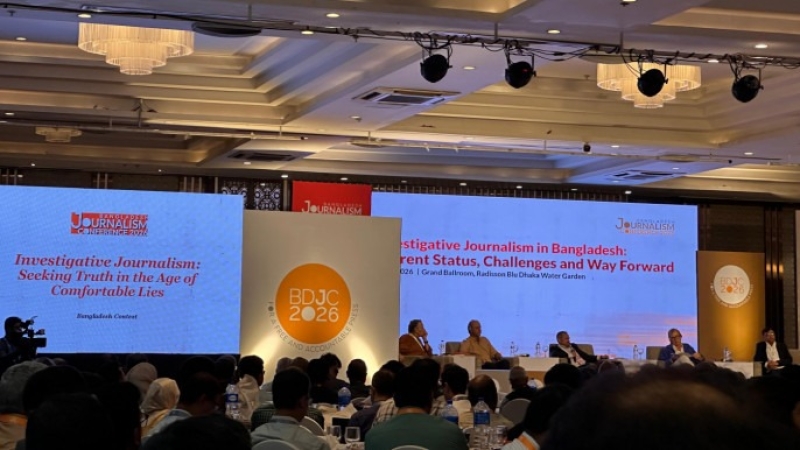
Speakers attend a session on investigative journalism during the Bangladesh Journalism Conference 2026 at Radisson Blu Dhaka Water Garden in Dhaka on 8 May, where foreign journalists and media experts discussed growing threats to investigative reporting in South Asia.
Journalists and media experts from several countries have warned that investigative journalism across South Asia is facing growing pressure from political polarisation, corporate influence, financial constraints and attacks on media institutions.
The concerns were raised at the Bangladesh Journalism Conference held at Radisson Blu Dhaka Water Garden on Thursday, where speakers called for stronger institutional support, international cooperation and greater protection for investigative reporters.
Zaffar Abbas said investigative journalism in countries such as Bangladesh and Pakistan increasingly depends not only on the courage of reporters but also on whether media owners and management are willing to withstand political and financial pressure.
Speaking during a session on investigative reporting in politically polarised societies, he said journalists exposing corruption often face organised smear campaigns, withdrawal of advertisements and institutional pressure intended to silence critical reporting.
“When corruption in state institutions or the private sector is exposed, retaliation often follows,” Abbas said.
He noted that newsroom editors play a crucial role in selecting stories, assigning reporters and deciding how far a media organisation is prepared to pursue sensitive investigations. However, he stressed that editorial independence cannot survive without long-term support from publishers and management.
Drawing on his experience in Pakistan, Abbas referred to investigations into corruption in the property, financial and government sectors that resulted in major financial and political consequences for media organisations.
Canadian investigative journalist Julian Sher said corruption has become increasingly global in nature, making cross-border collaboration among journalists more important than ever.
“The money moves across countries, so investigative journalism also requires international cooperation,” he said, adding that such reporting remains risky in many parts of the world.
Meanwhile, Iftekharuzzaman criticised the handling of attacks on media institutions in Bangladesh, saying journalists continue to face serious security threats.
He expressed concern over what he described as inadequate responses from authorities following attacks on media organisations, despite repeated appeals for intervention.
Speakers at the conference also warned that growing commercialisation within the media industry is weakening accountability journalism and undermining the future of investigative reporting in the region.
They emphasised that without stronger institutional commitment and adequate protection for journalists, investigative reporting could gradually lose its role as a watchdog in democratic societies.