

- Dhaka Tops Global Pollution List with Hazardous Air |
- Country Observes Martyred Army Day Today |
- 100 CSOs rally against Trump’s trade tactics, urge access to drugs |
- BNP believes in multiparty democracy, not revenge: Moyeen Khan |
- Bangladesh reaffirms commitment to revitalise SAARC process |
Nepal’s Rapper-Mayor Emerges as Front Runner for PM
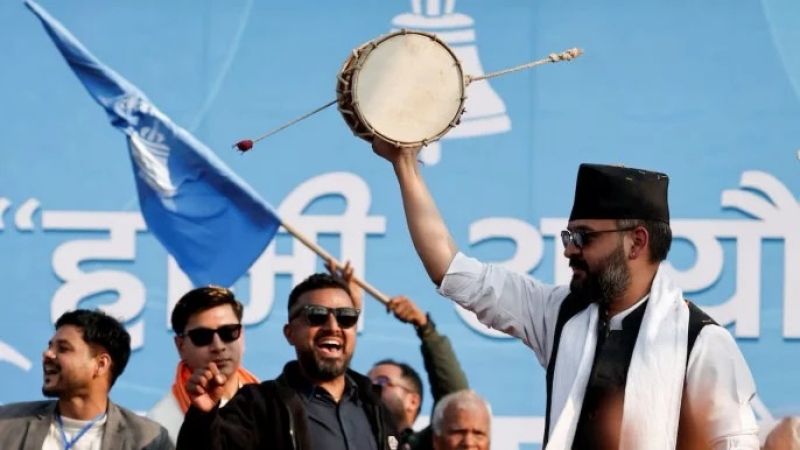
Balendra Shah, former mayor of Kathmandu popularly known as "Balen", who according to party officials, will become prime minister under an internal agreement if the Rastriya Swatantra Party (RSP) wins the March 5 elections, plays a "damru" percussion instrument during an election campaign in Janakpur, Nepal, January 19, 2026.
Nepal’s 35-year-old rapper-turned-politician, Balendra Shah—known as Balen—has emerged as the leading candidate to become the country’s next prime minister following the March 5 general election. His rise follows last September’s youth-led protests, which claimed 77 lives and forced former Prime Minister KP Sharma Oli to resign.
Balen first gained political experience as mayor of Kathmandu in 2022. Since resigning in January to contest the national election, he has built a strong following, particularly among young voters, through his social media presence, where he has over 3.5 million followers.
Political analysts and local observers suggest Shah’s popularity is reshaping Nepalese politics, challenging the dominance of established parties such as Oli’s Communist Party of Nepal (Unified Marxist–Leninist) and the centrist Nepali Congress. His Rastriya Swatantra Party (RSP) has pledged to maintain balanced relations with neighbouring giants China and India while pursuing domestic reforms.
As mayor, Shah focused on urban infrastructure, including waste management and healthcare services, though he faced criticism for alleged heavy-handed actions against street vendors. Analysts note that his future success as prime minister will hinge on assembling a capable team to tackle Nepal’s entrenched bureaucratic challenges.
Shah’s journey began as a rap artist critical of the ruling elite, with his 2019 hit “Balidan” earning over 12 million YouTube views. Inspired by artists like Tupac and 50 Cent, his lyrics often addressed social injustice and poverty, striking a chord with the country’s youth.
Joining the RSP last December, Shah now campaigns on a platform promising 1.2 million jobs, increased per capita income, expanded social safety nets, and economic growth, aiming to transform Nepal’s $100 billion GDP within five years. His meteoric rise from rap music to politics reflects a new era of youth-driven leadership in the Himalayan nation.