

- NCP Demands Impeachment, Arrest of President |
- PM Pledges to Modernise, Strengthen Border Force |
- Dhaka Tops Global Pollution List with Hazardous Air |
- Country Observes Martyred Army Day Today |
- 100 CSOs rally against Trump’s trade tactics, urge access to drugs |
Guterres Urges Global Fund for Equitable AI Access
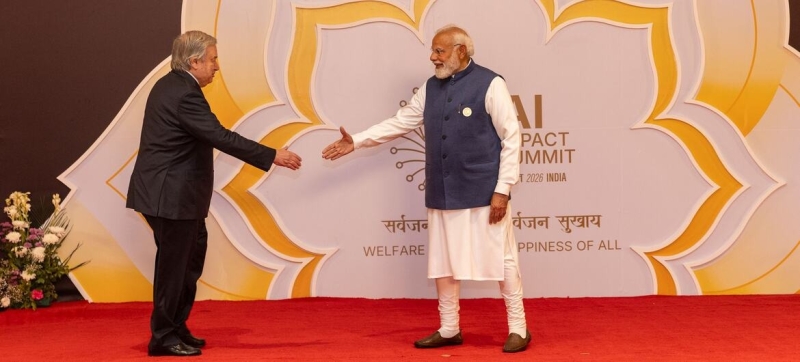
UN Secretary-General, António Guterres (left) is greeted by Indian Prime Minister Narendra Modi at the AI Impact Summit being held in New Delhi.
The future of Artificial Intelligence (AI) “cannot be decided by a handful of countries or left to the whims of a few billionaires,” the UN Secretary-General told the AI Impact Summit in New Delhi on Friday, calling for a Global Fund to help developing nations access the technology and build capacity.
António Guterres expressed concern that without investment many countries will be “locked out” of the AI age.
“Our target is $3 billion,” he said. “That’s less than one per cent of the annual revenue of a single tech company. A small price for AI diffusion that benefits all.”
UN-run initiatives
Mr Guterres emphasised the efforts the United Nations is making to ensure AI development is properly governed, especially the creation of the Independent International Scientific Panel on AI at last year’s General Assembly.
The panel of 40 world-leading experts — announced last week — seeks to share evidence and close knowledge gaps by analysing AI risks, opportunities and societal impacts.
“AI must belong to everyone,” the Secretary-General said in relation to the panel. He urged Member States, industry and civil society to contribute to its work.
Guardrails needed to protect people and planet
Mr Guterres also highlighted the launch of the Global Dialogue on AI Governance and its inaugural session in July. “We need guardrails that preserve human agency, human oversight and human accountability,” he said.
“AI can advance the Sustainable Development Goals. It can accelerate breakthroughs in medicine, expand learning opportunities, strengthen food security, bolster climate action and disaster preparedness, and improve access to vital public services,” he added.
The Secretary-General also warned of negative outcomes if AI growth remains unregulated, saying it “can deepen inequality, amplify bias and fuel harm.”
As AI’s energy and water demands soar, data centres and supply chains must switch to clean power and avoid shifting costs to vulnerable communities.
“We must invest in workers so AI augments human potential — not replaces it. We must protect people from exploitation, manipulation and abuse,” he said.
“No child should be a test subject for unregulated AI. Real impact means technology that improves lives and protects the planet,” he stressed.
“So, let’s build AI for everyone — with dignity as the default setting.”