

- India's Interlinking of Rivers: An idea delinked from realities |
- Explosion at China fireworks factory kills 26 people |
- ‘US military adventurism’ responsible for new attacks on UAE |
- Iran says US military killed five civilians in attacks on passenger boats |
- Dhaka tops list of world’s most polluted cities |
Gaza Ceasefire Not Enough as Children Continue to Die
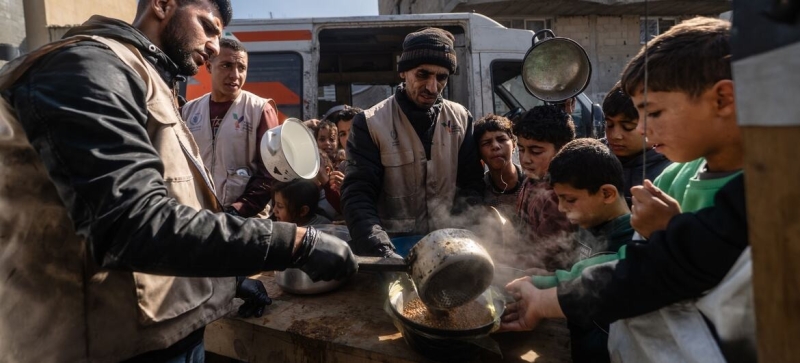
Children receiving a hot meal at a UN World Food Programme-supported kitchen in Khan Younis, Gaza.
Airstrikes, drone attacks, and hypothermia continue in Gaza despite the ceasefire, with more than 100 children killed since early October, the UN Children’s Fund (UNICEF) said on Tuesday.
“That’s roughly one child killed every day during a ceasefire,” UNICEF spokesperson James Elder told reporters in Geneva.
“These children are being killed by airstrikes, drone strikes—including suicide drones,” he said from Gaza City. “They are killed by tank shelling, live ammunition, and even remote-controlled quadcopters.”
Mr. Elder added that harsh winter conditions have also claimed the lives of children in recent days.
Hypothermia claims six children
“We’ve now recorded six children who died of hypothermia this winter,” he said. “I wish I could show you 30–40 km/h winds ripping through tents on the beach. It’s bitterly cold and wet.”
The UNICEF spokesperson said the ceasefire has allowed “genuine progress” in primary healthcare, with UNICEF and partners establishing the first health clinics in northern Gaza and expanding immunization services.
However, urgently needed medical evacuations of children remain stalled.
Mr. Elder noted “no noticeable improvement” in approvals for evacuating children with life-threatening injuries, nor in convincing host countries to accept young patients.
During his latest mission, he spoke to many children and families denied evacuation despite completing the formal process. These included a nine-year-old with shrapnel in his eye, a girl in Al Shifa Hospital who “may die,” and another child whose leg requires amputation. “All three are candidates for medical evacuation, but all have so far been denied,” he explained.
Before the war erupted in Gaza following Hamas-led attacks on Israel on 7 October 2023, between 50 and 100 patients were evacuated daily, according to the UN World Health Organization (WHO).
The WHO warned on Tuesday that extensive clearance procedures by Israeli authorities continue to delay deliveries of medicine and food. “Some essential medical items are classified as ‘dual-use’ and denied entry,” WHO said, referring to goods intended for civilian use but considered potentially usable for military purposes.
International NGO restrictions a concern
Mr. Elder also warned about a recent Israeli ban on international NGOs, which is set to take effect next month and could block life-saving assistance. He emphasized the importance of allowing international journalists into the enclave, which has not been granted despite the ceasefire.
“This is my seventh mission to Gaza, and every time I see the 360-degree devastation, flattening of homes, my jaw drops,” he said. “It is just as staggering now as it was the first time I saw it over two years ago.”
Two years of war have “left life for Gaza’s children unimaginably hard,” he added. “The psychological damage remains untreated, and it is becoming deeper and harder to heal the longer this goes on.”
“A ceasefire that slows the bombs is progress, but one that still buries children is not enough,” he concluded.