

- Bangladesh Economy Tops $500bn for First Time |
- People positive on Padma Barrage, experts urge caution over fallout |
- Parties convey their expectations at Bonn climate talks |
- ECNEC Approves 8 Projects Worth Tk 2,266 Crore |
- No Plan to Drop Bangla, History from Honours: Milon |
UN Ends Iraq Mission With Pledge of Ongoing Support
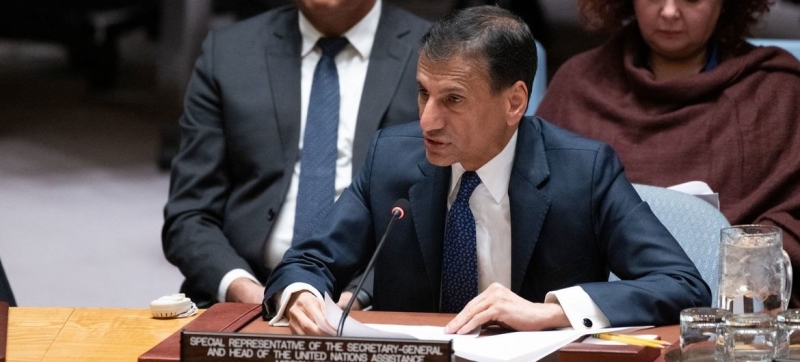
Mohamed Al Hassan, Special Representative of the Secretary-General and Head of the UN Assistance Mission for Iraq (UNAMI), briefs on recent political, security, and humanitarian developments in Iraq.
The recent parliamentary elections in Iraq mark a fitting conclusion to the work of the UN Mission in the country, the Security Council heard on Tuesday.
Mohammed Al Hassan, the Secretary-General’s Special Representative for Iraq, briefed members for the final time as the UN Assistance Mission in Iraq (UNAMI) prepares to conclude its mandate on 31 December after more than two decades of service.
“Today is indeed a great day for the international community and the United Nations, as we witness an honourable and dignified closure of a UN mission,” he said.
Victory and sacrifice
UNAMI was established by the Council in 2003, when the country was “grappling with the effects of decades of dictatorship, regional wars, internal conflicts, foreign occupation, and the terror of Da’esh,” he recalled.
“The road to peace, security and stability was long and difficult. However, with the support of the international community, Iraq emerged victorious, though with untold sacrifices,” he said.
He honoured the memory of all those who lost their lives since UNAMI began operations, including the 22 UN staff killed in the Canal Hotel bombing in August 2003—one of the darkest days in the organisation’s history.
Hard-won gains
Mr Al Hassan said he and his predecessors have been struck by the resilience and determination of the Iraqi people as they worked toward a more secure and prosperous future.
“From adopting a new Constitution to strengthening and consolidating democracy through 13 successful electoral processes, Iraq has incrementally secured hard-won gains against the odds,” he said.
Last month, Iraq held its sixth parliamentary elections, marked by a notable turnout of 56 per cent of registered voters. The vote was also among the most free, orderly and credible polls conducted so far.
He congratulated the Iraqi people, the Independent High Electoral Commission and UNAMI, which provided electoral assistance.
“I can hardly think of a more fitting final chapter to UNAMI’s activities than the scenes at polling stations across the country, where Iraqis from diverse backgrounds lined up in orderly queues to cast their ballots,” he said.
He expressed hope that a new Government will be formed without delay and noted that the formation of a Government in the semi-autonomous Kurdistan region “remains pending” after more than a year of negotiations.
Internal displacement and repatriation efforts
Although Iraq has overcome successive conflicts, their lasting effects continue to create significant humanitarian needs. Around one million people remain internally displaced, including more than 100,000 predominantly Yazidis from Sinjar, who suffered immeasurably under Da’esh.
Mr Hassan praised Iraq’s leadership in accelerating the repatriation of nationals from northeast Syria this year. Tens of thousands of people with alleged or actual ties to Da’esh remain detained in camps in the region.
He reported that approximately 20,800 people have returned to Iraq to date.
“As returns continue, it is essential that adequate resources support dignified and sustainable reintegration, including access to basic services, livelihoods and community-level support,” he said.
Human rights challenges
He also congratulated Iraq on its election to the UN Human Rights Council, noting that the position carries significant responsibility to uphold the highest standards of human rights.
He highlighted ongoing challenges, particularly in protecting the rights of minorities, women and youth, and safeguarding freedom of expression as a cornerstone of democratic society.
A new chapter for Iraq-UN partnership
Concluding his remarks, Mr Hassan stressed that UNAMI’s departure does not mark an end to the Iraq-UN partnership. Instead, it signals the beginning of a new chapter, rooted in Iraq’s leadership of its own future.
The UN will continue to stand by Iraq to build on its hard-won gains, providing technical expertise, advice and support.
“I reaffirm my full confidence in the resilience of the Iraqi people and the determination of their leaders to address the challenges ahead,” he said.
He urged them to “build bridges of trust and friendship, promote common interests with neighbouring countries, and restore the glory of Iraq as the cradle of civilisation.”